

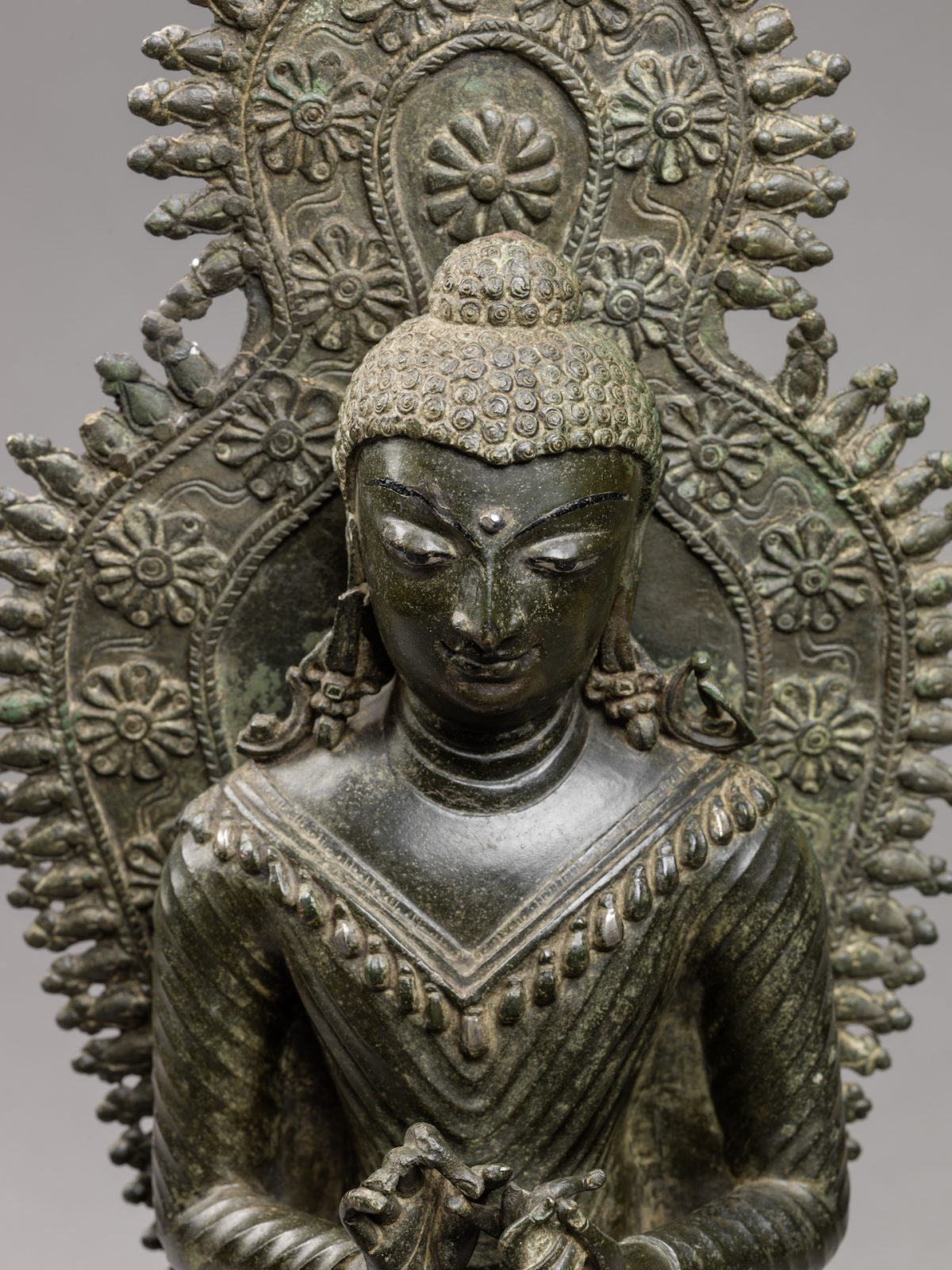
Buddhist scriptures illuminate a profound cosmology encompassing Buddhas of the past, the present, and the future. Central to this celestial tapestry is Maitreya, the prophesied Buddha of the future, whose advent is destined to occur when the teachings of our current Buddha, Shakyamuni, have faded into obscurity. While his arrival is projected to be millions of years hence, his name, meaning "kindness" in Sanskrit, and his dwelling place are known. The accompanying image, an artistic rendering likely originating from the Swat Valley in the 8th or 9th century, is believed to depict Maitreya. He is portrayed seated on a throne, adorned with the ushnisha, the cranial protuberance, one of the thirty-two auspicious marks signifying a "great being" and a Buddha. His celestial abode is Tushita, the "Joyous" heaven, situated in the cosmic skies above Mount Meru, the axis mundi of the Buddhist universe.
Maitreya’s presence is a singular mention within the Pali Canon, the foundational scriptures of Theravada Buddhism, prevalent in Sri Lanka and Southeast Asia. However, his significance escalates dramatically in the Mahayana tradition, encompassing Tibetan and East Asian Buddhism. He emerges as a key figure in numerous Mahayana sutras, including the Lotus Sutra, the Vimalakirti Sutra, and the Gandavyuha Sutra, appearing both as a member of the Buddha’s audience and as a crucial interlocutor. As the historical presence of Shakyamuni Buddha receded further into the past, the anticipation and importance of Maitreya, the future Buddha, grew in prominence.
The Buddha, according to tradition, outlined forty distinct subjects for meditation, offering a rich array of practices for monks and nuns. Among these, "recollection of the Buddha" (buddhanusmrti) stands out as a particularly cherished practice. This meditation involves contemplating the sublime qualities of the Buddha, often through a mantra such as: "The Blessed One is accomplished, fully enlightened, endowed with clear vision and virtuous conduct, sublime, the knower of worlds, the incomparable leader of humans to be tamed, the teacher of gods and humans, enlightened and blessed."
It is crucial to note that representational imagery of the Buddha in the form recognizable today did not emerge in India until the early second century CE, approximately five centuries after Shakyamuni Buddha entered nirvana. The advent of these Buddha images revolutionized the practice of "recollection of the Buddha," incorporating visualization. Meditators were instructed to gaze upon Buddha images, striving to internalize a detailed mental representation. Concurrently, in the second century CE, Buddhist practitioners in the region of Kashmir began to focus their "recollection of the Buddha" practices on Maitreya. Their aspirations were twofold: to receive his direct teachings or to achieve rebirth in Tushita heaven, enabling them to join his retinue upon his descent to re-establish Buddhism in the world. The statue depicted, created centuries later, likely served such devotional and aspirational purposes.
H2: The Twelve-Year Ordeal of Asanga
The most celebrated narrative of an encounter with Maitreya involves the 4th-century Indian monk Asanga, a pivotal figure in Buddhist history and the philosophical architect of the Yogacara, or "Mind Only," School. Asanga authored seminal texts on meditation, including practices centered on Buddha visualization. Born in Purushapura, Gandhara (modern-day Peshawar, Pakistan), Asanga’s profound knowledge meant that few could answer his inquiries. This intellectual solitude spurred him to seek enlightenment directly from the future Buddha.
Driven by this aspiration, Asanga retreated to a cave for meditation, praying for Maitreya’s manifestation. After three years of unwavering devotion, he experienced no divine revelation. On the verge of despair, he encountered a man painstakingly rubbing an iron spike with a piece of cloth. The man, a tailor, explained he was fashioning sewing needles. Asanga’s disbelief dissolved when the tailor revealed a box filled with already-crafted needles, a testament to extraordinary perseverance. Inspired, Asanga returned to his cave, renewing his entreaties to Maitreya. Another three years passed without success, leading to renewed despair, followed by a recommitment to his practice. This cycle of hope and disappointment, interspersed with periods of intense dedication, continued for a total of twelve years, with no sign of Maitreya.
As Asanga prepared to abandon his quest and return to his monastery, he observed a wounded dog outside the cave, its body infested with maggots. Moved by compassion, Asanga knelt to tend to the dog. As he prepared to remove the maggots with a stick, he realized that these creatures, like all sentient beings, deserved compassion. Removing them would deprive them of sustenance. Yet, he felt compelled to save the dog. A passerby approached, and Asanga, in an act of profound self-sacrifice, traded his monastic staff for the man’s knife. He then cut a piece of flesh from his own thigh, intending to transfer the maggots. He recognized that using a stick or even his fingers would inevitably harm some of the maggots. The only way to ensure their safety was to use his tongue. To suppress his revulsion, he covered his eyes and lowered his head to begin the delicate task.
H3: A Transformative Encounter
However, instead of encountering the warmth of flesh, his tongue touched the cold stone floor of the cave. Astonished, Asanga uncovered his eyes to find the dog vanished and Maitreya standing before him in resplendent glory. His confusion and initial dismay at the perceived failure of his twelve-year vigil were met by Maitreya’s explanation: he had been present all along, but Asanga’s mental obscurations prevented him from being seen. When Asanga remained skeptical, Maitreya drew his attention to the crumbs of food and dried saliva that had soiled his magnificent robes, evidence of his constant proximity to Asanga during his daily meals. Maitreya revealed that the obstacles hindering Asanga’s perception were not overcome by years of prayer and meditation alone, but by a singular act of selfless compassion.
Still doubting, Asanga was instructed by Maitreya to pick him up and carry him into the town. To Asanga’s bewilderment, no one could see Maitreya; they only observed a monk carrying a dog. Maitreya then instructed Asanga to place him down and grasp his robe. In a moment of divine ascension, Maitreya flew with Asanga to Tushita heaven. There, Asanga spent what felt like a single celestial morning, equivalent to fifty human years, absorbing the profound teachings that would later be known as the "five books of Maitreya." These texts are considered some of the most influential treatises in Mahayana Buddhism, shaping its philosophical and devotional landscape for centuries.
H2: The Cosmic Cycles and the Future of the Dharma
Maitreya’s eventual descent to Earth is envisioned as a momentous event that will usher in an era of unparalleled peace and spiritual flourishing. This grand re-establishment of the Dharma occurs within the Buddhist understanding of cosmic cycles. The current epoch, termed the "Stage of Abiding," is characterized by fluctuating human lifespans and a gradual decline and resurgence of the Dharma. Presently, humanity is on a downward trajectory in terms of lifespan, which is projected to decrease to as little as ten years before ascending again to a peak of eighty thousand years. This period of decline is inextricably linked to the deterioration of the world and the fading of Buddhist teachings.
This decline is attributed to the "five degradations":
- Degradation of lifespan: The diminishing average human lifespan.
- Degradation of views: The rampant proliferation of erroneous beliefs and ideologies.
- Degradation of afflictions: The intensification of negative emotions such as greed, hatred, and delusion.
- Degradation of sentient beings: The weakening of both physical and mental faculties of beings.
- Degradation of the eon: The deterioration of the physical environment.
As these degradations intensify, the capacity for individuals to follow the path to enlightenment diminishes, rendering spiritual realization increasingly difficult. The precise commencement of this period of decline has been subject to various calculations. In Japan, for instance, it was determined that the era of the Dharma’s decline began in 1052 CE. Consequently, many faithful adherents, particularly in East Asia, have shifted their focus from awaiting Maitreya’s arrival to seeking rebirth in Sukhavati, the Western Paradise of Amitabha Buddha, the Buddha of Infinite Light and Life. Rebirth in Sukhavati ensures liberation from the cycle of rebirth in this world and guarantees the attainment of Buddhahood.
H3: Maitreya’s Timely Arrival
The future Buddha, Maitreya, is said to have carefully considered the optimal human lifespan for his manifestation. In the Theravada tradition, the birth of Shakyamuni Buddha is contextualized within a lifespan of a hundred years. A lifespan too long would prolong the perception of suffering from aging and death, while a lifespan too short would impede disciples’ progress on the spiritual path. Maitreya, however, is anticipated to descend from his heavenly abode when the human lifespan reaches its zenith of eighty thousand years, a point estimated to be nearly six billion years from now. This vast temporal gulf explains why numerous individuals who have declared themselves to be Maitreya throughout history are regarded as pretenders.
Despite the immense chronological distance to Maitreya’s future advent, this lengthy wait is mitigated by his physical proximity. Unlike Buddhas who reside in pure lands, Maitreya remains within samsara, the cycle of existence, specifically in the Realm of Desire. This realm is characterized by attachment to sensory pleasures. His current dwelling in a heaven above Mount Meru is a realm to which beings can aspire for rebirth, and importantly, it is not immeasurably distant.
H2: The Symbolism of Maitreya’s Representation
The depiction of Maitreya in the artwork under consideration is rich with symbolic meaning. His hands are positioned in a gesture of teaching the Dharma, a posture that may allude to his interactions with Asanga. His seated posture on a throne, rather than the traditional lotus position, is significant. It signifies his readiness to swiftly arise and descend to Earth when the auspicious time arrives to re-establish the Dharma. As the profound narrative of Asanga illustrates, the practice of kindness is itself a powerful connection to Maitreya. In essence, through acts of compassion and selfless love, we can, in a very real sense, encounter the future Buddha. This embodies the profound Buddhist teaching that enlightenment and spiritual connection are not merely distant aspirations but are accessible through present actions and a compassionate heart.
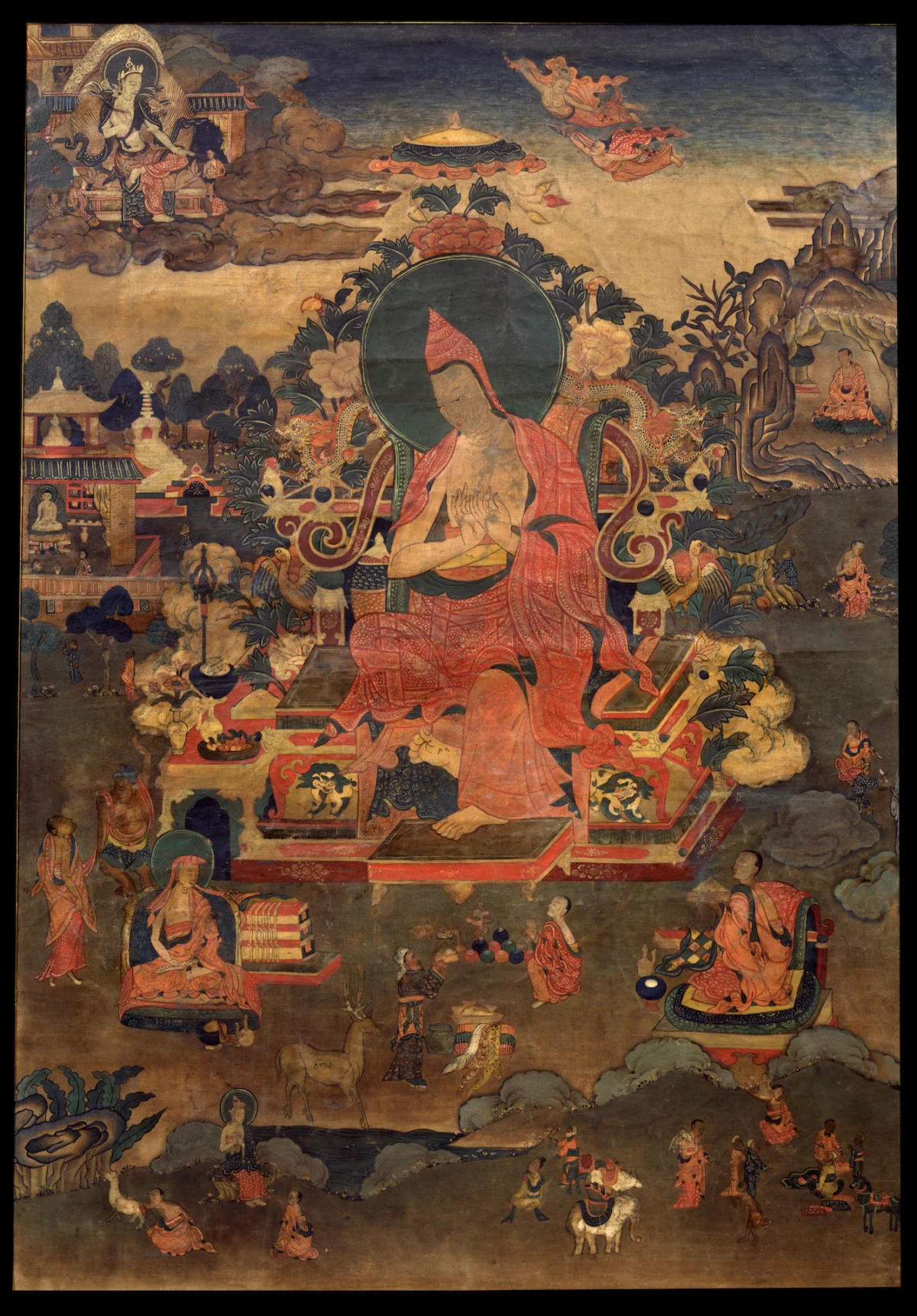
The accompanying image, a 19th-century Tibetan composition, further illustrates this narrative. It depicts Asanga surrounded by scenes from his biography: meditating in his cave, demonstrating compassion for the dog, and receiving teachings from Maitreya. This artistic rendition underscores the visual tradition of associating key biographical moments with the figures central to Buddhist mythology and practice.
The profound implications of Maitreya’s prophecy extend beyond theological contemplation, influencing the spiritual aspirations and practices of millions. The anticipation of his arrival serves as a constant reminder of the cyclical nature of existence, the impermanence of teachings, and the enduring power of compassion to bridge perceived cosmic distances. As the world navigates its own cycles of progress and decline, the figure of Maitreya offers a beacon of hope for future spiritual renewal, a testament to the enduring pursuit of enlightenment across vast stretches of time and space.

