

A significant 2026 study conducted in Alberta, Canada, has unveiled a critical challenge within mental health care: 40% of adults discharged from psychiatric hospital care return to an emergency department (ED) for mental health reasons within a year. The comprehensive analysis of 1,070 adults indicates that the most potent predictors of these return visits are not primarily clinical symptoms or diagnoses, but rather pressing social determinants such as recent emergency department use, unstable housing, and unemployment. This finding underscores a pressing need for a fundamental re-evaluation of post-discharge support and community integration strategies for individuals grappling with mental health challenges.
The period immediately following a psychiatric hospitalization is widely recognized as one of the most precarious phases in a patient’s recovery journey. Individuals are often navigating new medication regimens, coping with ongoing recovery processes, and frequently facing the daunting prospect of returning to an unstable home environment, or worse, no stable housing at all. This vulnerability is not unique to Alberta; global data consistently highlights the fragility of this transition. For instance, in New South Wales, Australia, a study tracking 35,056 individuals discharged from their first psychiatric admission revealed that 37% sought emergency care at least once within two years, and a staggering 40% were readmitted to a psychiatric hospital. Such statistics paint a stark picture of a systemic gap in continuity of care and support systems that often leaves individuals with limited options during a crisis, frequently funneling them back into the emergency room – a setting ill-equipped for sustained mental health management.
A return trip to the emergency department, while often perceived as a setback, is fundamentally a recourse for individuals in acute crisis, frequently representing the safest or only accessible option for immediate support. For healthcare providers and policymakers, the critical question shifts from blaming the individual to identifying which patients are most likely to require this acute intervention again and, more importantly, what forms of proactive, comprehensive support could mitigate this necessity. The Alberta study provides crucial insights into these predictive factors, pointing towards modifiable social conditions rather than inherent clinical traits as the primary drivers.
Unpacking the Alberta Psychiatric Discharge Study Methodology
The study, led by Elgendy et al., drew its sample from the Text4Support initiative, a larger Alberta-based clinical trial designed to assess the efficacy of supportive text messages, both alone and in conjunction with peer support, in easing the transition home for patients after psychiatric hospitalization. For the purpose of this particular analysis, researchers treated the entire Text4Support participant cohort as a single group to investigate which characteristics, measured during the hospital stay, correlated with subsequent emergency department utilization within a 12-month period.
The Text4Support interventions were multifaceted:
- Supportive Text Messages: Participants received daily automated text messages over a six-month period. These messages, carefully crafted by psychiatrists, psychologists, and individuals with lived experience of mental illness, were grounded in cognitive behavioral therapy (CBT) principles. They offered practical coping strategies, fostered hope, provided medication reminders, and gently encouraged early help-seeking behaviors.
- Peer Support: An additional layer of support involved contact with trained peer workers. These individuals, who had personal experiences of mental illness and recovery, offered invaluable emotional support and actively assisted participants in maintaining connections with outpatient care services and vital community resources. This dual approach aimed to provide a robust safety net for individuals navigating the complexities of post-discharge life.
Social Determinants Emerge as Dominant Predictors
After rigorous statistical adjustment for various confounding factors, only three variables emerged as significant predictors of a return ED visit within a year:
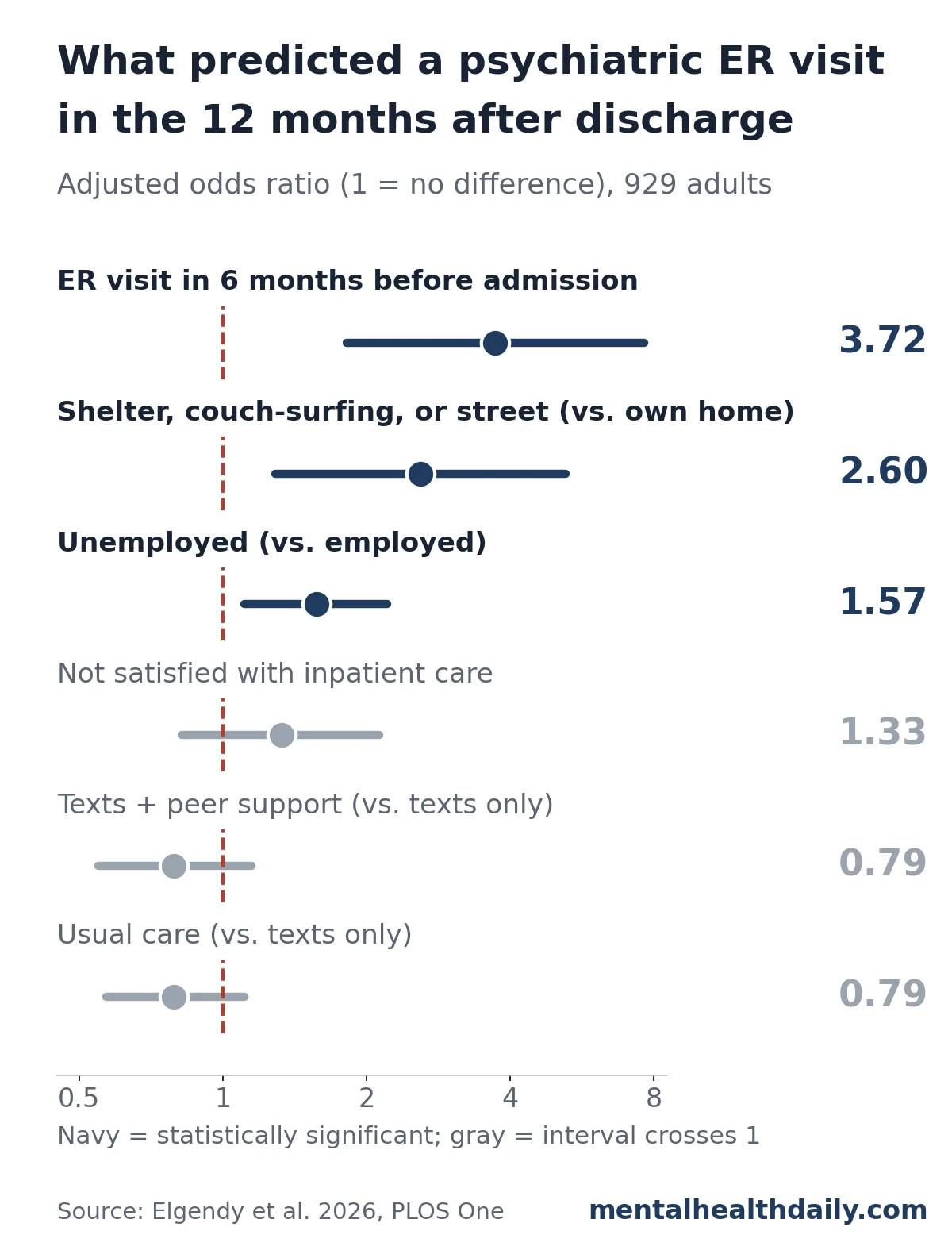
- Recent Emergency Visit Before Admission (Odds Ratio: 3.72): This was the strongest predictor, indicating that individuals who had utilized emergency services in the six months prior to their index psychiatric admission were nearly four times more likely to return to an ED. This factor serves as a powerful proxy for underlying unmet needs and systemic vulnerabilities that questionnaires might fail to capture. It suggests a pattern of acute care reliance, potentially stemming from rapid symptom escalation, limited access to after-hours outpatient care, or the ED becoming the de facto entry point for mental health support. Researchers posited that this could reflect unresolved clinical needs, inadequate transition support, or persistent unmet social needs.
- Unstable Housing (Odds Ratio: 2.60): Defined as living in a shelter, couch-surfing, or experiencing homelessness, unstable housing significantly increased the odds of an ED return by 2.6 times compared to those living in their own homes. This factor highlights the fundamental role of stable shelter in mental health recovery. Without a secure address, basic necessities like medication storage, consistent sleep, and maintaining contact with community mental health teams become immensely challenging, creating a perpetual state of stress and vulnerability that can precipitate crises.
- Unemployment (Odds Ratio: 1.57): Individuals who were unemployed were 1.57 times more likely to return to an ED than their employed counterparts. Unemployment not only deprives individuals of a stable income buffer, leading to financial stress, but also removes daily structure, purpose, and access to employer-linked benefits, including health coverage and mental health resources. Both housing and employment are external conditions that profoundly impact an individual’s capacity for recovery, rather than intrinsic personal traits.
Collectively, these predictors explained between 8.5% and 11.4% of the variation in who returned to the ED. While this percentage might seem modest, it is typical for complex social and health outcomes. Crucially, it signifies that these factors effectively flag higher-risk groups, enabling targeted interventions, even if they cannot definitively predict an individual’s specific trajectory.
Unexpected Non-Predictors: Inpatient Satisfaction, Symptom Scores, and Diagnosis
One of the more surprising findings from the Alberta study was the limited predictive power of factors traditionally considered central to patient outcomes:
- Inpatient Satisfaction: Despite growing emphasis on patient experience as a quality measure, and some evidence suggesting dissatisfaction can lead to disengagement from follow-up care, this study found no clear link. While patients who reported dissatisfaction had slightly higher odds of an ED return (OR 1.33), the confidence interval was broad (0.82 to 2.13), meaning the study could not statistically rule out the possibility of no effect. In this cohort, 89% reported being satisfied or very satisfied with their hospital stay, suggesting that satisfaction with the immediate care environment does not necessarily translate into better long-term community integration or crisis prevention.
- Symptom Scores at Discharge: Measures of depression, anxiety, resilience, and overall well-being at the point of discharge showed odds ratios close to 1 and were not statistically significant predictors of ED returns. This outcome challenged the researchers’ initial expectations, which anticipated that higher symptom severity would correlate with a greater likelihood of future crises. This suggests that while clinical symptoms are crucial for admission, their status at discharge might be less indicative of post-discharge ED use than social stability.
- Diagnosis: The study found no significant link between broad diagnostic categories and the likelihood of returning to the ED. This contrasts with some other research, such as a 2021 Quebec study by Kaltsidis et al., which found clinical need, particularly diagnoses like schizophrenia and personality disorders, alongside a history of psychiatric hospitalization, to be strong correlates of frequent mental health ED use. The Alberta analysis, however, focused on whether any return occurred, rather than frequency, and utilized broader diagnostic groupings, which may have obscured finer distinctions that become apparent among the most frequent users of emergency services.
Interventions: What the Analysis Says About Text Messages and Peer Support
The study also examined whether participation in the Text4Support trial’s intervention groups (text messages alone, or texts plus peer support) was linked to 12-month ED visits. The analysis found no statistically significant association between the study group assignment and ED return rates. Compared with text messages alone, both usual care and texts plus peer support had odds ratios of 0.79, with confidence intervals crossing 1, indicating no discernible difference.
It is crucial, however, not to interpret this as a failure of the Text4Support programs. The researchers explicitly stated that this particular analysis was not designed as the primary test of the interventions’ effectiveness. The trial’s main effectiveness analysis, published in 2025, focused on different outcomes and timeframes. That earlier study reported that readmissions fell more significantly with text messaging (with or without peer support) compared to usual care, showing a mean difference of 0.26 fewer admissions. Furthermore, text messages alone were associated with a reduction of hospital stay by an average of 7.28 days.
These two papers are not in conflict; they measure distinct outcomes over different periods. The collective evidence suggests that light-touch digital support mechanisms like text messaging may be effective in reducing psychiatric readmissions and shortening hospital stays, contributing to bed availability and resource efficiency, without necessarily eliminating the need for some individuals to access emergency care at some point within a full year post-discharge. This nuanced understanding is vital for developing targeted and realistic expectations for such interventions.
The Pervasive Challenge of Homelessness Across Canada
The Alberta study’s strong finding regarding housing instability resonates deeply with a consistent body of evidence across Canada, highlighting a widespread systemic issue. Research from other Canadian provinces reinforces this dire connection:
- Ontario Data: A 2018 study in Ontario found that individuals discharged to unstable housing (homelessness or shelters) were 2.5 times more likely to be readmitted to psychiatric hospital care within 30 days compared to those discharged to stable housing. While focusing on readmission and a shorter window, this echoes the Alberta findings on the immediate and profound impact of housing.
- Housing First Initiatives: The Canadian At Home/Chez Soi study, a major randomized controlled trial of the "Housing First" model, demonstrated unequivocally that providing immediate access to housing alongside support services dramatically improves housing stability for people with serious mental illness. Critically, participants who achieved stable housing in these trials also showed reduced use of psychiatric inpatient care and emergency services. While no study has directly isolated the effect of providing housing at discharge on preventing future ED visits, the evidence strongly suggests that addressing housing instability is a modifiable risk factor with broad positive implications for mental health outcomes and healthcare utilization.
Acknowledging Study Limitations and Evidence Strength
As an observational analysis, the Alberta study identifies groups at higher risk but cannot establish direct causality; it cannot definitively prove that changing a person’s housing or employment status would cause a reduction in their ED visits. Several specific limitations apply:
- Generalizability: The sample was drawn from a clinical trial in Alberta, which might not be fully representative of all psychiatric patients across Canada or in other healthcare systems.
- Data Completeness: Some factors, like the specific reasons for prior ED visits or detailed information on the quality and accessibility of outpatient care, were not fully captured.
- Intervention Blurring: The study treated the Text4Support participants as a single cohort, meaning it did not isolate the effects of the interventions on ED visits.
- Outcome Definition: The study focused on any ED visit within 12 months, rather than the frequency or severity of visits, which could obscure important distinctions among users.
- Social Desirability Bias: Self-reported data on sensitive topics like housing or employment might be subject to reporting biases.
Despite these limitations, the study’s findings are robust given its large sample size and the statistical adjustments made. It significantly strengthens the argument for integrating social determinants into mental health discharge planning.
Reimagining Discharge Planning for High-Risk Patients
The Alberta findings provide a compelling impetus for healthcare systems to fundamentally rethink discharge planning, shifting from a purely clinical focus to a more holistic, person-centered approach that prioritizes social stability. Key questions for discharge teams should include:
- Housing Security: "Where will this person sleep tonight, and for the foreseeable future? Is it safe and stable?"
- Economic Stability: "Does this person have a stable income or access to financial support? What are the barriers to employment?"
- Continuity of Care: "Is there a clear, accessible follow-up plan for outpatient care, and are there practical barriers to accessing it (e.g., transportation, childcare, phone access)?"
- Crisis Management: "Beyond the ED, what other options are available if a crisis arises after hours, and how can the patient access them?"
For patients and their families, these findings offer a crucial reframing of post-discharge challenges. A return to the emergency department often reflects the profound impact of external circumstances and systemic gaps rather than a personal failing or a worsening of clinical symptoms alone. Empowering patients and families to directly inquire about housing, income support, and robust follow-up plans during discharge discussions is essential. Crucially, the message remains clear: utilizing the emergency department during a mental health crisis is always the correct decision when safety is paramount, but the goal for the healthcare system must be to reduce the necessity of this as the only option.
Towards an Integrated Future: Policy and Practice Implications
The implications of the Alberta study are far-reaching, demanding a coordinated response from policymakers, healthcare administrators, and community organizations. The emphasis on social determinants necessitates a significant shift in resource allocation and policy development. Mental health care cannot operate in isolation from housing, employment, and social support services.
Policymakers must consider:
- Integrated Care Models: Developing models that embed social workers, housing navigators, and employment specialists directly within psychiatric inpatient and outpatient teams.
- Increased Funding for Housing First Initiatives: Expanding access to proven programs that provide immediate, low-barrier housing for individuals with mental illness.
- Enhanced Community-Based Support: Strengthening funding for crisis lines, mobile crisis teams, peer support networks, and accessible after-hours mental health clinics to provide alternatives to ED visits.
- Collaborative Partnerships: Fostering stronger collaboration between health authorities, social services, housing agencies, and employment support organizations.
From a practical perspective, hospitals should implement standardized screening tools for social determinants at admission and discharge, ensuring that a patient’s social context is as central to their care plan as their clinical diagnosis. Training for healthcare professionals should also be enhanced to equip them with the skills to address social needs or to effectively refer patients to appropriate community resources.
Ultimately, the Alberta study serves as a powerful reminder that mental health recovery is a complex, holistic process deeply intertwined with an individual’s social environment. By addressing the fundamental needs for stable housing, meaningful employment, and continuous, accessible support, healthcare systems can move beyond simply treating symptoms to fostering genuine, sustainable well-being and significantly reducing the burden on emergency departments. The path forward demands not just better clinical care, but a more compassionate and integrated societal response to mental illness.

