

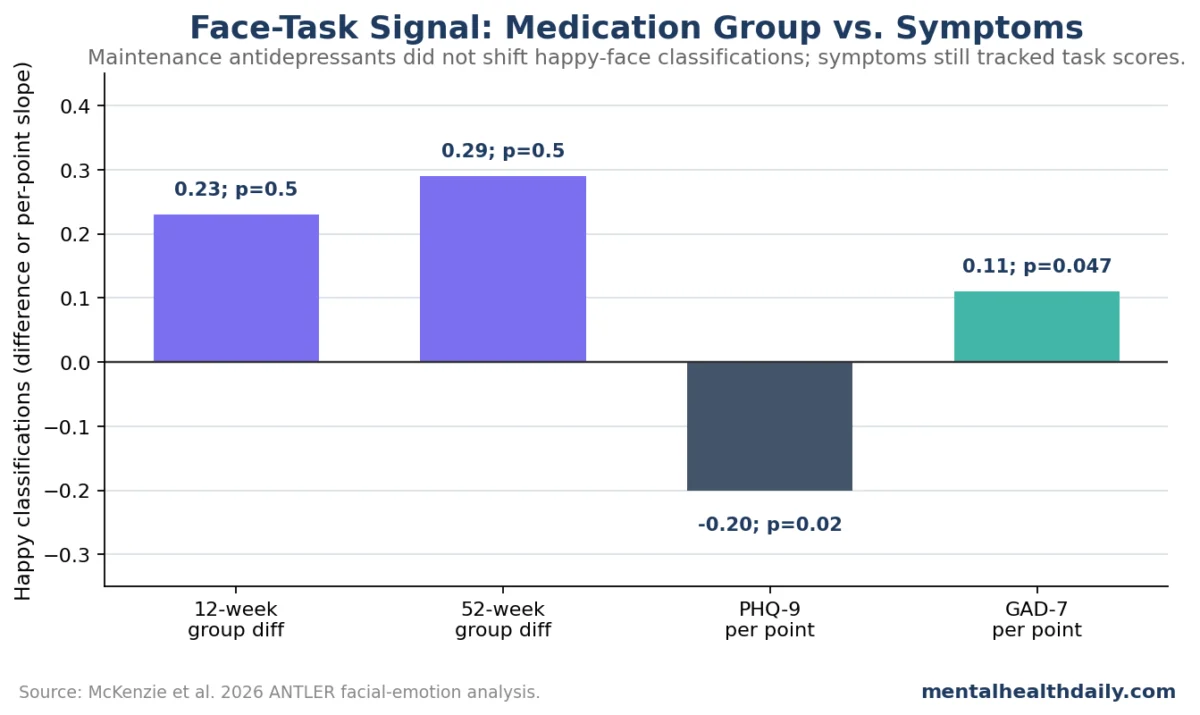
A mechanistic analysis from the 2026 ANTLER trial has revealed that maintaining antidepressant treatment in adults with remitted recurrent depression did not preserve a happier facial-emotion recognition pattern compared to placebo substitution. The study, which followed participants for up to 52 weeks, found no statistically significant evidence to support the hypothesis that ongoing medication maintains a positive emotional processing bias, a key prediction of the cognitive neuropsychological model of antidepressants. At 12 weeks, the adjusted mean difference was 0.23 (95% CI −0.5 to 1.0, p = 0.5), and at 52 weeks, it was 0.29 (95% CI −0.5 to 1.2, p = 0.5), indicating negligible and non-significant differences between the groups. This finding challenges a specific proposed mechanism of antidepressant action in the context of long-term maintenance care, while reinforcing the complexity of emotional processing and its relationship with psychiatric treatment.
Understanding the Cognitive Neuropsychological Model of Antidepressants
The field of psychopharmacology has long sought to understand the precise mechanisms through which antidepressants exert their therapeutic effects. Beyond simply elevating mood, a prominent theory posits that these medications, particularly selective serotonin reuptake inhibitors (SSRIs), work by subtly shifting emotional processing biases. This is known as the cognitive neuropsychological model of antidepressants. It suggests that before overt mood changes become apparent, antidepressants may alter how individuals perceive and interpret emotional information, guiding them towards more positive interpretations and away from negative ones. This "emotional bias" shift is believed to create more favorable learning conditions, gradually contributing to mood improvement over weeks and months.
Facial emotion recognition tasks are a common tool used to investigate this model. In these tasks, participants are typically asked to classify faces that morph between different expressions, for instance, transitioning from happy to sad. The underlying assumption is that if antidepressants promote a positive bias, individuals on medication might be more inclined to classify ambiguous faces as "happy" for longer into the morphing sequence, or to identify more faces as happy overall, compared to those not receiving treatment. McKenzie et al. aimed to test this specific mechanism within a long-term clinical context, leveraging the robust design of the ANTLER trial.
The ANTLER Trial: A Framework for Mechanistic Insight
The ANTLER trial was primarily designed as a relapse-prevention study, comparing maintenance antidepressant treatment with placebo substitution in adults who had a history of recurrent depression but were currently well. This specific population is crucial for understanding maintenance mechanisms. Unlike studies focusing on acute treatment, where participants are often symptomatic at baseline, ANTLER enrolled individuals who had already achieved remission. This allowed researchers to investigate whether continuing medication actively preserved a beneficial cognitive or emotional state, rather than simply initiating one.
The original ANTLER trial randomized 478 adults with recurrent depression. For the facial-emotion recognition analysis, 462 participants who completed at least one computerized task were included. The task involved viewing faces that gradually morphed from a happy expression to a sad one. The primary outcome for this mechanistic analysis was the number of faces classified as happy out of a total of 45 trials. Participants underwent these assessments at baseline, 12 weeks, and 52 weeks, providing a longitudinal perspective on potential changes in emotional processing biases.
The strength of this comparison lies in its clinical relevance. Participants were not starting treatment from scratch; they were already stable enough to enter a relapse-prevention trial. This unique setting allowed the researchers to ask a highly pertinent question: does ongoing medication actively maintain a positive emotional-processing bias, or does this bias, if present during acute treatment, fade or become irrelevant once remission is achieved?
Absence of a Sustained Happy-Face Bias
The core finding of the McKenzie et al. analysis was unambiguous: maintenance antidepressant treatment did not preserve a statistically significant happy-face bias compared to placebo substitution. At both the 12-week and 52-week follow-ups, the group that had discontinued antidepressants (and was on placebo) actually showed a slightly higher estimated happy-face score than the group maintaining antidepressants, after adjusting for confounding factors. However, these differences were minimal and fell far short of statistical significance.
It is important to note the direction of these findings. The results were not simply a failure to reach statistical significance for a potential benefit of maintenance antidepressants. Instead, the point estimates, though small, subtly leaned in the opposite direction of the hypothesized effect. For instance, the difference was less than one happy classification on a 45-trial task. Crucially, the confidence intervals for these differences easily encompassed zero, indicating no meaningful distinction between the two groups.
The robustness of these findings was further affirmed through various analytical approaches. A longitudinal model, which included participants with partial task data, did not reveal any medication-group effect. Similarly, an analysis restricted to adherent samples (those who consistently took their assigned treatment) also failed to demonstrate any support for the emotional-bias prediction. This consistent lack of evidence across different statistical models strengthens the conclusion that, in this specific context, maintenance antidepressants did not sustain a measurable happy-face advantage.
Symptoms Remain Linked to Emotional Interpretation
Despite the null finding regarding the maintenance antidepressant effect, the facial-emotion recognition task itself was not biologically empty or merely random noise. The study found that symptom severity was indeed associated with how participants interpreted facial expressions. Depressive symptoms, as measured by the Patient Health Questionnaire-9 (PHQ-9), were consistently linked to fewer happy classifications. Specifically, cross-sectionally, each one-point increase on the PHQ-9 was associated with 0.20 fewer happy responses. Longitudinally, each point increase was linked to 0.09 fewer happy responses. This indicates that even in a remitted population, residual or fluctuating depressive symptoms could still influence emotional processing.
Interestingly, anxiety symptoms, measured by the Generalized Anxiety Disorder-7 (GAD-7), showed a small positive association with happy classifications. Each GAD-7 point was linked to 0.11 more happy classifications. This complex pattern suggests that the relationship between distress and emotional interpretation is not a simplistic "all distress makes faces look sadder" narrative. Instead, it underscores the multifaceted nature of emotional processing and reinforces the caution against treating single emotional-processing tasks as universal biomarkers for overall mood or mental state.
This finding does not invalidate prior research that supports a broader connection between antidepressants, symptoms, and emotional processing. For example, Ahmed et al. reported emotional-processing effects in secondary analyses of the PANDA sertraline trial, and Bone et al. linked happy and sad facial-expression recognition to depressive symptom severity over time. The ANTLER study, however, refines this understanding by narrowing the claim: while emotional processing is clearly relevant to depression and symptom severity, maintenance treatment in remitted recurrent depression specifically did not preserve a measurable happy-face advantage using this particular task.
Laboratory Mechanisms and Real-World Maintenance Care
The discrepancy between the hypothesized mechanism and the observed results highlights a critical distinction between laboratory-based mechanistic studies and real-world clinical maintenance care. Selective serotonin reuptake inhibitors (SSRIs) are known to increase serotonin signaling by blocking its reuptake, and the emotional-bias model proposes that downstream mood benefits partly emerge from patients processing social and emotional information less negatively, fostering better learning conditions over time. This model remains plausible for early treatment phases, acute dosing studies, or when exploring other task domains beyond facial recognition.

However, the ANTLER trial investigated a different clinical setting: individuals with recurrent depression who were already well and faced a decision about continuing medication. In this specific context, facial emotion recognition, as measured by the happy-to-sad morph task, did not behave like a sustained medication signature. This suggests that mechanisms observed during the acute phase of treatment may not necessarily persist or be detectable in the same way once a patient has achieved remission and is in a maintenance phase.
The study’s design as a prespecified mechanistic analysis within a randomized trial lends significant strength to the medication comparison. It minimizes confounding factors often present in observational or cross-sectional studies. However, it is also important to acknowledge that a single face task represents a narrow window into a much broader and intricate cognitive system. Therefore, this study cannot definitively prove that all antidepressant mechanisms are unrelated to emotional processing, only that this specific task did not reveal a sustained effect in maintenance treatment.
The Crucial Distinction: Acute vs. Maintenance Treatment
A significant takeaway from the ANTLER study is the imperative to distinguish between acute treatment and maintenance treatment contexts. Many emotional-processing studies focus on short-term antidepressant exposure, aiming to understand whether early pharmacological changes alter attention, memory, reward processing, or threat perception before a patient consciously feels better. These studies are invaluable for elucidating initial drug actions.
In contrast, the ANTLER trial’s maintenance context involved participants who had already improved enough to be considered well. The clinical question was whether continuing medication preserved a protective state. It is plausible that a mechanism prominent during early treatment might fade, become redundant, or only be detectable under more stressful emotional tasks once symptoms have remitted. For instance, an initial shift towards positive bias might be crucial for breaking a depressive cycle, but once stability is achieved, other adaptive mechanisms, perhaps learned during the acute phase, might take over, making the direct pharmacological maintenance of that specific bias less critical or detectable.
This implies a crucial research implication: future maintenance studies should avoid assuming that biomarkers identified during early treatment remain stable or relevant after recovery. A truly useful long-term marker would need to not only change with treatment but also predict relapse before symptoms return, and clearly demonstrate how a drug modifies emotional processing under complex clinical conditions.
Furthermore, task sensitivity plays a role. The ANTLER face task specifically used happy-to-sad morphs, optimizing it for one type of social-emotional judgment. It is entirely possible that a patient might show medication-related changes in other cognitive domains, such as reward learning, negative memory recall, threat vigilance, or rejection sensitivity, while showing no discernible shift on this particular task. Emotional processing is a broad construct, encompassing various sub-domains, and a single task cannot capture its entirety.
Clinical Translation and Informed Decision-Making
The safest conclusion for clinicians is not that emotional processing is irrelevant to depression, but rather that maintenance antidepressant decisions should not rely on a presumed persistent happy-face recognition effect as measured by this type of task. The study unequivocally shows that the measured task did not differentiate between maintenance and discontinuation groups across 52 weeks.
For clinicians and patients grappling with maintenance treatment decisions, a range of factors remains paramount. These include a patient’s symptom history, their individual risk of relapse, the presence and tolerability of side effects, patient preference, and experiences from prior discontinuation attempts. These practical decision inputs remain more informative than a specific facial emotion recognition score.
The interpretation of such results is also complicated by factors like withdrawal symptoms and potential relapse. Individuals discontinuing antidepressants can experience a spectrum of symptoms that sometimes mimic a depressive relapse, while those continuing medication can experience side effects that might subtly alter emotional experience. A single face-classification score is inherently limited in its ability to disentangle these complex clinical states.
It is crucial to distinguish between mechanism research and patient management. Mechanism research, like the ANTLER mechanistic analysis, seeks to understand how drugs might work at a biological or cognitive level. Patient management, conversely, focuses on which course of action is most likely to protect a particular patient’s well-being. The ANTLER study provides a negative result for one specific mechanistic marker, but it does not diminish the broader clinical decision-making process, which remains dependent on a patient’s relapse history, individual circumstances, and a careful weighing of tradeoffs. This distinction allows the result to be useful for refining scientific understanding without overstating its direct implications for stable patients currently on maintenance medication.
This analysis was a secondary analysis of a larger discontinuation trial, meaning it was not a new trial designed exclusively around facial-emotion recognition. While this allowed for investigating a specific mechanism within a robust clinical setting, it also meant the task’s results had to contend with numerous real-world sources of variation: complex medication histories, the potential presence of withdrawal symptoms, residual anxiety, prior relapse burden, and diverse reasons for patients wanting to continue or stop treatment.
For a biomarker to truly revolutionize relapse prevention, it would need to meet a high bar: it should demonstrably change with treatment, predict relapse before overt symptoms return, and add significant information beyond what is already available from ordinary clinical history and patient assessment. The ANTLER face-task data, while valuable for mechanistic understanding, did not reach this high bar, even though emotional processing remains a plausible and important mechanism in other contexts of depression and its treatment.
Addressing Common Questions
Does this mean antidepressants do not prevent relapse?
No, absolutely not. The parent ANTLER trial, from which this mechanistic analysis was derived, was a relapse prevention study. This specific analysis focused on whether maintenance treatment preserved a particular cognitive mechanism – a happy-face recognition bias. It found no evidence for that specific mechanism, but it does not negate the overall efficacy of antidepressants in preventing relapse, which is supported by a substantial body of evidence.
Could antidepressants affect other emotional-processing tasks?
Yes, it is highly possible. Emotional processing is a broad domain. Tasks involving word recall, reward learning, attention allocation, threat processing, or social evaluation may behave differently and could still show medication-related effects. The ANTLER study is strongest against a broad claim that long-term maintenance visibly sustains a positive facial-emotion interpretation across the board. Its findings are specific to the happy-to-sad morph task.
What should clinicians take from this result?
Clinicians should understand that facial emotion recognition, as measured in this study, should not be used as a stand-alone sign that maintenance antidepressants are biologically active or preserving a specific positive bias. Instead, clinical decisions regarding maintenance treatment should continue to be guided by a comprehensive assessment of symptom history, individual relapse risk, the presence and tolerability of side effects, patient preference, and any history of prior discontinuation attempts. These factors remain the most practical and reliable inputs for informed decision-making in long-term depression management.

