

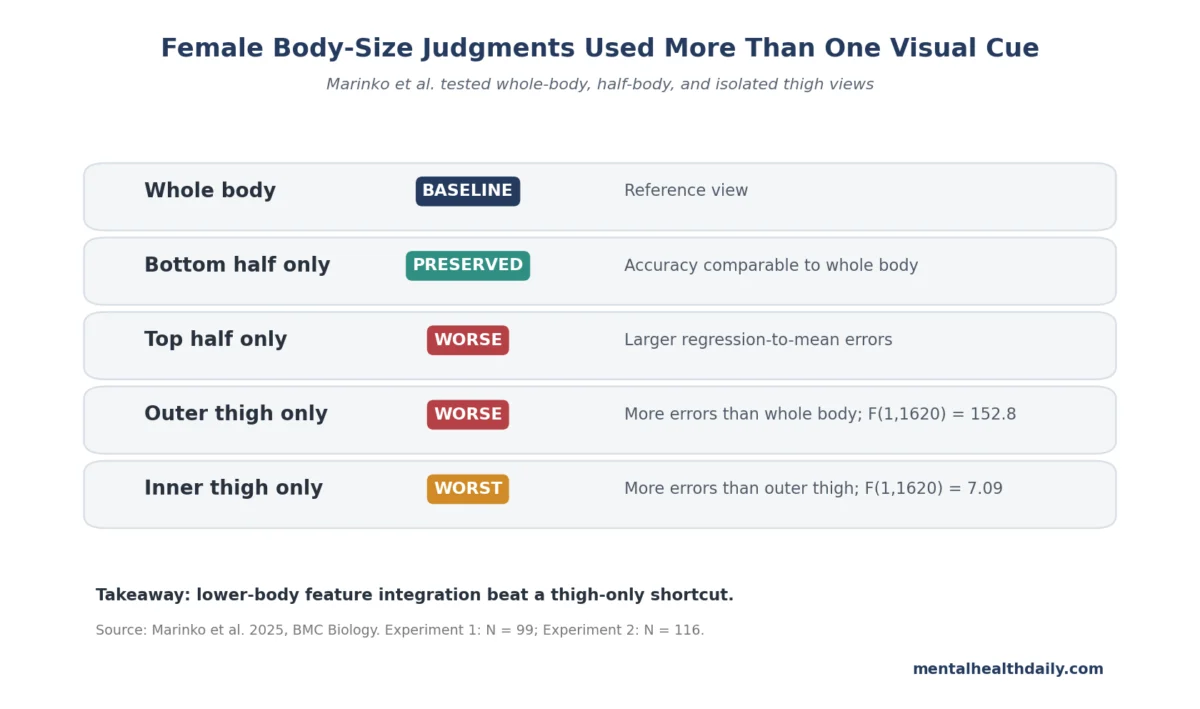
A landmark study published in BMC Biology has unveiled crucial insights into how the human visual system processes information to judge female body size, revealing that accurate perception relies heavily on the integration of lower-body features rather than isolated anatomical segments. The research, conducted across two meticulous experiments, challenges simplistic notions of body-size assessment, particularly refuting the idea that a single, specific body part, such as the thigh, acts as a sole determinant. This finding holds significant implications for the fields of body-image research, clinical psychology, and the understanding of perceptual mechanisms underlying body dissatisfaction and eating disorders.
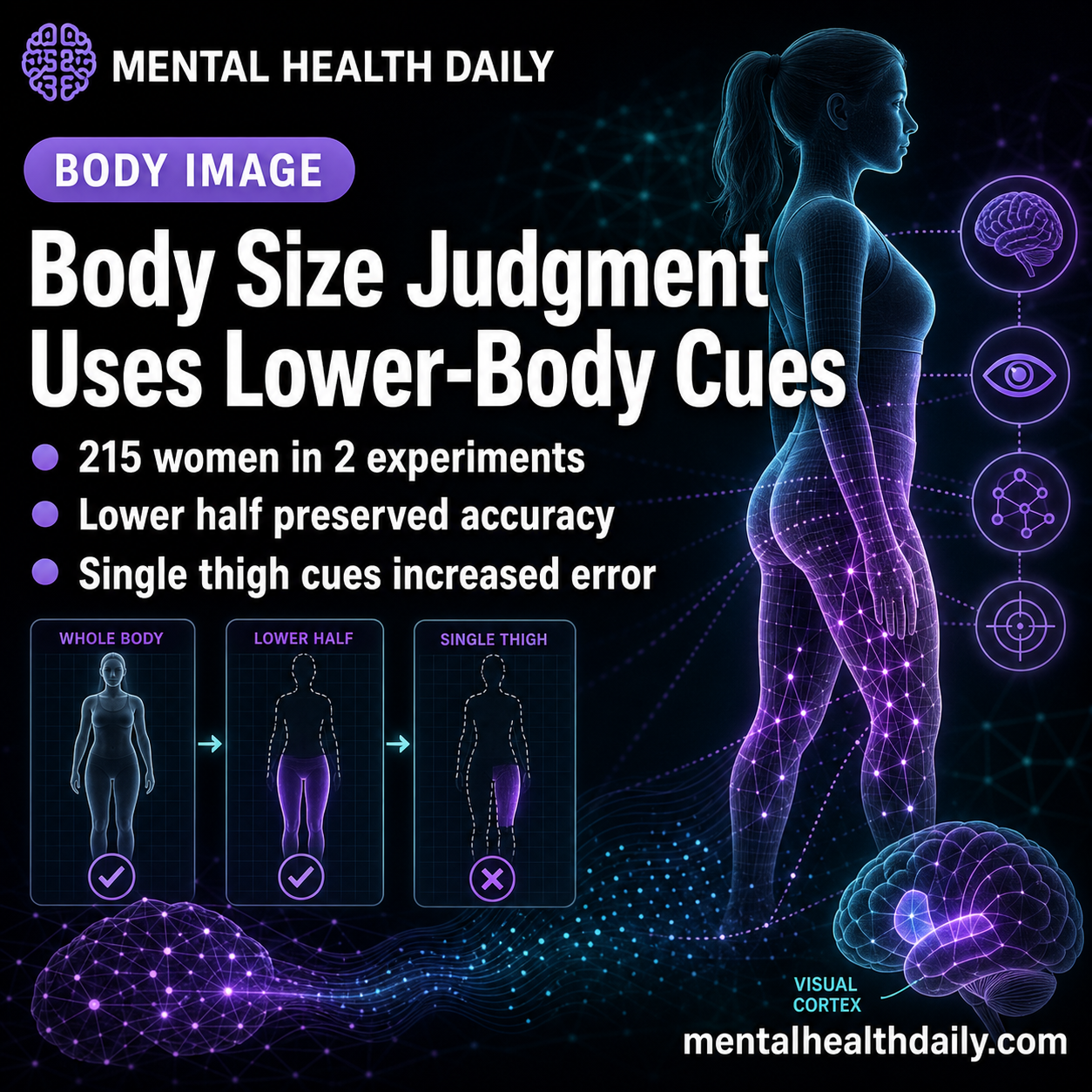
The study’s primary revelation is that a full-body view is not always necessary for accurate female body-size judgments. Instead, bottom-half views were found to preserve accuracy to a degree comparable to whole-body views. Conversely, isolating specific regions like the inner or outer thigh led to a marked increase in perceptual errors. This distinction underscores the concept of "lower-body feature integration," suggesting that the visual system synthesizes multiple cues from the lower body to form a coherent judgment, rather than relying on a singular, "thigh-only" shortcut.
Understanding Body-Size Judgment and Its Clinical Relevance
Body-size judgment refers to the cognitive process of estimating a body’s dimensions based on visual input. It represents the perceptual facet of a broader and complex issue known as body image, which also encompasses emotional components like dissatisfaction, behavioral patterns such as body checking and avoidance, and fear-driven interpretations of one’s own physical form. Disturbances in body image are clinically paramount, particularly within the context of eating disorders like anorexia nervosa and bulimia nervosa, where patients frequently misperceive or overestimate their body size. The mechanisms underpinning these disturbances involve intricate perceptual processes: the visual system must prioritize certain cues, assign them appropriate weighting, and navigate potential biases from recently viewed body images.
Previous research has consistently highlighted the pervasive nature of body-image disturbance. A seminal meta-analysis by Cash and Deagle in the 1990s was instrumental in establishing body-image disturbance not as a vague personality trait but as a quantifiable clinical feature prevalent across various eating-disorder populations. More contemporary measurement methodologies have evolved from broad assessments of body dissatisfaction to sophisticated visual mapping techniques and precise perceptual markers. For instance, studies like that by Ralph-Nearman et al. have utilized digital body-image mapping in individuals with anorexia nervosa, demonstrating a clear correlation between visual disturbance measures and illness severity. This progress underscores a growing recognition that body-image disturbance is partly measurable through objective perceptual metrics alongside subjective self-reports. The BMC Biology study by Marinko et al. contributes to this evolving understanding by dissecting the specific visual cues at play.
The Methodology: Deconstructing Visual Perception
To investigate the nuances of body-size judgment, Marinko et al. employed a "bodyline task," a well-established visual-perception task. In this task, participants are presented with various body images and asked to position each body on a continuous size scale. This method is particularly valuable because it allows researchers to differentiate a participant’s average judgment from two more specific error patterns: systematic bias (consistently over- or under-estimating) and regression-to-the-mean error (tendency to pull judgments of extreme sizes towards the average).
Experiment 1: Bottom-Half Views Preserve Accuracy
The initial experiment aimed to determine whether participants required a full-body view or could accurately judge size from partial views. After carefully screening five participants who demonstrated unreliable discrimination of body-size categories, the analysis proceeded with 99 women. These participants evaluated body images across three viewing conditions – whole-body, top-half, and bottom-half – spanning seven distinct body-size categories.
The results unequivocally demonstrated that participants could clearly distinguish between the different size categories (F(2.48, 242.83) = 2164.72, p < 0.001), indicating a robust ability to perceive size differences. While the main effect of view condition alone did not reach statistical significance (F(2, 196) = 2.74, p = 0.067), a significant interaction between body size and view condition was observed (F(7.28, 713.32) = 37.99, p < 0.001). This interaction is critical, signifying that the effect of the viewing condition depended on the actual body size being judged.
Practically, the findings were direct and compelling. Bottom-half-only views yielded judgment accuracy that was highly comparable to whole-body views. Participants viewing only the lower half of the body maintained a remarkable level of precision, indicating that this region provides a substantial amount of the visual information necessary for size estimation. In stark contrast, top-half-only views resulted in notably larger regression-to-the-mean errors. This effect was particularly pronounced at the extreme ends of the body-size scale, meaning judgments of very thin or very large bodies were disproportionately pulled towards an average size when only the top half was visible. This suggests that the top half alone lacks sufficient distinctive cues, especially for differentiating extreme body shapes.
Experiment 2: Isolated Thigh Cues Increase Perceptual Error
Building on the first experiment’s findings that the lower half carried sufficient information, Experiment 2 posed a more refined question: could a single, isolated region within the lower body provide enough information by itself? To answer this, researchers compared whole-body viewing with isolated inner-thigh and outer-thigh views in a new cohort of 116 women.
The answer was a definitive no. Both conditions involving isolated thigh regions produced significantly worse body-size judgments compared to whole-body viewing. For regression-to-the-mean error, the outer-thigh comparison strongly favored a model exhibiting a shallower slope and greater error (F(1, 1620) = 152.8, p < 0.001). Similarly, the inner-thigh comparison also demonstrated significantly poorer performance than whole-body viewing (F(1, 1620) = 262, p < 0.001). These statistical results translate into a clear increase in perceptual inaccuracy when only a fragmented view of the thigh was available.
Furthermore, inner-thigh-only viewing performed marginally worse than outer-thigh-only viewing in terms of regression-to-the-mean error (F(1, 1620) = 7.09, p = 0.008). The study also observed that "serial dependence bias" broadened when only one thigh region was visible. Serial dependence refers to the phenomenon where a person’s current perception is subtly influenced by what they perceived immediately before. The estimated serial-dependence amplitude, a measure of this carryover effect, increased from A = 0.43 for whole-body viewing to A = 0.47 for outer-thigh viewing, and significantly to A = 0.64 for inner-thigh viewing. This indicates that judgments became more susceptible to the influence of previous images when visual information was restricted to isolated thigh regions, further highlighting the diminished accuracy and increased perceptual noise.
The Concept of Lower-Body Feature Integration
The central finding of these experiments points to "lower-body feature integration." This concept posits that the human perceptual system actively combines multiple visible cues from the lower body—such as hip width, leg length, thigh circumference, and their relative proportions—rather than relying on a single anatomical patch. A bottom-half view provides a rich tapestry of these integrated cues, enabling the visual system to accurately estimate size. However, stripping that view down to only one isolated thigh region removes critical contextual information that the visual system normally utilizes, leading to impaired judgment. This suggests that the brain does not simply measure a single dimension, but rather synthesizes a complex set of spatial relationships.
Bridging Perceptual Science and Body-Image Research
While the Marinko et al. study does not directly prove that lower-body cue weighting causes eating disorders, its relevance to body-image research is substantial. The participants in this study were not a clinical sample of individuals with eating disorders, and the task involved judging images of other female bodies, not a person’s own body. Therefore, the findings should not be misinterpreted as a diagnostic tool or a direct guide for clinical intervention.
However, the contribution is precise and impactful: if body-size perception fundamentally depends on integrated lower-body cues, then existing clinical body-image measures must evolve. Such measures should not assume that a global body outline or a single self-report of dissatisfaction fully captures the intricate perceptual problem. Instead, they should aim to map which specific visual cues individuals utilize and how these cues are integrated. This study suggests that lower-body cue weighting could be one measurable component of this larger, complex perceptual system.
A Chronology of Visual-Cue Studies Leading to Feature Integration
The BMC Biology study is not an isolated finding but builds upon a growing body of research investigating the visual cues involved in body perception:
- 2019 – Irvine et al.: This study utilized eye-tracking and visual masking to explore which cues drive self-assessment of body size. Their key insight was that where people direct their gaze (fixation) is not necessarily the same as the information their visual system actually processes. Observers might look centrally, but judgment accuracy could depend on subtle body-edge cues that define width and shape. This laid groundwork for understanding the dissociation between overt attention and underlying perceptual mechanisms.
- 2024 – Marinko et al. (Prior Study): A preceding study by the same lead author investigated whether internal body features contributed useful information beyond just the silhouette shape. This research found that removing internal features significantly increased body-size judgment errors and altered serial-dependence patterns. This result strongly argued against a simple "outline-only" account of body perception, suggesting that internal details are also critical.
- 2025 – Marinko et al. (Current Study): The present BMC Biology study, focusing on lower-body cues, adds a more specific piece to this puzzle. It demonstrates that while comprehensive lower-body information can preserve accuracy, fragmented lower-body cues cannot.
Cumulatively, this evidence strongly favors a "feature-integration model." This model posits that body-size perception relies on the synthesis of multiple visual cues, and accuracy inevitably diminishes when the visual input removes too much of this essential cue structure and context.
Dispelling the "Thigh Obsession" Claim
It is crucial to frame these findings accurately to avoid misinterpretations. A common pitfall in popular discourse could be to reduce this complex research to a simplistic claim that "people judge female body size by looking at thighs." The actual result is far more nuanced and cautious. While bottom-half information was sufficient for accurate judgment in Experiment 1, a single, isolated thigh region was demonstrably insufficient in Experiment 2.
This critical distinction fundamentally alters the interpretation:
- Evidence Strength: This is a highly controlled visual-perception study, adept at identifying task-specific judgment mechanisms under specific conditions. It is not designed to diagnose body-image disturbance, establish causality in the development of eating disorders, or dictate which body region clinicians should target in treatment.
- Clinical Caution: Translating these findings directly into eating-disorder care necessitates further research. Specifically, studies must directly test self-body perception in clinical populations, examine how these perceptual mechanisms relate to symptom severity, and investigate their modulation by treatment. Judging standardized images of other bodies is fundamentally different from judging one’s own body, especially under the profound pressures of anxiety, mirror exposure, social comparison, or restrictive-eating behaviors that characterize eating disorders.
The most valuable takeaway from this research, therefore, is methodological. It strongly suggests that body-image research needs to move beyond generalized concepts of dissatisfaction and begin to meticulously measure which specific visual cues individuals use and how those cues are integrated into a holistic perception. Assuming that global dissatisfaction, patterns of gaze, and perceptual accuracy are interchangeable constructs would be a significant oversight. The weighting of lower-body cues, as identified by Marinko et al., may represent one crucial and measurable piece of this intricate perceptual system.
Measurement Implication: The study’s findings advocate for more sophisticated "cue mapping" in body-image assessment, rather than simply establishing a new rule about focusing on a particular body part. The lower-body signal proved significant because it maintained critical visual structure and context, not because one isolated feature alone could carry the entirety of the body-size judgment.
Key Questions Addressed by the Study:
- Does this mean thighs cause body-image problems? No. The study meticulously examined the visual information utilized during body-size judgments. It does not provide evidence that thigh-focused attention directly causes body dissatisfaction, precipitates eating-disorder symptoms, or leads to clinical body-image disturbance. These are distinct psychological and clinical phenomena that require different avenues of investigation.
- Why did bottom-half views perform better than top-half views? The lower body likely preserved a greater amount of the critical visual width and shape information that participants instinctively use to infer overall body size. Top-half views, conversely, lost enough of these relevant dimensions, leading to a stronger tendency for judgments of both very thin and very large bodies to regress towards an average-size estimation.
- What is serial dependence in plain English? Serial dependence describes a subtle "carryover effect" from the last visual stimulus perceived. If, for instance, the previous body image a participant viewed was larger or smaller, their subsequent body-size judgment for the current image might be subtly pulled in that same direction. The study found this effect was amplified when visual information was fragmented.
- Could this research aid eating-disorder research? Yes, but its contribution is indirect. The results suggest that body-image measures within clinical research should give careful consideration to which specific visual cues are available and how they are processed, in addition to self-reported feelings of body dissatisfaction. Future clinical studies are still needed to determine whether individuals with diagnoses such as anorexia nervosa, bulimia nervosa, or body dysmorphic disorder exhibit different patterns of cue weighting or altered feature integration compared to healthy controls.
The Bottom Line: The research by Marinko et al. significantly refines our understanding of the perceptual side of body-image research. It demonstrates conclusively that female body-size judgment is neither purely holistic nor simply reducible to an assessment of one isolated body part. Instead, accurate perception critically depends on multiple lower-body cues working in concert, highlighting the complex and integrative nature of visual processing in body image. This deeper understanding paves the way for more precise diagnostic tools and targeted therapeutic approaches in the future.

