

A groundbreaking 2026 PROTECT study, involving 174 older adults, has demonstrated that self-administered fingerprick blood tests for p-tau217 and GFAP biomarkers correlate significantly with cognitive functions, supporting their potential use in remote Alzheimer’s disease risk triage rather than as definitive diagnostic tools. This research marks a pivotal step toward more accessible and less invasive preliminary screening for neurodegenerative conditions, particularly in settings where traditional clinical evaluations are challenging. The study found that levels of phosphorylated tau at amino acid 217 (p-tau217) in capillary blood correlated with episodic memory (r = 0.299, p < 0.001), while glial fibrillary acidic protein (GFAP) correlated with working memory (r = 0.183, p = 0.034). These findings underscore the utility of remote capillary sampling as an initial screening mechanism to identify individuals who may benefit most from subsequent comprehensive clinical evaluation, thereby streamlining pathways to specialist care and clinical trials.
The Growing Challenge of Alzheimer’s Disease Diagnosis
Alzheimer’s disease (AD) is the most common cause of dementia, characterized by progressive cognitive decline that profoundly impacts memory, thinking, behavior, and daily function. Affecting millions globally, its prevalence is projected to rise significantly with an aging population, posing immense healthcare and societal challenges. Early and accurate diagnosis is critical not only for initiating potential treatments that can slow disease progression but also for enabling patients and their families to plan for the future. However, the current diagnostic landscape for Alzheimer’s disease often involves a complex, lengthy, and resource-intensive process. This typically includes detailed clinical assessments, neuropsychological testing, structural and functional neuroimaging (such as MRI or PET scans for amyloid and tau pathology), and sometimes invasive cerebrospinal fluid (CSF) analysis via lumbar puncture. These methods can be costly, require specialized facilities and personnel, and present geographical or physical barriers for many individuals, particularly those in rural areas or with limited mobility. The development of simpler, more accessible screening tools has long been a priority in dementia research.
Advancements in Blood-Based Biomarkers
The field of Alzheimer’s diagnostics has witnessed a revolution with the advent of blood-based biomarkers. For years, definitive diagnosis of Alzheimer’s pathology required post-mortem examination or highly specialized, expensive, and often invasive tests. However, recent advancements have identified specific proteins in the blood that can reflect the underlying pathological changes of AD, namely the accumulation of amyloid plaques and tau tangles in the brain. Plasma p-tau217, for instance, has emerged as a particularly promising biomarker. It represents a specific form of tau protein that becomes phosphorylated at amino acid 217, with its elevation strongly indicating the presence of Alzheimer’s-type tau and amyloid biology in the brain. This marker has shown high diagnostic accuracy in distinguishing AD from other neurodegenerative disorders and even from healthy aging, often performing comparably to CSF and PET imaging. GFAP, on the other hand, is a marker of astrocyte activation, which can signal neuroinflammation, vascular injury, or a broader glial response to neurodegeneration. While less specific to Alzheimer’s pathology than p-tau217, GFAP’s elevation can indicate generalized brain injury or inflammation, providing a broader snapshot of neurological health. Both p-tau217 and GFAP, when measured in venous blood, have already proven to be more robust than many older dementia-screening tools, setting the stage for exploring their utility in less conventional, more accessible sampling methods.
The PROTECT Study: Pioneering Remote Capillary Sampling
The 2026 PROTECT study, led by Corbett et al., sought to answer a crucial operational question: could older adults reliably collect capillary blood at home, and would the resulting biomarker values align meaningfully with cognitive performance, functional status, venous blood measurements, and user feedback? The UK PROTECT research program, known for its extensive work in understanding brain health and cognitive aging, provided an ideal cohort for this investigation. The study initially recruited 226 participants, with 174 successfully completing the self-administered blood-test kits. The final analytical group comprised 146 individuals with normal cognition and 28 with a dementia diagnosis, reflecting a mean age of 66.03 years and a 54% female representation. This demographic profile allowed for a robust assessment across a spectrum of cognitive abilities.
The methodology was designed for maximum ease of use and minimal friction. Participants received a mailed kit containing all necessary components for a fingerprick blood collection. Clear, concise instructions, often supplemented by video tutorials, guided them through the process. The collected samples were then returned via pre-paid mailers to a central laboratory for analysis. This streamlined workflow was critical to assessing the practical feasibility and acceptability of remote sampling, aiming to overcome the logistical hurdles traditionally associated with venous blood draws, which necessitate clinic visits or phlebotomy services. The ultimate goal was to pair this accessible capillary sampling with computerized cognitive testing and remote trial screening workflows, significantly expanding the reach of preliminary neurocognitive assessments.
Biomarker Specificity: p-tau217 vs. GFAP
The study’s findings reinforced the distinct roles of p-tau217 and GFAP in reflecting different aspects of neurodegeneration. Capillary p-tau217 exhibited its strongest cognitive association with episodic memory, a cognitive domain profoundly and visibly affected early in the typical progression of Alzheimer’s disease. Beyond episodic memory, p-tau217 also correlated with attention, executive function, and both functional measures of daily living. This specificity aligns with extensive research indicating p-tau217 as a highly sensitive and specific marker for Alzheimer’s pathology. Previous work by Palmqvist et al. (referencing the original article’s citations) has demonstrated plasma p-tau217’s capability to differentiate Alzheimer’s disease from other neurodegenerative disorders, while Ashton et al. (also referenced) reported strong diagnostic accuracy for a plasma p-tau217 immunoassay against confirmed Alzheimer pathology.
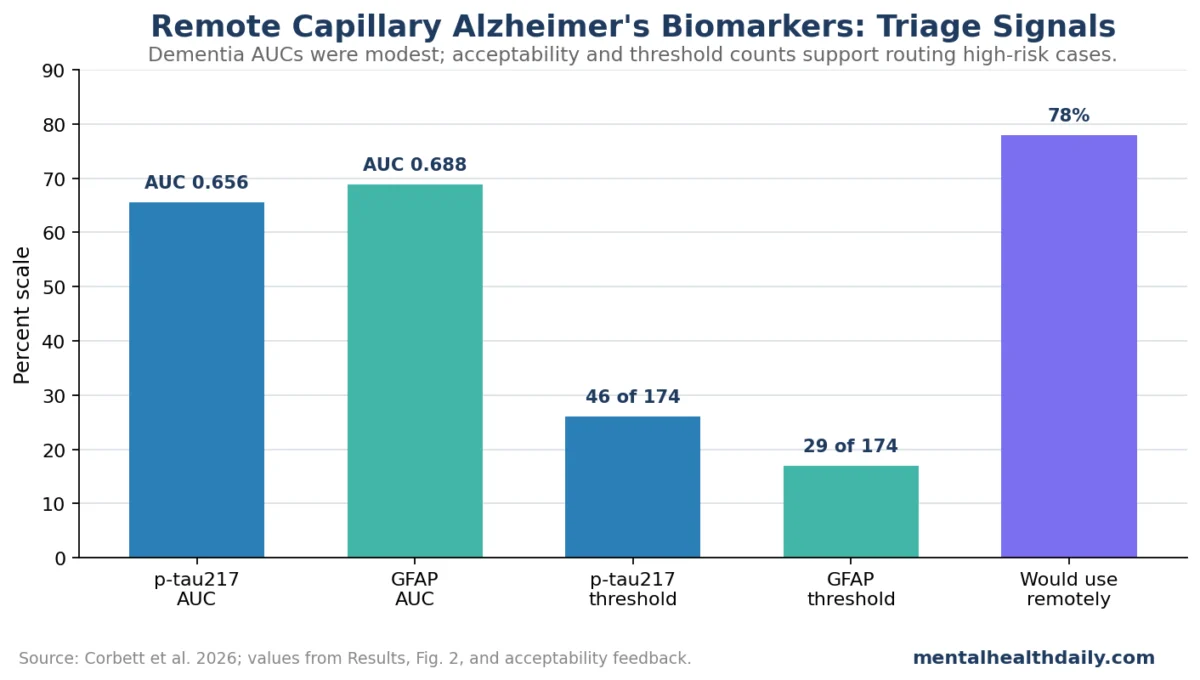
GFAP, conversely, showed a broader but less Alzheimer-specific pattern. It correlated with working memory, executive function, and instrumental activities of daily living (IADLs), but notably not with the IQCODE functional informant measure. The researchers also identified a relationship between elevated GFAP and a history of heart disease, suggesting that its elevation might reflect broader neuroinflammatory processes or vascular injury, rather than solely Alzheimer-specific glial responses. This distinction is crucial for interpreting results, as astrocyte activation, which GFAP measures, can arise from various injury pathways beyond Alzheimer’s, including stroke, trauma, and other inflammatory conditions. Therefore, while clinically useful, GFAP serves as a less direct "Alzheimer label" compared to p-tau217. The study graphically illustrated this, showing that while both markers separated dementia vs. non-dementia status better than chance (capillary p-tau217 AUC 0.656, GFAP AUC 0.688), these values are not considered diagnostic-grade. The strongest use case, as depicted in the study’s figures, is triage – providing enough signal to prioritize formal evaluation, but not enough specificity to replace it.
Identifying Higher-Risk Subgroups: Thresholds and Clinical Utility
To translate these biomarker correlations into practical application, Corbett et al. established prespecified 85% specificity thresholds: 0.016 pg/ml for capillary p-tau217 and 12.45 pg/ml for capillary GFAP. Applying these thresholds, the study identified 46 participants (26%) with elevated p-tau217 and 29 participants (17%) with elevated GFAP. Critically, individuals exceeding these thresholds performed demonstrably worse on several cognitive and functional measures. For those with elevated p-tau217, memory differences showed a Cohen’s d of 0.548 (p = 0.020), IADL differences d = 0.542 (p = 0.017), and IQCODE differences d = 0.657 (p = 0.001), all indicating moderate to large effect sizes. For elevated GFAP, the IADL difference was even larger at d = 0.754 (p = 0.004), and executive function differences were d = 0.541 (p = 0.016).
A key validation of the remote sampling method was the robust correlation of these capillary biomarker thresholds with established venous plasma measurements. Plasma p-tau217 effectively discriminated the capillary p-tau217 threshold group with an Area Under the Curve (AUC) of 0.785, and plasma GFAP discriminated the capillary GFAP threshold group with an AUC of 0.895. This strong alignment between capillary and venous measurements is vital, confirming that the remote fingerprick test yields clinically meaningful results that map onto established blood chemistry, rather than producing spurious artifacts. This cross-validation is essential for the credibility and eventual adoption of any new diagnostic or screening tool.
The Nuance of Triage: Combining Biomarkers with Cognitive Context
The study’s most significant clinical proposition is the integration of these remote biomarker results with cognitive context for an optimized triage profile. Specifically, the combination of p-tau217 levels above the 85% specificity threshold and memory performance low enough to meet age-associated cognitive decline criteria could powerfully identify individuals who warrant faster progression to a formal dementia evaluation. This integrated approach offers a more robust screening mechanism than symptom questionnaires alone, which can often be subjective and lack biological specificity.
The distinction between risk sorting (triage) and definitive diagnosis is not merely semantic; it is fundamental to patient management and ethical practice. While the AUC values of 0.656 for capillary p-tau217 and 0.688 for GFAP indicate that these markers separate dementia from non-dementia status better than chance, they are not high enough to be considered diagnostic-grade. This means that a significant overlap exists between biomarker levels in individuals with and without dementia, underscoring the need for confirmatory testing. Furthermore, a normal biomarker result cannot entirely rule out non-Alzheimer causes of cognitive decline, very early pathology below the detection threshold, or future conversion to dementia.
The recommended clinical role for remote p-tau217 and GFAP is therefore multifaceted: to efficiently sort risk, reduce screen failures in clinical trials, and direct scarce specialist appointments towards individuals with the strongest biological signal for neurodegeneration. Crucially, these tests should not be used to deliver an Alzheimer’s diagnosis to an individual at home without further clinical context. The useful application of these tests lies in their capacity as a referral aid. A positive remote blood result should prompt a comprehensive evaluation that integrates the biomarker findings with memory performance, daily functional reports, medication reviews, depression screening, sensory assessments, and vascular risk history. This holistic approach ensures that appropriate confirmatory imaging, cerebrospinal fluid testing, or specialist evaluations are pursued only when clinically warranted, avoiding unnecessary anxiety or procedures.
Implications for Clinical Trials and Public Health
The most immediate and impactful application of these remote capillary biomarkers may lie in clinical trial recruitment. Alzheimer’s prevention and early-intervention trials typically require screening large cohorts to identify a smaller group of participants with specific biomarker profiles indicative of early AD pathology. This process is often resource-intensive and prone to high screen-failure rates, where many potential participants undergo costly initial assessments only to be deemed ineligible. Fingerprick p-tau217 could dramatically reduce these expensive screen failures by pre-identifying individuals who are more likely to have confirmatory amyloid or tau evidence, thereby making trial recruitment more efficient and cost-effective.
For routine population screening, the pathway is more complex and requires further rigorous validation. Population screening programs necessitate strong evidence that testing improves outcomes, reduces harms (such as anxiety or unnecessary interventions), and does not create avoidable burdens. A single cross-sectional correlation study, while highly informative, cannot fully address these comprehensive implementation questions. Longitudinal follow-up studies are the critical missing link. Future research must demonstrate whether remote biomarker-plus-cognition profiles accurately predict future diagnosis, accelerated functional decline, or eligibility for treatment trials over several years, outperforming existing referral pathways.
The equity argument for remote testing is compelling, particularly regarding access. Many individuals with early cognitive impairment, especially those in rural areas or with socioeconomic disadvantages, never enter specialist care pathways due to travel barriers, limited clinic capacity, or the sheer burden of traditional screening. A mailed capillary kit can significantly lower these barriers, expanding access to preliminary assessment. However, this increased accessibility also carries a heightened responsibility to avoid overdiagnosis and ensure appropriate follow-up. A remote positive result must trigger a defined sequence of cognitive testing, medical review, and confirmatory assessment, rather than leaving patients with a label and no clear path forward.
Managing False Positives and Low-Signal Results
The study also highlights the importance of managing both positive and low-signal results carefully. For instance, a person with elevated GFAP and existing vascular disease might benefit more from aggressive vascular-risk management strategies than from an immediate Alzheimer’s label. Conversely, an individual with elevated p-tau217 and documented memory decline would strongly warrant a confirmatory Alzheimer’s workup. Distinguishing between these pathways is paramount to the clinical utility of the biomarker pair.
Furthermore, a low capillary biomarker result should never dismiss a caregiver’s report of worsening memory, medication errors, falls, hallucinations, or financial mistakes. Instead, it should narrow the immediate probability of Alzheimer’s-specific pathology while keeping the broader differential diagnosis open. This is especially crucial in primary care, where myriad conditions—including depression, sleep apnea, anticholinergic medications, alcohol exposure, hearing loss, and cerebrovascular disease—can mimic early dementia symptoms. The ultimate goal is to provide a tool that enriches diagnostic pathways, not one that oversimplifies the complex reality of cognitive decline.
The Future Landscape of Dementia Care
The PROTECT study represents a significant stride towards democratizing early assessment for Alzheimer’s disease and related dementias. While not a direct-to-consumer diagnostic tool, the self-administered fingerprick test for p-tau217 and GFAP offers a practical, scalable solution for remote risk triage. Its potential to reduce screen failures in clinical trials and expand access to preliminary evaluation for underserved populations is immense. However, successful integration into routine primary care will depend on further longitudinal validation, careful consideration of ethical implications, and the development of robust, clinician-led confirmatory pathways. The promise of this technology lies in its ability to facilitate earlier, more targeted interventions, ultimately improving outcomes for individuals grappling with cognitive impairment.

