

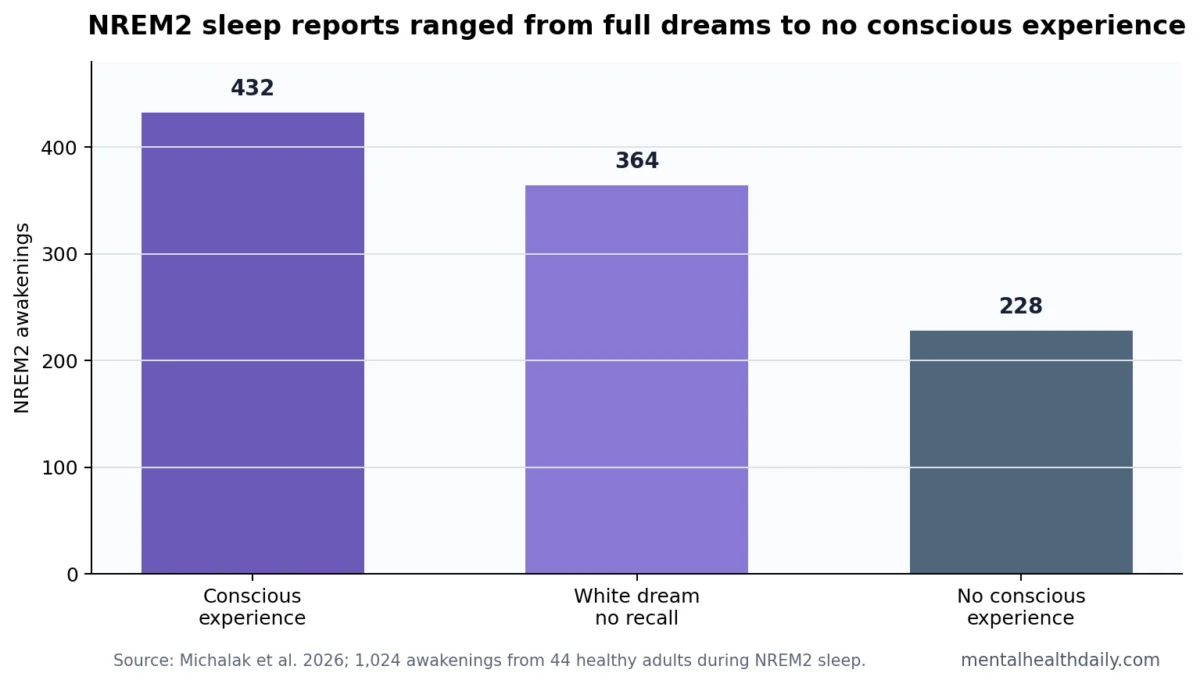
A landmark 2026 study published in PLOS Biology has significantly advanced our understanding of the subjective experience of sleep, revealing that the content of mentation during non-rapid-eye-movement stage 2 (NREM2) sleep directly influences how deeply an individual perceives their rest. The extensive research, involving 256-electrode electroencephalography (EEG) and a staggering 1,024 NREM2 awakenings, demonstrated that immersive, vivid dreaming strongly predicted deeper subjective sleep (beta = 0.277), while reflective, thought-like mentation was associated with shallower perceived sleep (beta = -0.195). This finding challenges long-held assumptions about sleep quality, suggesting that the conscious experiences occurring just before waking play a crucial role in shaping a sleeper’s overall sense of restfulness.
Unpacking the Nuances of NREM2 Sleep
NREM2 sleep is a pivotal stage in the human sleep cycle, typically constituting the largest portion of an ordinary night’s rest. Positioned between the lighter NREM1 and the deeper, slow-wave NREM3 sleep, NREM2 has historically not been considered the primary stage for vivid dreaming, a phenomenon more commonly associated with REM sleep. However, increasing research, including this comprehensive study by Michalak et al., confirms that mental activity, ranging from vague sensations to elaborate dreams, frequently occurs during NREM2. The ability of individuals to report mental experiences upon awakening from this stage underscores its often-underestimated complexity.
The study rigorously differentiated between subjective sleep depth—how deep sleep felt to the sleeper immediately after awakening—and physiological sleep depth. The latter is traditionally inferred from objective measures such as EEG frequency patterns, arousal thresholds, the presence of slow waves, and standard sleep-stage scoring. By directly asking participants about their perceived sleep depth alongside their mental experiences, Michalak et al. bridged a critical gap between objective physiological data and the subjective reality of sleep. This distinction is crucial because two individuals with identical physiological sleep architecture might report vastly different sleep quality based on their pre-awakening mental state.
Methodology: A Deep Dive into the Sleeping Brain
To achieve these insights, Michalak and colleagues orchestrated an elaborate experimental design. Forty-four healthy adult participants underwent 196 overnight recordings, each equipped with a high-density 256-electrode EEG system. This advanced EEG setup allowed for a highly detailed mapping of electrical activity across the scalp, offering a more granular view of brain states than conventional lower-electrode systems.
Throughout the night, participants were repeatedly awakened from NREM2 sleep. Immediately upon awakening, they were prompted to report on their preceding mental activity, their perceived depth of sleep, and their current level of sleepiness. This serial-awakening method, while intentionally disruptive to natural sleep, provided an unprecedented dataset of 1,024 subjective reports directly correlated with specific physiological moments during NREM2. This immediacy minimized the confounding effects of memory decay or distortion that can affect dream recall from morning reports.
The reported conscious experiences were categorized into three broad groups:
- Conscious experiences with recalled content (432 awakenings): These were instances where participants described specific dream narratives or thoughts.
- Conscious experiences without recall of content (364 awakenings): Often referred to as "white dreams," these reports indicated an impression of having experienced something during sleep, but without any specific retrievable details. This category is significant as it highlights that the absence of recall does not equate to an absence of consciousness.
- No conscious experience (228 awakenings): In these cases, participants reported a complete lack of mental activity prior to awakening.
Key Findings: Immersive Dreams Feel Deep, Abstract Thoughts Feel Shallow
The most compelling revelation from the study emerged from the qualitative analysis of these experiences. Researchers employed principal component analysis to distil the intricate dream ratings into two primary dimensions:
- Perceptual Immersion: This dimension encompassed the vividness, sensory richness, duration, emotional intensity, bizarreness, and overall REM-like quality of the reported experience.
- Reflective Thought: This dimension characterized more abstract, cognitive, or thinking-like mentation.
The statistical analysis yielded striking results:
- Perceptual immersion was a strong positive predictor of deeper subjective sleep (beta = 0.277, 95% Confidence Interval [CI] 0.208 to 0.346, p < 0.00001). This robust finding indicates that the more vivid and immersive a dream experience, the deeper the sleep felt to the individual.
- Conversely, reflective thought was a significant negative predictor of subjective sleep depth (beta = -0.195, 95% CI -0.287 to -0.102, p = 0.00004). This suggests that experiencing abstract, thought-like mentation prior to awakening made sleep feel shallower.
This pattern offers a crucial explanation for why the simplistic notion that "dreaming means light sleep" often fails to capture the full picture. Vivid, perceptually immersive dreaming, even in NREM2, can contribute to a profound sense of deep rest. In contrast, minimal conscious presence or fragmented, thought-like mentation was associated with the lowest subjective depth ratings. Interestingly, complete unconsciousness also contributed to a feeling of deep sleep, but it was not the sole pathway to achieving this perception.
EEG Activation and the Conscious Experience Disconnect
The study also delved into the complex relationship between brain electrical activity and subjective sleep depth. High-density EEG, with its capacity to record scalp electrical activity from numerous electrodes, allows researchers to map frequency patterns across the head with high spatial resolution. Generally, higher gamma activity and a higher gamma-to-delta ratio are associated with lighter perceived sleep, indicating more wake-like brain states.
However, the Michalak et al. study uncovered a critical nuance: the presence of conscious experience significantly modulated this relationship. When participants reported dreaming, wake-like cortical activation appeared less disruptive to their subjective sleep depth. The paper described this as an attenuation of the usual inverse relationship between high-frequency activity (often associated with wakefulness) and deep-feeling sleep. This suggests that the context of brain activation—specifically, whether it underpins an immersive dream experience—can alter its subjective impact on sleep quality.
This finding aligns with previous seminal work in the field. Nir et al. (2010) demonstrated that dream reports could be predicted by local EEG patterns in a "posterior cortical hot zone," rather than by sleep stage alone, highlighting the localized nature of consciousness during sleep. Siclari et al. (2017) further extended this NREM point with high-density EEG, showing that NREM dreaming depends on local sleep dynamics rather than a global "on/off" switch for consciousness. The Michalak study builds upon this foundation by directly linking these local brain dynamics and their resultant conscious experiences to the perception of sleep depth.
Sleep Depth and Sleepiness Diverge Overnight
Another counterintuitive finding concerned the trajectory of subjective sleep depth and sleepiness across the night. The study revealed that subjective sleep depth increased as the night progressed (beta = 0.127, 95% CI 0.103 to 0.151, p < 0.00001). This stands in contrast to the typical expectation that physiological sleep pressure declines overnight, leading to a feeling of lighter sleep as the homeostatic need for rest dissipates.
Intriguingly, subjective sleepiness followed a different, less steep trajectory. The interaction between time and measure showed that sleepiness increased less steeply than perceived sleep depth (beta = -0.166, 95% CI -0.277 to -0.056, p = 0.00325). This suggests a decoupling of these two subjective measures, with perceived sleep depth potentially being more influenced by the quality of internal mentation, including increasingly immersive dream experiences, than by the waning homeostatic drive for sleep.
Implications for Clinical Practice and Sleep Research
The Michalak et al. study carries significant clinical implications, particularly for individuals struggling with sleep complaints. Complaints about "light sleep" may not solely map onto objective metrics like stage scoring or total sleep duration. Instead, the quality and content of conscious experience immediately prior to awakening, along with factors like awakenings, sleep inertia, and memory for mentation, may profoundly shape whether sleep is perceived as restorative.
This research underscores the crucial distinction between sleep architecture—the objective distribution of sleep stages (NREM1, NREM2, NREM3, REM) across the night—and sleep perception—the subjective experience of that sleep. While polysomnography can accurately classify stages and arousal events, it cannot capture the intricate tapestry of conscious or near-conscious experiences occurring within those stages. The study directly measured this gap by pairing EEG-defined NREM2 awakenings with immediate subjective reports.
The results help explain why two individuals with seemingly identical sleep-stage summaries might report vastly different sleep quality. One might awaken from NREM2 with an immersive dream and rate their sleep as deep, while another, experiencing vague presence, fragmented thoughts, or partial awareness, might rate their sleep as shallow, despite objectively being in the same sleep stage.
Redefining Sleep Quality Measurement
The study advocates for a more nuanced approach to measuring sleep quality. It suggests that subjective sleep quality cannot be adequately reduced to total sleep time or the percentage of time spent in any single sleep stage. A comprehensive model of sleep perception, the researchers propose, requires at least three layers: objective physiology, the timing of awakenings, and the conscious or near-conscious experience immediately preceding awakening.
This multi-layered perspective also illuminates why consumer sleep trackers, despite their growing sophistication, can sometimes "feel wrong" even when their stage estimates are directionally reasonable. A device can estimate movement, heart rate, breathing, or EEG-like signals, but it typically lacks the capacity to discern whether the user was experiencing immersive dreaming, abstract thought, minimal presence, or true unconsciousness. Consequently, the subjective report can diverge significantly from the device’s score.
For insomnia research, the implications are particularly salient. Insomnia often involves a persistent mismatch between objective sleep parameters and perceived sleep quality. While the Michalak study focused on healthy adults, it provides a plausible mechanism for this mismatch: the specific content and form of near-awakening experience could dictate whether sleep feels deep, fragmented, or even absent, irrespective of the actual physiological sleep state. Future research in insomniac populations could explore whether thought-like, less immersive mentation contributes to feelings of shallow sleep, even when objective sleep metrics appear adequate.
The serial-awakening method employed by the study is a significant strength, as it minimizes memory delay. Morning dream recall can often miss earlier mentation or be reinterpreted through later sleep and waking experiences. By asking immediately after NREM2 awakenings, the researchers obtained a more direct and accurate read on the experience that genuinely preceded the sleep-depth rating. However, this immediacy comes with a trade-off: repeated awakenings, by design, fragment sleep, making the experience less natural. Thus, the findings are best interpreted as a controlled map of sleep perception rather than a perfect replication of an uninterrupted night.
Broader Scientific Context and Future Directions
The study’s findings necessitate a more careful use of "sleep-depth" language. When an individual reports "light sleep," they might be referring to their sleep-stage structure, frequent awakenings, a low arousal threshold, unpleasant thought-like mentation, or a memory of being partly aware. These are overlapping yet distinct problems. The 2026 data underscore the critical importance of considering the latter two possibilities.
From a research perspective, the next crucial step involves pairing objective sleep measurement with richer immediate reports in populations who complain of poor sleep despite adequate measured sleep, especially those experiencing repeated brief awakenings and gaps in morning recall. This could lead to more targeted interventions for sleep disorders.
It is vital to reiterate that the study is correlational. It convincingly demonstrates an association between immersive NREM2 dreaming and deeper perceived sleep, but it does not establish causality. Further experimental research would be needed to determine if actively inducing or altering dream immersion or sensory input could directly influence subjective sleep quality. The inherent fragmentation of sleep due to serial awakenings also means that the repeated questioning itself could potentially alter subsequent sleep perception, a limitation acknowledged by the researchers.
The work also supports the theoretical framework proposed by Windt et al. (2016), which posits that minimal conscious experience can exist without full narrative content. This concept helps interpret the lowest-depth category in the Michalak study: a vague sense of presence, neither restful unconsciousness nor immersive dreaming, might leave sleep feeling shallow.
Ultimately, the study’s strongest inference is that subjective sleep depth is, at least in part, constructed. While the brain’s electrical state is undoubtedly important, the specific form of conscious experience occurring within that state holds significant sway over how sleep is perceived. This does not invalidate subjective reports; rather, it highlights that they measure a distinct, yet equally vital, layer of sleep experience. Polysomnography classifies stage and arousal, while an immediate awakening report captures the quality of conscious experience—immersion, thought, vague presence, or nothing remembered. These sources are not competitors but rather complementary tools, and the most insightful research will explore how they combine to form the holistic experience of sleep. For insomnia and sleep-quality research, understanding this combination is the practical target for improving patient outcomes.

