

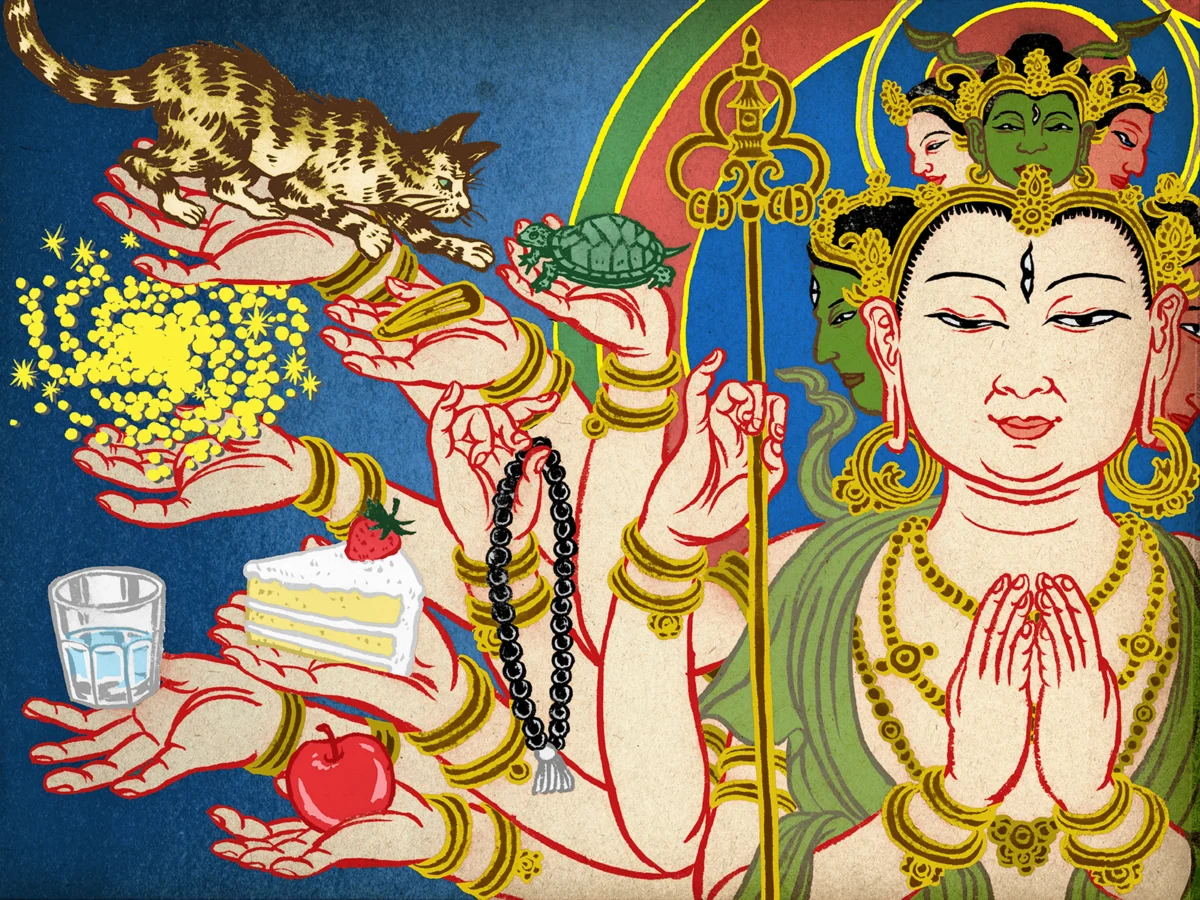
The complex philosophical underpinnings of the Heart Sutra have been translated and reinterpreted countless times throughout history, but a recent literary undertaking offers a uniquely personal and contemporary perspective. Renowned Japanese poet Hiromi Ito, known for her groundbreaking explorations of pregnancy, childbirth, and female sexuality, has embarked on a year-long serialization of her book, Reading the Heart Sutra, with Tricycle magazine. This deeply reflective work, translated into English for the first time by Jeffrey Angles, delves into Buddhist texts through the lens of Ito’s own life experiences—motherhood, loss, and the care of aging parents. The latest installment, a conversation between Ito and her daughter, Kanoko, offers a profound dialogue about the nature of reality, perception, and the elusive concept of emptiness.
A Personal Encounter with Ancient Wisdom
The chapter opens with a tender yet candid portrayal of the mother-daughter relationship. Hiromi Ito introduces her daughter, Kanoko, acknowledging that her writing often blends the distinct identities of her three daughters into a single, resonant voice. This playful ambiguity immediately sets a tone of intimate exploration, hinting at the subjective nature of perception that will become a central theme. Kanoko, now an adult, works with individuals experiencing autism and schizophrenia, and moonlights as an improvisational musician. Her recent interest in becoming a nun, and her engagement with a Christian church, adds another layer to her multifaceted spiritual journey, a journey that eventually led her to the Heart Sutra.
"I like the part about the five skandhas," Kanoko shares with her mother, a seemingly simple statement that unlocks a profound discussion. The skandhas, or five aggregates, are fundamental concepts in Buddhist philosophy, representing the components that constitute an individual’s perceived self: form, sensations, perceptions, mental formations, and consciousness. Ito’s daughter, despite her struggles with verbal expression and a regressed command of Japanese, displays a keen intellectual curiosity, prompting a deeper dive into the sutra’s teachings.
Unpacking the Five Aggregates: A Dialogue of Understanding
The core of the chapter lies in the daughter’s explanation of the Heart Sutra to her mother, a dialogue that oscillates between direct translation, personal interpretation, and relatable analogies. The Heart Sutra, attributed to Avalokiteśvara Bodhisattva, begins with the profound assertion: "Form does not differ from emptiness; emptiness does not differ from form." This paradoxical statement is the gateway to understanding the sutra’s message.
Kanoko explains that Avalokiteśvara, often referred to by his Japanese name Kannon, experienced a deep realization during meditation. He perceived that all the phenomena he believed to be real—the very constituents of his self—were, in fact, formulations of the five skandhas, and that these aggregates lacked inherent, independent substance. This realization, Kanoko emphasizes, is not merely an intellectual exercise; it is the key to liberation from suffering.
The dialogue meticulously unpacks each of the five aggregates, illustrating their nature through everyday examples. "Form," Kanoko explains, is not just visual appearance but "what’s there, whether I’m trying to see it or not. It means the thing in and of itself—the thing that’s there whether I’m there to perceive it or not." This challenges the egocentric view of reality, suggesting that objects possess an existence independent of our observation.
The subsequent aggregates—sensations, thoughts, impulses, and consciousness—are explored with increasing nuance. Kanoko uses the example of a cake to demonstrate how sensations arise from contact with form, leading to thoughts and perceptions. The impulse to consume the cake, and the subsequent consciousness that integrates these experiences, are all part of this intricate web. The critical insight is that these processes, while forming our perceived reality, are impermanent and interdependent.
The Illusion of Form: A Hairpin and a Cake Analogy
To illustrate the emptiness of form, Kanoko employs two compelling analogies: a hairpin and a cake. She posits that a hairpin, perceived as such by humans, might be seen as a mere plaything by a cat, or entirely overlooked by a turtle focused on its own immediate needs. This highlights how the "meaning" of an object is not intrinsic but assigned by the perceiver. The hairpin’s identity as a hairpin is a human construct, contingent on our conceptual framework.
The cake analogy extends this idea by emphasizing impermanence. A cake, recognizable as such in one moment, will inevitably change over time, spoiling and eventually decaying into dust. This gradual transformation, or even complete disintegration over years, demonstrates that the "cake" we perceive is a fleeting phenomenon, not an enduring entity. The sutra’s assertion that "form itself is emptiness" means that what we identify as "form" is fundamentally transient and devoid of an independent, unchanging essence.
Emptiness as "Empty of Meaning": A Universe of Interconnectedness
Kanoko grapples with the meaning of "empty," proposing that it can be understood as "empty of meaning." The phenomena we perceive are not isolated realities but rather "itty-bitty bits of the entire universe." Our tendency to assign specific meanings and reasons to these occurrences—like celebrating a birthday with a cake—is a product of chance and cultural conditioning, not an inherent truth of the object itself. The sutra, therefore, suggests that things do not possess inherent, fixed meanings or purposes.
The connection between the Chinese character for "empty" (空, kū), which also means "sky," is explored. The sky, representing the vastness of the universe, underscores the idea that all perceived things are merely components within this grand, interconnected whole. The notion of self, which we hold so dear, is itself a temporary configuration within this cosmic flow.
Beyond the Self: Implications for Suffering and Nirvana
The discussion then pivots to the implications of this understanding for human suffering. Kanoko explains that prajñāpāramitā, often translated as "perfection of wisdom" or "transcendent wisdom," is the realization that leads to the escape from suffering. This wisdom allows one to see through illusions and attachments, thereby dispelling fear and delusion.
The sutra’s assertion that "all dharmas are marks of emptiness" means that all phenomena—all conditioned things—are characterized by this lack of inherent existence. They do not arise or disappear in an absolute sense, nor do they possess fixed qualities of purity or impurity, increase or decrease. This perspective offers a radical reorientation towards life and death, purity and defilement, suggesting that these dualistic concepts are, from a cosmic viewpoint, illusions.
A Personal Application: Understanding a Patient
The chapter takes a poignant turn as Kanoko shares an experience from her work with patients exhibiting autism and schizophrenia. She describes a patient who can visually process forms but cannot connect them to their meaning or to his own identity. He can match pictures of apples but does not recognize them as apples, illustrating a profound disconnection between perception and conscious understanding.
This disconnect, Kanoko suggests, mirrors the sutra’s exploration of the five aggregates. The patient’s inability to assign meaning to visual stimuli or auditory input highlights the constructed nature of our own reality. Names, for instance, are arbitrary sounds that gain meaning through our cognitive processes. Without this meaning-making capacity, the world remains a collection of uninterpreted forms. This observation provides a powerful, real-world example of how the breakdown of the aggregates can manifest.
The Mantra of Wisdom: A Path to Liberation
The latter part of the chapter delves into the concluding verses of the Heart Sutra, focusing on the mantra: "Gate gate pāragate pārasaṃgate bodhi svāhā." Kanoko explains that this mantra signifies the ultimate realization of prajñāpāramitā. It is a powerful incantation that removes suffering and leads to enlightenment. The repetition of "gate" (gone) signifies movement beyond illusion and suffering, towards the "far shore" of nirvana.
The sutra’s final lines reiterate the emptiness of all phenomena, from sensory experiences to the very concepts of aging and death, suffering and its cessation. This is not a nihilistic pronouncement but an invitation to a profound shift in perspective. By understanding that all things are impermanent and devoid of inherent existence, one can transcend the anxieties and attachments that fuel suffering.
A Mother’s Reflection and a Daughter’s Insight
Hiromi Ito concludes the chapter with her own poetic rendering of the Heart Sutra, blending her daughter’s interpretations with her own poetic sensibility. This re-imagining emphasizes the continuous flow of the universe, the illusory nature of the ego, and the transformative power of understanding emptiness. The poem’s structure, mirroring the sutra’s verses, offers a contemporary echo of ancient wisdom.
The dialogue between mother and daughter, spanning philosophical depth and personal experience, underscores the enduring relevance of the Heart Sutra. It demonstrates how ancient texts, when approached with openness and lived experience, can offer profound insights into the human condition, the nature of reality, and the path towards liberation from suffering. The serialization of Reading the Heart Sutra promises further explorations of these timeless themes, offering readers a unique opportunity to engage with Buddhist philosophy through the intimate lens of familial connection and poetic reflection.

