

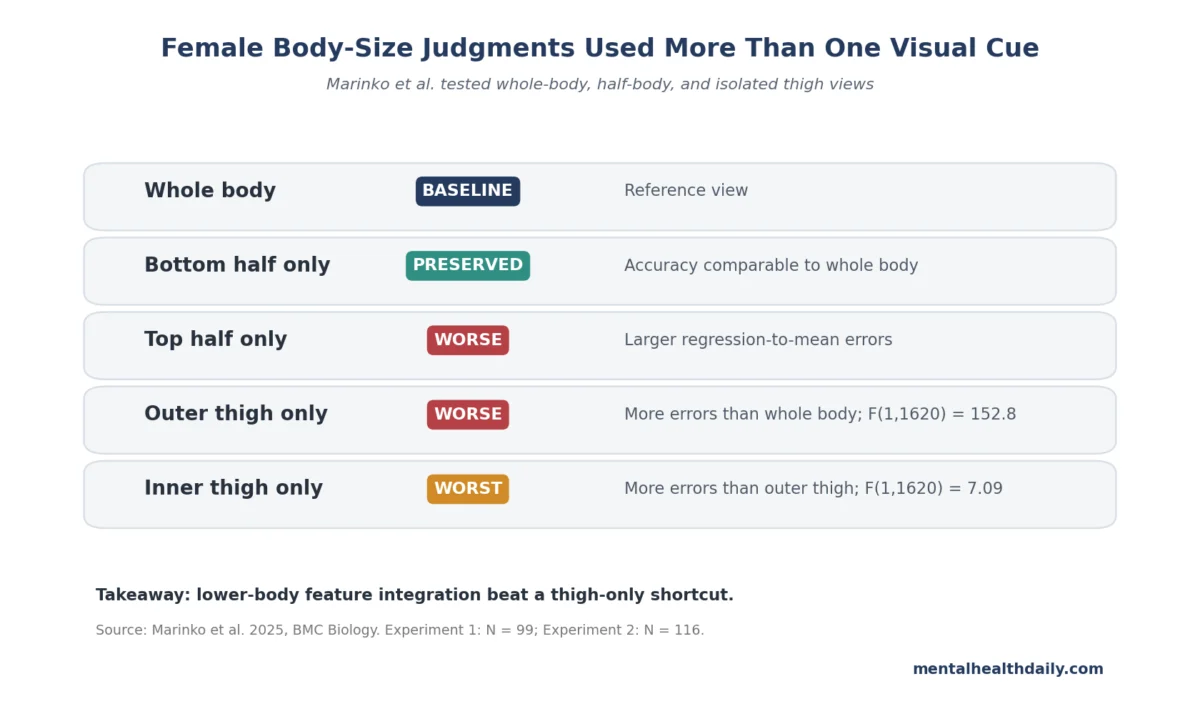
A recent study published in BMC Biology has significantly advanced our understanding of how individuals perceive female body size, revealing that while a full-body view is not always necessary for accurate judgments, the integration of multiple lower-body cues is paramount. The groundbreaking two-experiment study, conducted by Marinko et al., demonstrated that observers could maintain remarkable accuracy in judging female body size when presented with only bottom-half views. However, this precision sharply declined when views were restricted to isolated inner- or outer-thigh regions, underscoring the importance of contextual feature integration over singular focal points. This finding provides a critical refinement to body-image research, suggesting that the visual system relies on a more complex amalgamation of information from the lower body rather than a simplistic "thigh-only" heuristic.
Unpacking the Initial Findings: The Power of the Lower Half
The research commenced with Experiment 1, which sought to determine the minimum visual information required for accurate body-size judgments. Researchers employed a "bodyline task," a specialized visual-perception methodology where participants evaluate body images and assign them to specific categories on a size scale. This task is particularly effective because it allows for the differentiation of a person’s average judgment from more specific patterns of perceptual error, such as systematic overestimation or underestimation.
In this initial phase, 99 women participated, judging images presented in three conditions: whole-body, top-half, and bottom-half views. These views spanned seven distinct body-size categories. The results were compelling: participants consistently and accurately distinguished between the various size categories, a finding supported by strong statistical significance (F(2.48, 242.83) = 2164.72, p < 0.001). Crucially, the main effect of view condition did not reach statistical significance (F(2, 196) = 2.74, p = 0.067), indicating that, on average, the type of view (whole, top-half, bottom-half) did not dramatically alter overall judgment. However, a significant interaction between body size and view condition (F(7.28, 713.32) = 37.99, p < 0.001) revealed a more nuanced pattern.
The practical implication of this interaction was clear: bottom-half-only views yielded judgment accuracy comparable to that achieved with whole-body views. In stark contrast, top-half-only views led to substantially larger "regression-to-the-mean" errors. This phenomenon describes a tendency for judgments of extreme stimuli (very thin or very large bodies) to be pulled towards the average. Specifically, when only the top half of the body was visible, participants struggled to accurately assess bodies at the thinner and larger ends of the size spectrum, tending to perceive them as closer to an average size. This suggests that the lower body, with its contours and proportions, offers a wealth of information critical for anchoring size judgments across the full range of body types.
The Limits of Isolation: Why a Thigh Alone Isn’t Enough
Building on the insights from Experiment 1, the researchers posed a more granular question in Experiment 2: if the lower half provides sufficient information, can a single, isolated region of the lower body carry this information independently? To explore this, 116 women were asked to judge body sizes under whole-body viewing conditions, as well as with views restricted solely to the inner-thigh or outer-thigh regions.
The answer was unequivocal: no. Both isolated thigh-region conditions resulted in significantly poorer body-size judgments compared to whole-body viewing. For regression-to-the-mean error, the outer-thigh comparison indicated a shallower slope and greater error (F(1, 1620) = 152.8, p < 0.001), signifying a stronger pull towards the average for extreme body sizes. The inner-thigh comparison showed an even more pronounced deterioration in accuracy compared to whole-body viewing (F(1, 1620) = 262, p < 0.001). Furthermore, inner-thigh-only viewing performed slightly worse than outer-thigh-only viewing in terms of regression-to-the-mean error (F(1, 1620) = 7.09, p = 0.008).
Beyond general accuracy, the study also examined "serial dependence bias," a perceptual phenomenon where an observer’s judgment of a stimulus is influenced by the characteristics of the previously viewed stimulus. In simple terms, if the previous body image was larger or smaller, the subsequent judgment might be subtly pulled in that direction. The study found that serial-dependence bias broadened considerably when only one thigh region was visible. The estimated serial-dependence amplitude (A) was 0.43 for whole-body viewing, increasing to 0.47 for outer-thigh viewing, and further to 0.64 for inner-thigh viewing. This indicates that without the full context of the lower body, the visual system became more susceptible to the "carryover" effect from prior images, further highlighting the loss of reliable cues.
These findings collectively point to "lower-body feature integration." This concept posits that the human perceptual system actively combines multiple visible cues from the lower body to form an estimate of overall size. A bottom-half view provides a sufficient array of these cues and their spatial relationships, allowing for accurate size estimation. However, when this view is reduced to a solitary anatomical patch, such as a single thigh region, critical contextual information is lost, leading to increased perceptual errors and biases.
The Broader Context: Body-Image Disturbance and Clinical Relevance
The implications of this research extend significantly into the field of body-image research, particularly concerning body-image disturbance, a clinically important feature in eating disorders. Conditions like anorexia nervosa and bulimia nervosa often involve patients who misperceive or overestimate their body size. The mechanism behind this includes perceptual processes, where the visual system must weigh various cues, assign importance to them, and potentially be biased by recent visual experiences.
Historically, body-image disturbance was sometimes viewed as a vague psychological complaint. However, landmark work, such as Cash and Deagle’s meta-analysis, solidified its status as a measurable clinical feature across diverse eating-disorder samples. This paved the way for more objective measurement approaches, moving beyond broad body dissatisfaction to focus on visual mapping and specific perceptual markers. For instance, Ralph-Nearman et al. utilized digital body-image mapping in patients with anorexia nervosa, demonstrating a correlation between visual disturbance measures and illness severity. This shift acknowledges that body-image disturbance is not solely a subjective feeling but also involves quantifiable perceptual errors.
It is crucial to contextualize the Marinko et al. study within this framework. While the study’s participants were not a clinical eating-disorder sample, and the task involved judging images of other female bodies rather than one’s own, its contribution is nevertheless significant. It refines our understanding of the fundamental perceptual mechanisms underlying body-size judgment. If accurate body-size perception relies on the integrated processing of lower-body cues, then current and future clinical body-image measures must move beyond simplistic global body outlines. Instead, they should consider how specific visual cues are processed and integrated, potentially informing more nuanced diagnostic and therapeutic approaches.
A Chronology of Understanding: The Evolution of Perceptual Research
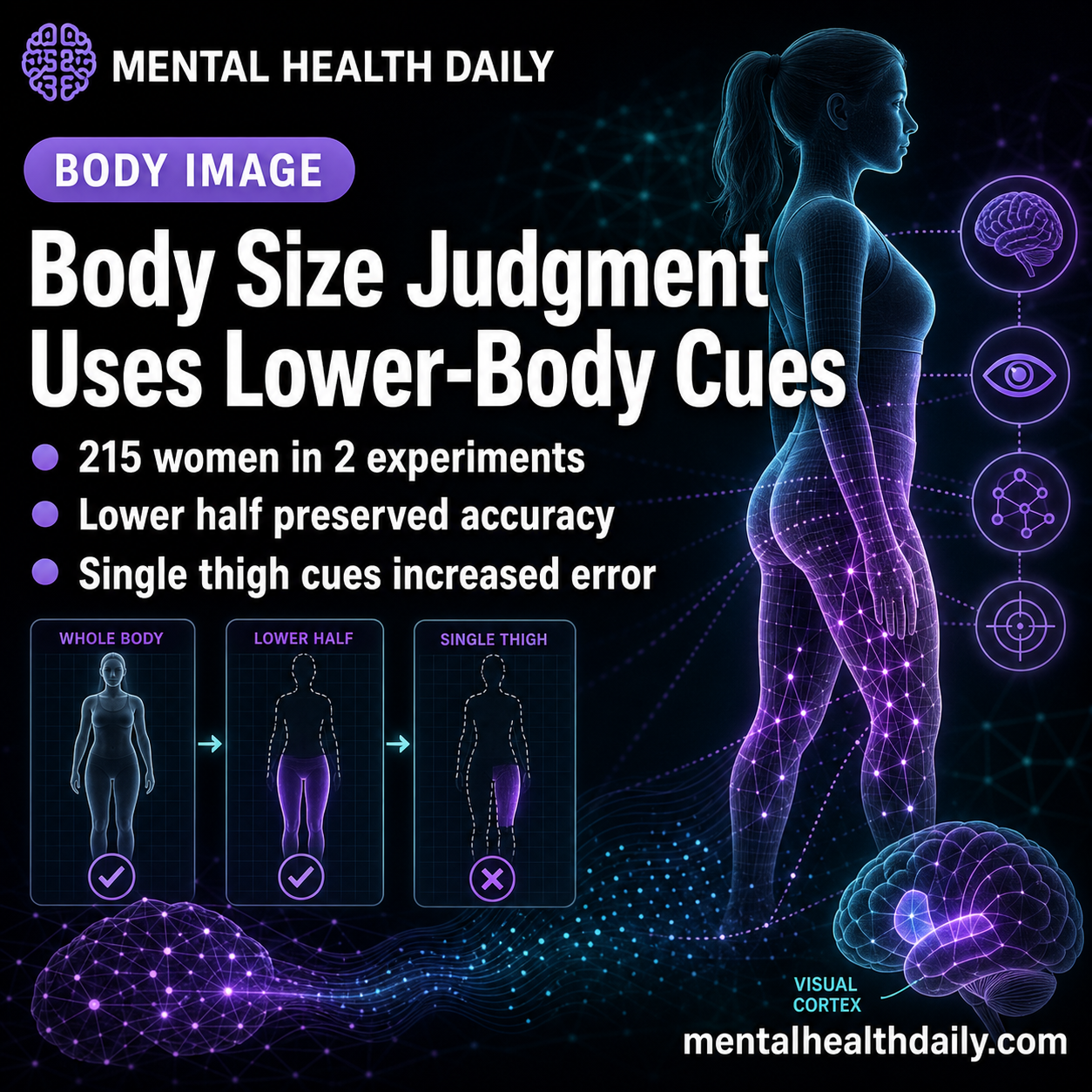
The Marinko et al. study represents a crucial step in a growing body of research dedicated to deconstructing the visual mechanisms of body perception. This journey has seen researchers progressively move from observing general body dissatisfaction to meticulously investigating the specific visual cues that drive size judgments.
Early work in body image often relied on self-report questionnaires, which, while valuable for assessing emotional and cognitive aspects, provided limited insight into the raw perceptual processes. The recognition of body image disturbance as a core clinical feature of eating disorders prompted a need for more objective measures.
- Late 20th Century: The establishment of body image disturbance as a measurable clinical feature. Cash and Deagle’s 1997 meta-analysis was instrumental in providing empirical evidence for its prevalence and significance in eating disorders.
- Early 21st Century: The emergence of visual-perceptual tasks. Researchers began to develop tools like the "bodyline task" to objectively quantify how individuals perceive body size, separating it from affective responses.
- Mid-2010s onwards: Focus on specific visual cues. Studies started exploring which parts of the body, or which visual features (e.g., edges, internal details), contribute most to body size judgments. Irvine et al. (2018), for example, used eye-tracking and visual masking to show that observers might fixate on central body regions, but judgment accuracy often depended on peripheral body-edge cues defining width and shape. This highlighted a potential disconnect between where people look and what information their visual system actually uses.
- Recent Work (Marinko et al. 2024): A preceding study by Marinko et al. in 2024 investigated whether internal body features provide useful information beyond just the silhouette shape. Their findings indicated that removing internal features increased body-size judgment errors and altered serial-dependence patterns, arguing against a simple "outline-only" account of perception.
- Current Study (Marinko et al. 2025): The current research specifically adds the dimension of lower-body dominance and the necessity of feature integration. It confirms that while substantial lower-body information can preserve accuracy, isolated fragments cannot.
Together, these studies paint a consistent picture favoring a "feature-integration model." This model posits that body-size perception is a sophisticated process that leverages multiple visual cues. Accuracy degrades when the visual input removes too much of this essential cue structure, forcing the perceptual system to rely on less robust or incomplete information.
Addressing Misconceptions: Beyond a "Thigh Obsession" Narrative
It is critical to interpret these findings with precision, guarding against oversimplification or misrepresentation, especially in popular discourse. The study does not support a simplistic "thigh obsession" claim, which might suggest that people exclusively judge female body size by focusing on thighs. Such a framing would be a misreading of the nuanced results.
The key distinction lies between the sufficiency of integrated lower-body information and the insufficiency of isolated thigh regions. Experiment 1 showed that the bottom half of the body provided enough visual data for accurate judgments. This bottom-half view, however, encompasses a range of features – hip width, leg length, overall lower-body contours – all integrated by the visual system. Experiment 2 then demonstrated that stripping away this broader context, leaving only an inner or outer thigh, severely impaired judgment accuracy.
This careful distinction changes the interpretation significantly:
- Evidence Strength: The study is a rigorously controlled visual-perception experiment. It is adept at identifying task-specific judgment mechanisms under controlled conditions. It is not designed to diagnose body-image disturbance, prove causality in eating disorders, or dictate specific treatment targets for clinicians.
- Clinical Caution: Translating these findings into direct eating-disorder care requires further studies that directly investigate self-body perception, its relationship to symptom severity, and treatment response. The act of judging standardized images of other bodies in a laboratory setting is fundamentally different from judging one’s own body under the complex pressures of anxiety, mirror exposure, social comparison, or restrictive eating.
The most valuable takeaway from this research is methodological. It strongly suggests that body-image research should prioritize measuring which specific visual cues individuals utilize and how these cues are integrated, rather than assuming that global body dissatisfaction, eye-gaze patterns, and perceptual accuracy are interchangeable constructs. The weighting of lower-body cues, as identified in this study, represents one measurable piece within this larger, intricate perceptual system. It underscores that the lower-body signal mattered because it preserved critical visual structure, not because one isolated feature served as the sole determinant of judgment.
Implications for Future Research and Clinical Practice
The Marinko et al. study offers a robust foundation for refining both research methodologies and potential clinical approaches in the realm of body image.
For Researchers:
- Enhanced Cue Mapping: The study champions the need for more sophisticated cue mapping in body-image research. Future studies should move beyond broad assessments to pinpoint which specific visual features (e.g., width-defining edges, curvature, specific ratios) are most heavily weighted by the visual system for different body regions.
- Investigating Clinical Populations: The next logical step is to replicate and extend these experiments with clinical populations, such as individuals with anorexia nervosa, bulimia nervosa, or body dysmorphic disorder. Do these groups exhibit different cue weighting patterns? Do they rely more heavily on specific, potentially distorted, cues?
- Dynamic Perception: Further research could explore how these perceptual processes change over time, under different emotional states, or in response to therapeutic interventions.
- Cross-Cultural Comparisons: Investigating how cultural ideals and societal pressures might influence the weighting of specific visual cues in different populations could offer valuable insights.
For Clinicians:
- Nuanced Assessment: While not a direct clinical tool, the findings encourage clinicians to adopt a more nuanced perspective on body-image assessment. Instead of solely relying on self-reported dissatisfaction, incorporating tasks that probe perceptual accuracy and cue utilization could provide a more complete picture of a patient’s body image disturbance.
- Informing Interventions: Understanding which visual cues are most salient for perception could, in the long term, inform the development of more targeted perceptual retraining interventions. If certain cues are consistently misread or overemphasized, therapies could focus on recalibrating the processing of those specific features.
- Education and Awareness: The research can help educate patients and the public about the complex, often unconscious, nature of body perception, helping to demystify body image challenges and reduce self-blame.
The Societal Lens: Media, Body Ideals, and Perception
While the study is strictly a visual-perception experiment and does not directly address societal influences, its findings resonate with broader discussions about media portrayal and body ideals. In many cultures, the lower body (hips, thighs, buttocks) is often a focal point of aesthetic scrutiny and societal standards for women. The fact that the visual system relies heavily on integrated lower-body cues for accurate size judgments highlights a biological predisposition that could, in environments saturated with specific body ideals, become a vulnerability.
Public health advocates and media literacy experts can use such research to emphasize the artificiality and often unrealistic nature of digitally manipulated images. By understanding that our perceptual systems are constantly integrating complex visual information, we can better appreciate how distorted images might subtly (or overtly) bias our perceptions, contributing to body dissatisfaction.
Bottom Line: The Marinko et al. study provides a crucial sharpening of the perception side of body-image research. It unequivocally demonstrates that female body-size judgment is neither purely holistic nor reducible to the perception of a single body part. Instead, accuracy fundamentally depends on the intricate integration of multiple visual cues, particularly those emanating from the lower body. This understanding promises to foster more precise research and, eventually, more effective interventions for body image disturbance.

