

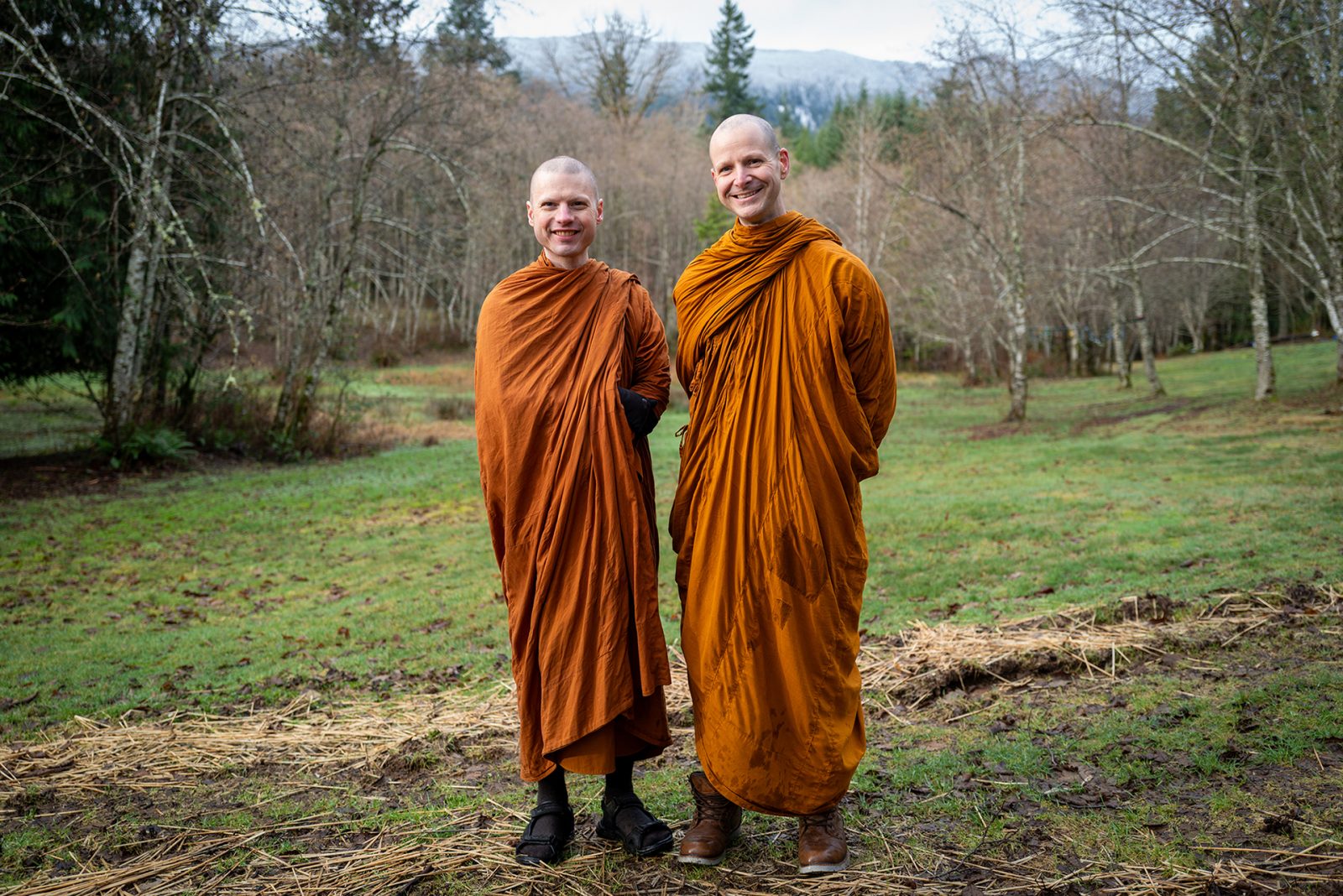
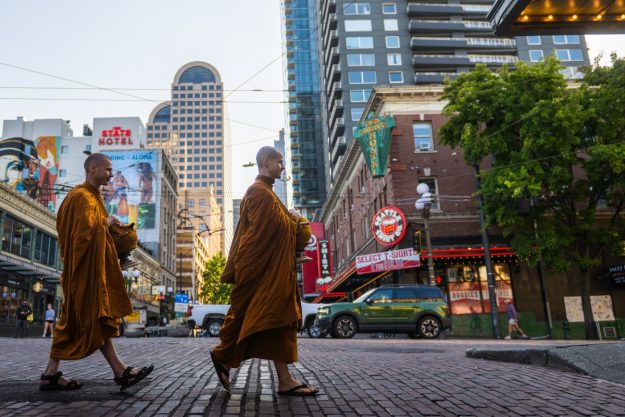
Two saffron-robed monks, Ajahn Kovilo and Ajahn Nisabho, embody a modern iteration of ancient Buddhist tradition, walking daily into Seattle’s bustling Pike Place Market with alms bowls in hand. For five years, they have relied on the generosity of strangers for their single daily meal, a practice that has sustained them without fail. This seemingly simple act is the cornerstone of their vision for Clear Mountain Monastery, a new Theravada Buddhist forest monastery taking shape on ninety acres of forested land in North Bend, Washington, approximately forty minutes outside Seattle. Their journey to this nascent spiritual center has been shaped by extensive experience in Thailand, India, Myanmar, Goenka meditation halls, and, notably, a warm and ongoing partnership with Saint Mark’s Episcopal Cathedral in downtown Seattle.
The Genesis of a Monastery: From Alms Rounds to Community Building
The practice of alms rounds, known as pindapata in Theravada Buddhism, is a deeply ingrained aspect of monastic life, symbolizing dependence on the lay community and fostering humility. Ajahn Nisabho recounted their initial foray into Pike Place Market, stating, "The first day we went downtown, seven people offered food in thirty minutes." This immediate success defied any initial apprehension. Even moments of near scarcity have been met with unexpected kindness, such as the time a homeless individual offered them a box of protein bars. Ajahn Kovilo humorously recalled a Thai monk friend, Ajahn Gai, teasing him about the potential challenges of soliciting alms in a city known for its seafood, only to be proven wrong by the inherent generosity of its people.
Despite Seattle’s reputation as one of the most secular cities in the United States, Clear Mountain Monastery has found fertile ground for its teachings. Ajahn Nisabho observed, "we didn’t know how this monastic venture would play out there." However, they discovered a significant hunger for spiritual community, particularly among younger demographics, a trend that contrasts with the predominantly baby boomer populations often found in established Buddhist convert sanghas. Their Saturday gatherings, hosted at Saint Mark’s Cathedral, now attract around ninety in-person attendees, with an additional hundred joining online, complemented by daily Zoom meditation sessions. This approach aligns with Ajahn Nisabho’s philosophy: "The Buddha taught in the vernacular, and the vernacular of this age is social media. We’ve found a way of rippling the teachings out through YouTube and other things, and people are so hungry for community."
Bridging the "Siloed Existence" of Convert Buddhism
Clear Mountain Monastery aims to address what Ajahn Nisabho terms "the siloed existence that is the endemic problem of convert Buddhism in the US." Their vision extends beyond a traditional meditation hall; it is an endeavor to construct a robust "social architecture of practice." This architecture emphasizes communal activities like potlucks and, crucially, interfaith connections. "These last five years have been building up that architecture of faith," Ajahn Nisabho stated. "Everything’s offered freely, and support has really come from inspiration."
A Growing Theravada Presence in the Pacific Northwest
The establishment of Clear Mountain Monastery is part of a broader trend of Theravada monastic communities emerging along the West Coast. Ajahn Kovilo highlighted a constellation of newer foundations, including Pacific Hermitage in White Salmon, Passaddhi Vihara in Olympia, Parayana in Port Townsend, Dhammadharini in Penngrove, California, and Karuna Vihara in Santa Cruz. These join established communities like Sitavana in British Columbia, Abhayagiri in Ukiah, and Metta Forest Monastery near San Diego.
This burgeoning network has led to the Pacific Northwest being dubbed the "New Gandhara" by Ajahn Sona, the abbot of Sitavana Monastery. This appellation, a nod to the ancient Indian region where Buddhism once flourished, signifies the growing presence of Theravada monasteries for both monks (bhikkhus) and nuns (bhikkhunis). The monks emphasize the Buddha’s teaching that his sasana (dispensation) is incomplete without the "fourfold assembly" of monks, nuns, laymen, and laywomen. By their estimation, only two locations globally—Western Australia and the Pacific Northwest—currently host such a comprehensive convergence of Theravada monks and nuns in close proximity.
Securing a Sacred Space: The North Bend Property
After a three-year search, Clear Mountain Monastery secured ninety forested acres in North Bend six months prior to the article’s publication. This location is strategically situated within an elk migration corridor and remains within a forty-minute drive of Seattle, allowing for the continuation of their vital alms round practice. Ajahn Nisabho explained the significance of this proximity: "In Asia, the model depends on being close enough to the city for alms round, so it’s not novel—but it is quite novel for forest monasteries in North America," where most are located two or more hours from urban centers.
The acquisition of this land was made possible by a $5 million fundraising campaign. The long-term vision for the monastery includes housing for up to twenty monastics, a dedicated quarter for visiting bhikkhunis, a lay sala for daily chanting and meditation, a temple open to day visitors, and a protected forested area for monks seeking deeper solitary practice. "We don’t want to lose that side of things," Ajahn Kovilo affirmed, underscoring the importance of preserving opportunities for intense individual practice.
Personal Journeys to the Monastic Path
The paths of both Ajahn Nisabho and Ajahn Kovilo to monastic life are deeply rooted in their personal spiritual explorations. Ajahn Nisabho, a native of Spokane, Washington, grew up in a Buddhist household, his parents having studied with figures like Jack Kornfield. Hermann Hesse’s Siddhartha at age fifteen was a formative experience, igniting a profound connection to the "vision of the Buddha" that "shone gold in my heart." He described this as a moment of stepping into a preordained path. He pursued meditation through college and engaged in social work, including a year in Calcutta, before finding his calling in monastic life after a transformative visit to Abhayagiri Monastery. The profound "silence" he encountered there revealed the necessity of a monastic container to confront his own suffering. He eventually ordained in Thailand under Ajahn Anan at Wat Marp Jan.
Ajahn Kovilo’s journey began with ten-day Goenka Vipassana retreats, leading to the realization that his life required a more sustained spiritual commitment. His deep dive into the Pali canon, particularly the online resources provided by Access to Insight (much of it the work of American-born Thai forest monk Thanissaro Bhikkhu, or Ajaan Geoff), solidified his resolve. Upon discovering Ajaan Geoff was the abbot of a monastery in Southern California, he relinquished his possessions and hitchhiked north, intending a short stay but remaining for eighteen months. He was ordained at Abhayagiri in 2010 by Ajahn Pasanno and Ajahn Amaro. His subsequent six years involved further training in Thailand and studies in Mahayana traditions at Dharma Realm Buddhist University. Both monks identify with the broader network of monastics within the Thai forest tradition, with Ajahn Nisabho currently working on a biography of Luang Por Pasanno and Ajahn Kovilo having edited Stillness Flowing, a biography of Ajahn Chah.
A Unique Interfaith Partnership: Saint Mark’s Episcopal Cathedral
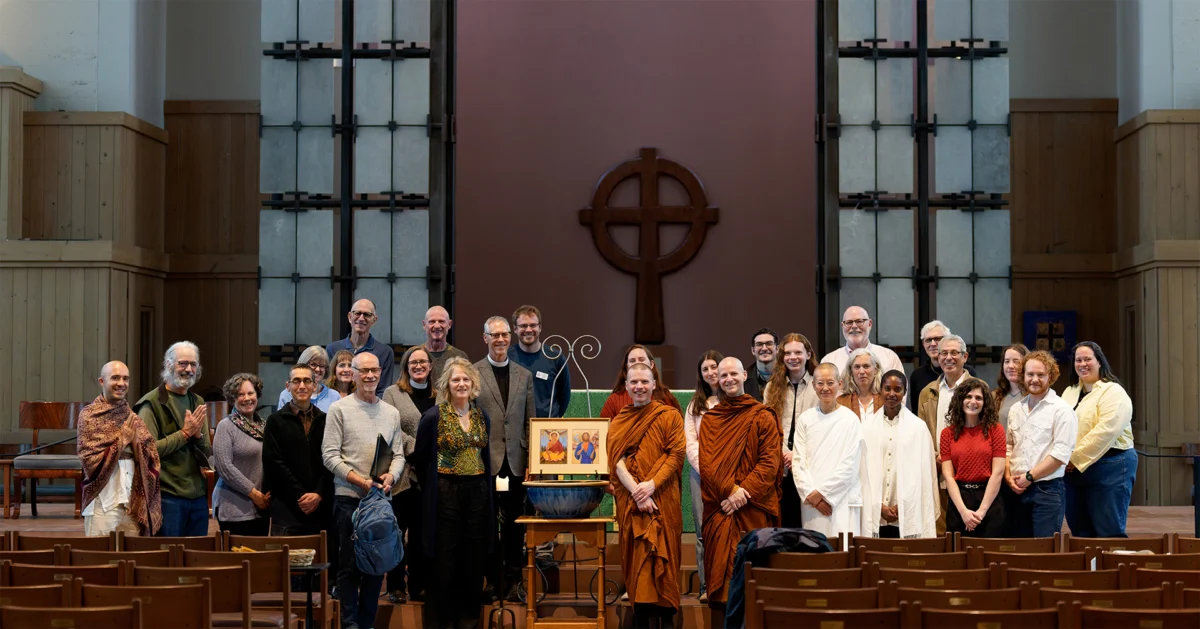
The establishment of Clear Mountain Monastery would have been significantly more challenging without the unwavering support of Saint Mark’s Episcopal Cathedral, which has hosted their community gatherings for the past five years. When Ajahn Nisabho and Clear Mountain board member Steve Wilhelm first approached the cathedral leadership, they presented their situation without demands, seeking only a "space of giving." The response was immediate and welcoming, with a granola bar offered on the spot and a simple invitation to "just meet here." Ajahn Kovilo noted the poignant detail that Saint Mark’s is the very place where Luang Por Sumedho, a prominent disciple of Ajahn Chah and a pioneer of the Thai forest tradition in the West, once served as an altar boy at age eleven, creating a subtle yet profound historical link between the two traditions.
This interfaith relationship has deepened over time. The two communities now share an annual January lunch, with Clear Mountain members bringing a meal to the cathedral staff as a gesture of gratitude. This ongoing dialogue has also birthed an interfaith worship service, inspired by Thich Nhat Hanh, titled "Living Buddha, Living Christ, Living Spirit."
Reverend Canon Emily Griffin, canon vicar of Saint Mark’s since October 2024, traced the origins of the service to a mid-2023 conversation where Ajahn Nisabho expressed a desire for deeper connection through shared prayer. A collaborative effort between cathedral staff, a key lay volunteer, and the monks revealed significant common ground. Griffin observed, "What they discovered was that there were resonances between the perfections of character related to enlightenment in Buddhism and what are called the Fruits of the Spirit in the New Testament." The cathedral’s existing engagement with Taizé services, an ecumenical chant-based worship style, provided a natural framework for this new collaboration.
The inaugural "Living Buddha, Living Christ, Living Spirit" service was held in the summer of 2024, with the third iteration drawing approximately 150 attendees. Griffin remarked on the profound impact of these services: "What’s beautiful about it is that folks from both traditions walk away feeling their own faith enriched. Not only are you appreciating a tradition that’s not your own and valuing the other but you’re seeing your own tradition in greater depth, which is just a gift."
Mutual Enrichment and the Gift of Presence
The exchange of insights and practices extends in both directions. Beyond the Saturday gatherings, Ajahn Nisabho and members of Clear Mountain occasionally participate in Sunday worship at Saint Mark’s, while cathedral members have been invited to join the monks in meditation. Griffin characterized the relationship as one of "openness, curiosity, and respect," stating, "Our relationship has been life-giving and enriching."
When asked about the unique contribution of the monks to her congregation, Griffin emphasized not doctrine, but a heightened sense of presence. "I think one of the real gifts they bring is the reminder that being fully present is a gift," she stated. "As Episcopalians, we can be a little task-oriented. . . . The emphasis on quality of time and relationship-building has been a real gift to us, and has helped us lean into that—because it’s part of our tradition, too, but in the rush to get things done, we sometimes lose it. The way they embody presence inspires us to do the same."
The overarching theme that emerged from discussions with the ajahns and their interfaith partners was the profound importance of skillful relationship and community building. This resonates with the ancient Buddhist teaching, famously articulated by Ananda to the Buddha: "Beautiful friendship is half of the holy life." The Buddha’s profound reply, "Oh no, beautiful friendship is the whole of the holy life," encapsulates the essence of Clear Mountain Monastery’s vision and its burgeoning impact on the spiritual landscape of the Pacific Northwest.

