

It was during the Zhenguan era of the Tang dynasty, a period roughly corresponding to the early 7th century in the West and a time when Japan was formalizing its era names, that a government official named Lu Qiuyin is said to have served as Chief Censor of Taizhou. However, the historical existence of Lu Qiuyin is subject to scholarly debate, with his biography conspicuously absent from both the old and new Tang Book. This omission raises questions about his precise administrative role and the accuracy of the accounts that place him in such a significant position. The Chief Censor, in the Tang administrative hierarchy, held authority comparable to the supreme administrator of a zhou (state) or jun (county). China’s vast territory was meticulously divided into dao (regions), which were further subdivided into zhou or jun, then xian (prefectures), xiang (districts), and finally li (villages). The head of a zhou was known as a cishi, while the head of a jun was called a taishou. The discrepancy in administrative nomenclature, particularly the improper use of jun for what is ken in Japan, has been noted by scholars like Mr. Yoshida Tōgo, highlighting potential inaccuracies in historical records and their translation across cultures. If Lu was indeed the Chief Censor of Taizhou, his position would have been equivalent to a prefectural governor, a role that should have warranted inclusion in the Tang Dynasty Biographies. Nevertheless, for the narrative to unfold, the existence of Lu Qiuyin is assumed.
A New Appointment and an Unforeseen Affliction
The narrative begins on Lu Qiuyin’s third day in office in Taizhou. Having transitioned from the dusty environs of Chang’an, where he endured the harsh climate of North China, to the fertile lands and clear waters of Taizhou, Lu found himself in an exceptionally buoyant mood. The preceding days had been filled with formal audiences with numerous subordinate officials, each presenting their departmental affairs. Amidst this bustling commencement of his tenure, Lu keenly felt the weight and exhilaration of his administrative power.
The previous day, Lu had declared his intention to rise early and visit the Guoqing Temple in Tiantai Prefecture, a decision made while he was still in Chang’an, anticipating his arrival in Taizhou. This planned excursion was not a mere sightseeing trip but was prompted by a pressing personal matter. Shortly after his appointment as Chief Censor in Chang’an and on the eve of his departure for Taizhou, Lu had been afflicted by an excruciating headache. Though diagnosed as a simple rheumatic ailment by his physician, Lu, known for his anxious disposition, found no relief from the prescribed medication. "Well, we might have to postpone the day of our departure," he had confided to his wife, when a maid announced the arrival of a "beggar bonze" at the front gate, requesting an audience with the master of the house.
Intrigued, Lu, despite his limited exposure to Buddhist sutras or Taoist philosophy, having focused solely on Confucian classics and five-character quatrains for his civil service examinations, harbored a peculiar respect for figures of the Buddhist and Taoist faiths. This respect, perhaps stemming from an awe of the unknown, led him to grant the bonze an audience, requesting his wife to withdraw from the room.
The Enigmatic Monk and the Miracle of Water
The visitor was a tall monk, clad in a tattered, soiled robe. His hair, long and uncut above his eyes, appeared to be a source of mild annoyance. He carried a simple iron bowl. After a silent appraisal, Lu inquired about the purpose of his visit. The monk, with a directness that belied his humble appearance, stated he had heard of Lu’s impending journey to Taizhou and his suffering from a headache, offering his services as a healer.
Lu, confirming the severity of his ailment and his contemplation of delaying his departure, asked about the proposed method of cure. The monk dismissed conventional medicine, asserting that bodily ailments are illusions. He proposed to cure Lu’s headache using "magic" with nothing more than a bowl of clean water. Lu, accustomed to making decisions on the fly and lacking a firm grounding in medical theory, readily agreed. His previous choice of a physician had been based more on convenience than expertise, a pragmatic approach he extended to this unexpected encounter. The bonze’s dignified demeanor, coupled with the perceived harmlessness of a water-based remedy, instilled a degree of trust, echoing what the author describes as a form of "blind respect for something one doesn’t comprehend," similar to how high-ranking officials in Tokyo might rely on alternative treatments.
A maid was summoned to fetch well water, which was poured into the iron bowl. The monk received it, holding it close, and fixed his gaze upon Lu. In that prolonged, silent moment, Lu found his attention fixated on the bowl. Then, without warning, the monk took a sip and sprayed the water onto Lu’s head.
The suddenness of the act left Lu astonished, a cold sweat breaking out on his back. The monk’s simple question, "Your headache?" was met with a surprised declaration from Lu: "Oh? It’s gone!" The persistent focus on his pain had been so consuming that the unexpected distraction of the monk’s unconventional treatment had effectively dissolved it.
The monk quietly emptied the remaining water, bid Lu farewell, and turned to leave. Lu, however, called him back, eager to express his gratitude. The monk declined any material reward, stating his alms were for the benefit of all beings and to subdue the arrogant, not for personal gain. Lu, respecting this refusal, then inquired about the monk’s origin. He learned that the monk’s name was Fenggan and that he hailed from the Guoqing Temple in Tiantai.
Lu, feeling a nascent connection with Fenggan, seized the opportunity to inquire about any notable individuals in Taizhou whom he might benefit from meeting. Fenggan, after a moment’s consideration, named two figures: Shide, residing at the Guoqing Temple, whom he identified as an embodiment of Samantabhadra, and Hanshan, living in a rock cave west of the temple known as Cold Boulder, whom he described as Manjushri. With these pronouncements, Fenggan departed, leaving Lu with a profound sense of purpose for his planned visit to the Guoqing Temple.
Philosophical Reflections on the Pursuit of the Way
Interspersed with the unfolding narrative is a philosophical discourse on humanity’s engagement with spiritual or philosophical pursuits, termed "the Way." The author categorizes individuals into three distinct groups:
- The Indifferent: These are individuals deeply engrossed in their professions, concerned with daily survival, and who do not contemplate the Way. This also includes avid readers of books who, while their deep thought might lead them to understanding, often fulfill their duties without existential inquiry.
- The Seekers: This group actively pursues the Way, either by dedicating their lives to it or by integrating its principles into their daily routines. This pursuit spans various traditions, including Confucianism, Daoism, Buddhism, and Christianity. For these individuals, their mundane tasks can become the very manifestation of the Way.
- The Respectful Observers: Occupying a middle ground between the indifferent and the seekers, these individuals acknowledge the existence of the Way but are not actively engaged in its pursuit. They may feel distant from it, yet hold a degree of respect for those who are closer to it. This respect, however, can become "blind" when directed towards figures or concepts that are not fully understood, rendering it ultimately ineffectual. The author emphasizes that this blind respect, while a form of reverence, is "utterly useless even if the object you direct it to happens to be right on target." This commentary provides a framework for understanding Lu Qiuyin’s character and his motivations.
The Journey to Guoqing Temple
Following these reflections, the narrative resumes with Lu Qiuyin’s departure from his official residence in Taizhou for the Guoqing Temple. Clad in formal attire and accompanied by a retinue of sixty attendants, Lu embarked on his journey. It was early winter, with a hint of frost in the air. The procession proceeded north, skirting the left bank of the Shifengxi, a tributary of the Jiaojiang. The initially cloudy sky eventually cleared, revealing a pale sun that cast a gentle light on the autumn maples lining the riverbank. Passersby, both young and old, respectfully made way for the procession, kneeling as Lu’s litter passed. Within his conveyance, Lu felt a sense of profound satisfaction, viewing his journey to pay formal respects to men of wisdom as a personal triumph.
The distance from Taizhou to Tiantaixian was approximately sixty li, roughly equivalent to six and a half ri in Japan. Lu’s litter bearers proceeded at a leisurely pace, ensuring they did not arrive until well past noon. Upon reaching Tiantaixian, Lu was met by local officials and rested at the governor’s residence, where a feast was offered. It was during this reception that he learned the Guoqing Temple was an additional sixty li away, with the terrain becoming increasingly steep. Realizing they would not reach the temple before nightfall, Lu decided to remain overnight at the governor’s residence.
The following morning, the governor bid Lu farewell. The weather remained consistent with the previous day. The mountain, often referred to as the "Tiantai of eighteen thousand zhang," was known to be inhabited by tigers. The journey was slow, and lunch was taken en route. It was at sunset that Lu’s party finally reached the imposing gates of the Guoqing Temple, a monastery reputedly built by Emperor Yang of Sui in memory of the Great Teacher Zhiyi.
Encounters at Guoqing Temple
The temple, aware of the Chief Censor’s visit, extended a respectful welcome. A monk named Daoqiao greeted Lu and escorted him to the guest quarters. After the customary tea and cakes were served, Lu inquired about a monk named Fenggan. Daoqiao confirmed Fenggan had resided in a monastery behind the main hall but had recently departed on pilgrimage and had not yet returned.
Lu pressed for details about Fenggan’s activities within the temple. Daoqiao recounted that Fenggan had primarily been involved in husking rice for the monks. When Lu probed further, asking if there was anything unusual about Fenggan, Daoqiao admitted that while they initially saw him as a kindly, hardworking brother, he eventually came to be regarded as someone special. His abrupt departure remained a mystery. Daoqiao then recounted a peculiar incident: Fenggan had returned from the mountain one day riding a tiger, chanting poems as he rode back and forth within the temple corridors. This penchant for reciting poetry, even at night, was a distinctive characteristic. Lu, hearing this, mused that Fenggan must be a "living arhat." He then inquired about the status of Fenggan’s former monastery. Daoqiao stated it remained empty, with occasional tiger roars heard at night.
Lu, his curiosity piqued, requested to be taken to the empty dwelling. Brushing aside cobwebs, Daoqiao led Lu to Fenggan’s former quarters. In the fading light, the room appeared bare. Daoqiao pointed to tiger footprints etched into the stone floor. A gust of wind, swirling fallen leaves outside, amplified the desolate silence, causing Lu to experience a shiver of apprehension.
Hastily exiting the dwelling, Lu asked Daoqiao if a monk named Shide was still at the temple. Daoqiao, noting Lu’s extensive knowledge of their affairs, replied that Shide had recently been warming himself by the kitchen fire with a man named Hanshan. He offered to summon Shide if Lu had business with him. Lu, surprised to learn of Hanshan’s presence, requested to be taken to the kitchen.
As they walked, Lu inquired about Shide’s arrival at the temple. Daoqiao believed he had arrived a long time ago, having been brought back from the pine woods as a foundling by Fenggan. Shide’s initial duties involved assisting with rituals at the main altar in the kitchen, such as burning incense and offering food. However, a peculiar incident occurred when he was found eating alongside the statue after placing offerings, apparently due to a misunderstanding of proper reverence. Consequently, Shide was assigned to prepare meals for the monks in the kitchen.
Lu then inquired about Hanshan. Daoqiao explained that Hanshan lived in a stone cave west of the temple, known as Cold Rock. He subsisted on leftover rice and vegetables collected by Shide from the monks’ meals, which Hanshan collected in a bamboo tube. Lu, following Daoqiao, pondered the identities of these individuals. If Hanshan and Shide, engaged in such humble tasks, were indeed Manjushri and Samantabhadra, he questioned who Fenggan, the tiger-rider, might be, likening his confusion to that of a novice actor at a play.
The Kitchen Encounter and the Laughter of Enlightenment
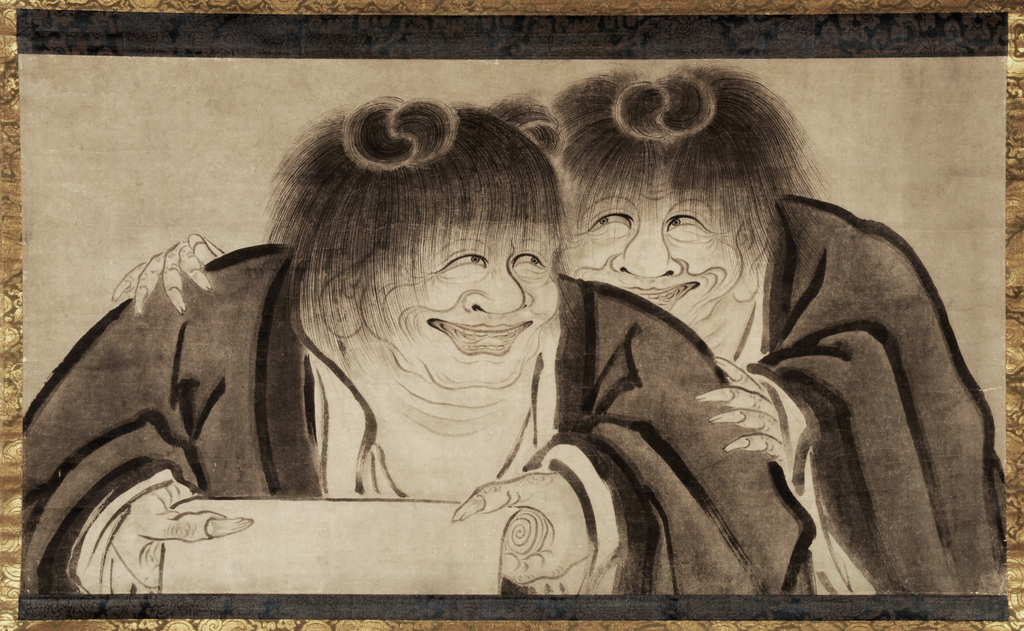
Daoqiao led Lu into the steamy, somewhat disheveled kitchen, apologizing for its state. Amidst the haze, Lu observed three large ovens with glowing embers and numerous monks preparing food. Daoqiao called out for Shide. In the dim light, Lu spotted two monks squatting near the farthest oven, warming themselves. One, bare-headed with short hair and straw sandals, grinned at Daoqiao’s call – this was likely Shide. The other, wearing a bark hat and wooden clogs, remained motionless, presumed to be Hanshan.
Lu approached them, formally bowed, and introduced himself with a lengthy recitation of his official titles: "I am Lord Steward of the Imperial Council, Provincial Commander-in-Chief, Chief Censor of Taizhou, Army Chief of Staff, with Emperor-bestowed Scarlet Robe and Fish Tally, and I humbly call myself Lu Qiuyin."
Shide and Hanshan exchanged glances, then simultaneously burst into hearty, unrestrained laughter that seemed to erupt from their very depths. They rose and fled the kitchen, with Hanshan exclaiming, "Fenggan prattled!" Lu, stunned, watched them disappear. As the other monks began to serve the meal, Daoqiao stood pale and speechless.
Implications and Broader Impact
The narrative of Lu Qiuyin, Fenggan, Shide, and Hanshan, though presented as a historical account, offers profound insights into themes of spiritual perception, the nature of enlightenment, and the limitations of conventional understanding. The story challenges the reader to consider that those who embody profound wisdom may not always conform to societal expectations or display overt signs of erudition. Fenggan’s unconventional healing, his tiger-riding prowess, and his identification of Shide and Hanshan as bodhisattvas suggest that true spiritual realization transcends worldly status and formal learning.
Lu Qiuyin’s journey represents a quest for meaning beyond administrative duties and worldly success. His initial "blind respect" for the bonze evolves into a deeper, albeit still somewhat bewildered, contemplation of the figures he encounters. His earnest introduction of his extensive titles to Shide and Hanshan, met with their disarming laughter, highlights the stark contrast between worldly power and spiritual liberation. Their laughter, far from being disrespectful, can be interpreted as a recognition of the futility of attaching significance to such temporal achievements in the face of true enlightenment.
The story also serves as a cautionary tale about the limitations of intellectualism and the potentially misleading nature of societal hierarchies. Lu, a man of considerable official standing, finds himself humbled and somewhat bewildered by the seemingly ordinary monks who are implied to possess extraordinary spiritual depth. The author’s philosophical interlude on different attitudes towards the Way underscores the idea that genuine spiritual progress requires more than passive acknowledgment; it demands active seeking and a willingness to transcend conventional understanding.
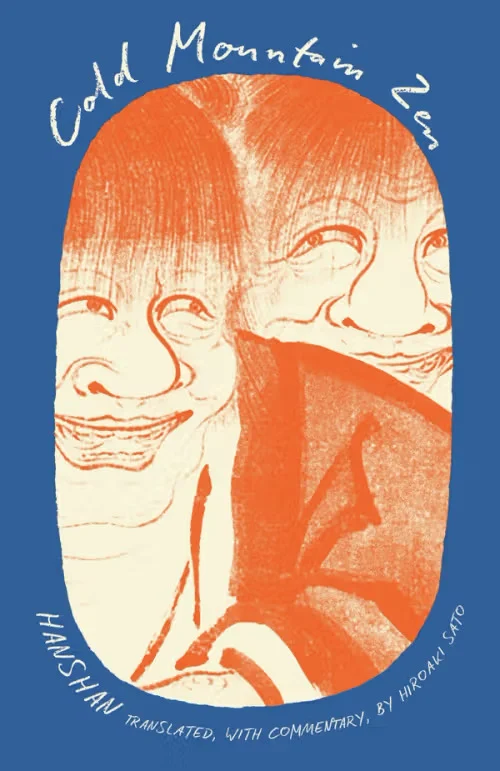
The enduring legacy of this tale, attributed to Mori Ōgai and translated by Hiroaki Sato, lies in its ability to provoke reflection on the nature of reality, the essence of wisdom, and the often-unseen manifestations of the sacred in the everyday world. It suggests that true enlightenment may be found not in grand pronouncements or esteemed positions, but in the simple acts of living, in the shared laughter of those who have glimpsed a deeper truth, and in the quiet understanding that transcends all titles and accolades. The tale continues to resonate, inviting readers to question their own perceptions and to seek wisdom in unexpected places, much like Lu Qiuyin’s transformative journey to Tiantai.

