

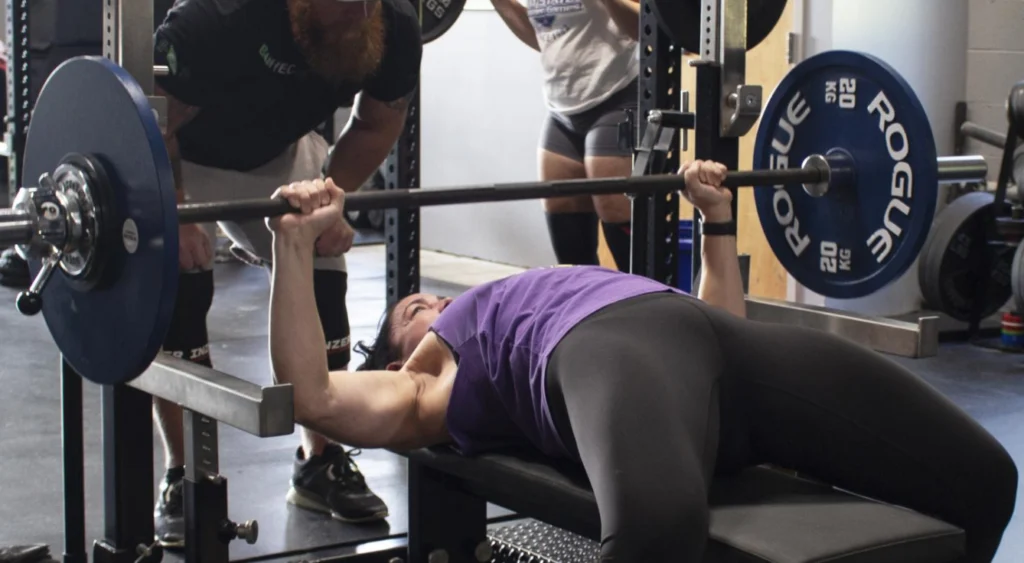
The bench press remains the quintessential metric of upper-body strength in both competitive powerlifting and general resistance training, yet the technical execution of the lift remains a subject of significant debate among practitioners and biomechanists. At the center of this discourse is the placement of the feet: whether they should remain firmly planted on the floor or elevated onto the bench. While traditional strength standards emphasize the floor-based approach for maximum stability and force production, a growing body of evidence and coaching philosophy suggests that the feet-elevated variation, often referred to as the Larsen Press, offers unique developmental advantages for hypertrophy, core stability, and scapular health.
The Mechanics of the Traditional Bench Press
The conventional bench press is defined by five points of contact: the head, the upper back/shoulders, the buttocks, and both feet. Maintaining these points of contact is not merely a matter of protocol but a fundamental requirement for creating a stable kinetic chain. When the feet are placed on the floor, the lifter can engage in "leg drive," a technique where force is generated through the lower body and transferred through the torso to the upper back. This tension stabilizes the arch and provides a solid platform from which the pectorals, deltoids, and triceps can exert force.
From a structural perspective, the arch created during a traditional bench press is often misunderstood. Critics frequently suggest that arching the back increases the risk of lumbar injury; however, biomechanical analysis reveals that the lumbar spine possesses a natural lordotic curve. In a bench press, the arch is used to shorten the range of motion (ROM) and optimize the angle of the glenohumeral joint. According to Greg Robins, a strength coach at The Strength House, the arch acts as a structural bridge. When pressure is applied from both ends—the shoulders and the feet—the resulting tension creates a rigid, stable arch that protects the shoulder capsule from excessive strain while maximizing the load capacity of the lift.
Chronological Evolution of Bench Press Methodologies
The history of the bench press has seen a shift from rudimentary floor presses in the early 20th century to the highly technical, specialized movements seen in modern powerlifting. In the "Silver Era" of bodybuilding (1940s–1950s), the bench press was often performed with a flat back, as the primary goal was muscular isolation rather than maximal weight. It was not until the formalization of powerlifting in the 1960s and the founding of the International Powerlifting Federation (IPF) in 1972 that foot placement became a standardized technical requirement.
By the 1990s and early 2000s, the "Westbury" and "conjugate" methods popularized the idea of using various bench press accessory movements to overcome plateaus. During this period, the feet-up bench press was often viewed with skepticism, frequently dismissed as a "novice mistake" or a sign of poor stability. However, the emergence of elite lifters like Adrian Larsen—for whom the Larsen Press is named—challenged this stigma. Larsen, who competed at an elite level despite physical limitations that affected his leg use, demonstrated that incredible pressing power could be generated even without traditional leg drive. This sparked a re-evaluation of the movement within the broader strength and conditioning community.
Technical Analysis: The Larsen Press and Feet-Elevated Variations
The Larsen Press involves performing the bench press with the legs extended straight or slightly bent, hovering off the floor or resting lightly on the bench. By removing the feet from the floor, the lifter eliminates the ability to use leg drive, which has several immediate biomechanical consequences.
First, the removal of the lower-body base of support introduces an element of instability. This forces the internal and external obliques, as well as the deeper core musculature, to work harder to maintain the lifter’s position on the bench. Second, the movement increases the "effective" range of motion. Without the aggressive arch facilitated by leg drive, the torso sits flatter, meaning the barbell must travel a greater distance to reach the chest.
Tony Bonvechio, a specialist in strength mechanics, notes that the primary benefit of the feet-up variation is the forced maintenance of upper back tightness. "One of the most common errors in the bench press is the collapse of the upper back during the eccentric (lowering) phase," Bonvechio explains. "When the legs are removed from the equation, the lifter is forced to maintain the shoulder blade position and upper back arch through muscular effort alone. This teaches the lifter how to stay ‘tight’ throughout the movement, a skill that translates directly back to the traditional bench press."
Supporting Data and Comparative Performance
Data from electromyography (EMG) studies suggest that while the traditional bench press allows for the highest total load, the feet-elevated bench press can result in higher relative activation of the pectoralis major and anterior deltoids due to the lack of momentum and the increased stabilization requirements.
In a comparative analysis of force production:
- Traditional Bench Press: Typically allows for 10% to 20% more weight to be moved compared to the Larsen Press. This is due to the "total body" nature of the lift and the mechanical advantage of the arch.
- Feet-Elevated Press: Increases the time under tension (TUT) and requires higher levels of motor unit recruitment to stabilize the load. It is often used as a "self-limiting" exercise, meaning the lifter cannot use heavy enough weight to cause technical breakdown without first losing balance.
Furthermore, for athletes dealing with specific types of lower back pain, such as spondylolisthesis or general facet joint irritation, the traditional arched position can sometimes exacerbate symptoms. In these clinical or rehabilitative contexts, placing the feet on the bench can flatten the lumbar spine, reducing compressive forces on the posterior elements of the vertebrae while still allowing for upper-body hypertrophy training.
Expert Responses and Industry Standards
The consensus among modern strength coaches has shifted from a dogmatic "feet on the floor" rule to a more nuanced, goal-oriented approach. While the IPF and other major powerlifting federations still require the feet to be flat on the floor (or at least in contact with the ground) for a lift to be considered valid in competition, the use of feet-up variations in training is now widely accepted.
Greg Robins emphasizes that using feet-up variations is a strategic tool for "purposeful difficulty." By making the exercise harder through instability and increased range of motion, lifters can achieve a significant training stimulus with lighter absolute loads. This reduces the systemic fatigue on the central nervous system (CNS) and minimizes the wear and tear on the joints that often accompanies "max effort" training sessions.
Reaction from the powerlifting community has also highlighted the "awareness" factor. Lifters who rely heavily on a massive arch and aggressive leg drive often lose the ability to "press" with their chest, instead "launching" the weight. The feet-elevated variation forces a return to pressing fundamentals, ensuring that the primary movers are doing the majority of the work.
Broader Impact and Training Implications
The integration of feet-up bench press variations into mainstream fitness programs reflects a broader trend toward "functional hypertrophy"—the pursuit of muscle growth through movements that also improve stability and technical proficiency. For the general fitness enthusiast, the choice between feet on the floor or feet on the bench should be dictated by specific objectives:
- For Maximal Strength: The traditional bench press with feet on the floor remains the gold standard. The stability provided by the ground allows for the highest levels of force production and is essential for anyone looking to compete in powerlifting.
- For Hypertrophy and Technical Correction: The Larsen Press or feet-on-bench variations are superior for isolating the pressing muscles and teaching upper back rigidity. These variations are also highly effective for lifters who find that traditional benching causes lower back discomfort.
- For Injury Prevention: Alternating between the two styles can prevent overuse injuries. The traditional bench press places significant stress on the shoulders in a specific groove, whereas the feet-up version alters the mechanics enough to provide a "break" for the joints while still maintaining high intensity.
In conclusion, the debate over foot placement in the bench press is no longer a matter of right versus wrong, but rather a matter of application. The traditional floor-based press is a masterclass in total-body tension and power, while the feet-elevated variation is a sophisticated tool for building stability, improving mechanics, and maximizing muscular development. As strength science continues to evolve, the most successful training programs will likely be those that leverage both techniques to build a more resilient and powerful athlete.

