

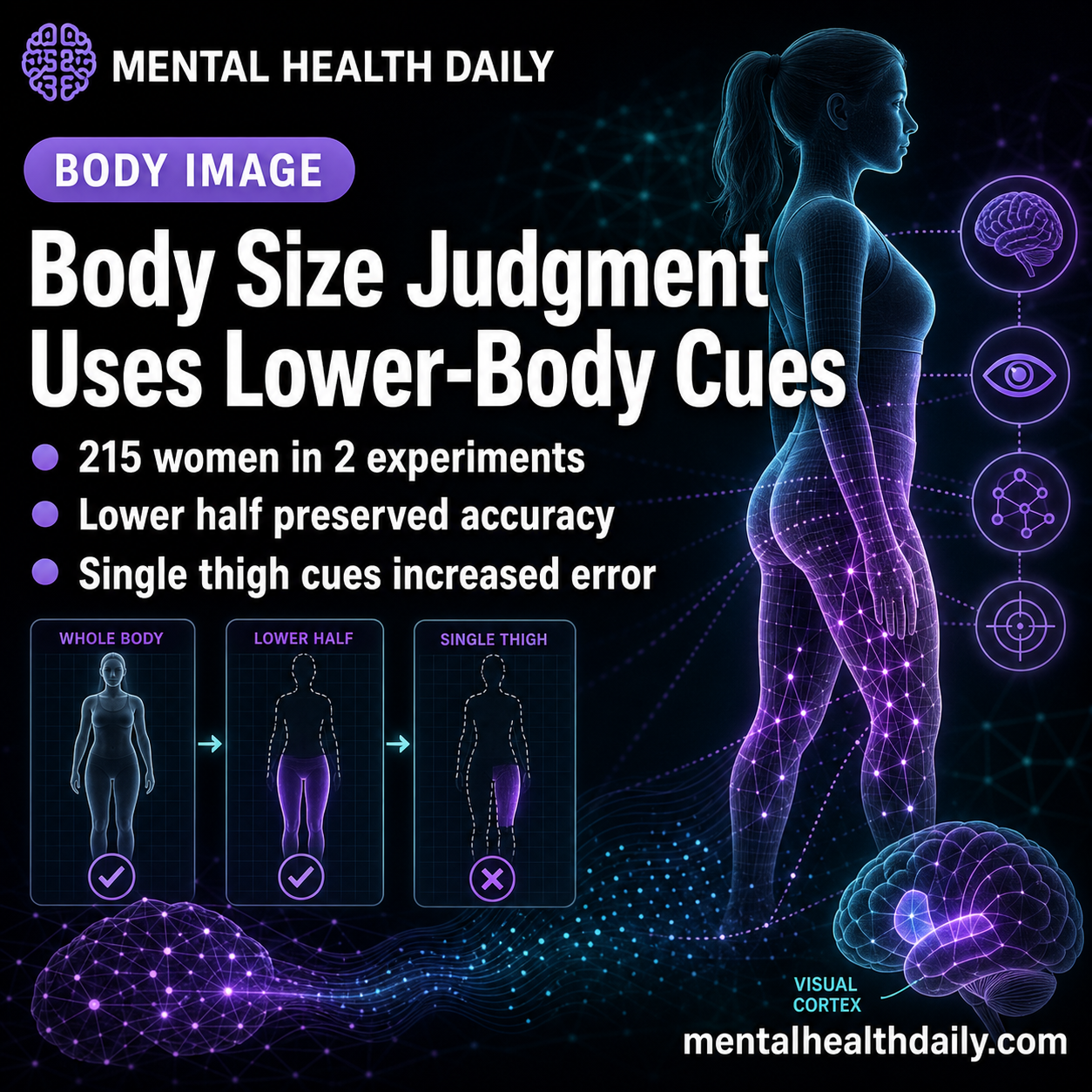
A recent study published in BMC Biology has unveiled crucial insights into how humans perceive female body size, demonstrating that accurate judgments do not necessarily require a full-body view but rely significantly on the integration of lower-body features. This two-experiment investigation, involving a total of 215 women, revealed that views of the bottom half of the body alone preserved judgment accuracy in 99 participants. Conversely, isolating specific regions like the inner or outer thigh led to a marked increase in perceptual errors compared to whole-body views in a second experiment involving 116 women. These findings challenge simplistic notions of body perception, suggesting a complex "lower-body feature integration" process rather than a mere "thigh-only" shortcut, a distinction with profound implications for body-image research and clinical understanding of eating disorders.
The Nuance of Body-Size Perception: A Deep Dive into the Study’s Findings
Body-size judgment, at its core, involves estimating the dimensions of a body from visual information. This perceptual process is a fundamental component of the broader issue of body image, which encompasses a spectrum of experiences including body dissatisfaction, obsessive body checking, avoidance behaviors, and fear-driven interpretations of one’s own physical shape. When these perceptions become distorted, it can lead to significant clinical concerns, particularly in the context of eating disorders. Patients struggling with conditions like anorexia nervosa or bulimia nervosa frequently exhibit body-image disturbance, characterized by an overestimation or misreading of their own body size. Understanding the mechanisms behind this distortion—how the visual system selects cues, assigns weight to them, and how recent visual experiences bias subsequent judgments—is paramount for effective diagnosis and treatment.
The research conducted by Marinko et al. aimed to dissect these perceptual mechanisms using a rigorous approach. Their methodology centered on a "bodyline task," a visual-perception exercise where participants assess body images and position them on a size scale. This task is particularly adept at distinguishing a person’s average judgment from more specific patterns of error, such as systematic biases or regression to the mean.
Experiment 1: The Power of the Lower Half
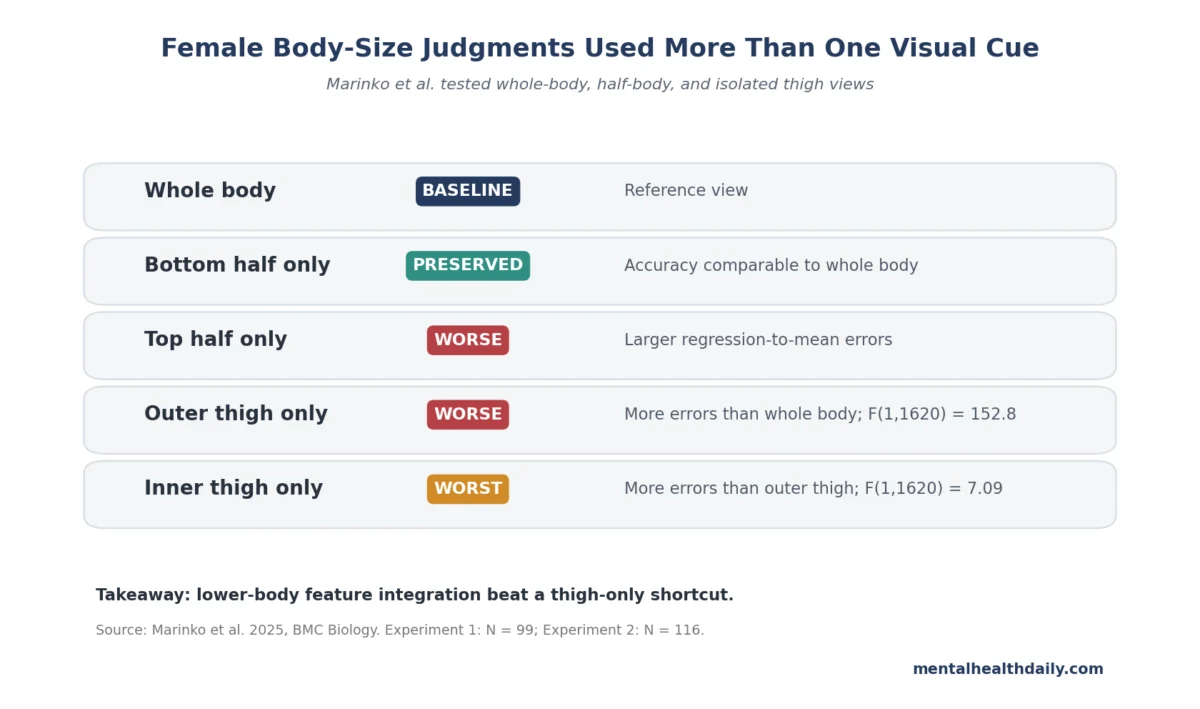
The initial experiment sought to determine whether a complete view of the body was essential for accurate size judgments or if partial views could suffice. Researchers presented 99 women (after an initial screening of 5 participants who could not reliably differentiate body-size categories) with images under three conditions: whole-body, top-half, and bottom-half views. Participants were tasked with categorizing these images across seven distinct body-size categories.
The results unequivocally demonstrated that participants were capable of clearly distinguishing between different size categories, a finding supported by strong statistical significance (F(2.48, 242.83) = 2164.72, p < 0.001). While the main effect of the view condition itself did not reach statistical significance (F(2, 196) = 2.74, p = 0.067), a crucial interaction between body size and view condition was observed (F(7.28, 713.32) = 37.99, p < 0.001). This interaction highlighted a key practical pattern: judgments made from bottom-half-only views were remarkably comparable in accuracy to those made from whole-body views. In stark contrast, top-half-only views led to substantially larger "regression-to-the-mean" errors, particularly evident at the extreme ends of the body-size spectrum—meaning very thin or very large bodies were incorrectly perceived as closer to an average size. This suggests that the lower body provides critical visual information for size assessment, enabling a more precise and less biased judgment across diverse body shapes.
Experiment 2: Isolated Cues Fall Short
Building on the insights from the first experiment, the researchers posed a more granular question: if the lower half provides sufficient information, can a single, isolated region within the lower body carry that same informational weight? To investigate this, Experiment 2 involved 116 women who compared whole-body viewing with isolated inner-thigh and outer-thigh views.
The answer was a resounding "no." Both isolated thigh-region conditions resulted in significantly poorer body-size judgments compared to whole-body viewing. Statistical analysis revealed that for regression-to-the-mean error, the outer-thigh comparison indicated a shallower slope and greater error (F(1, 1620) = 152.8, p < 0.001). The inner-thigh comparison similarly performed worse than whole-body viewing (F(1, 1620) = 262, p < 0.001). Furthermore, inner-thigh-only viewing performed marginally worse than outer-thigh-only viewing on this error metric (F(1, 1620) = 7.09, p = 0.008).
Beyond accuracy, the study also examined "serial dependence bias"—the phenomenon where a previous visual stimulus subtly influences the perception of the next. When only a single thigh region was visible, this bias broadened considerably. The estimated serial-dependence amplitude was 0.43 for whole-body viewing, increasing to 0.47 for outer-thigh viewing, and further to 0.64 for inner-thigh viewing. This indicates that without the full context of the lower body, participants were more susceptible to the carryover effect from previously viewed images, further compromising the independence and accuracy of their judgments.
Beyond Simple Views: The Concept of Lower-Body Feature Integration
The central finding of this study is the concept of "lower-body feature integration." This implies that the perceptual system does not rely on a single, isolated anatomical patch to estimate body size, but rather combines multiple visible cues from the lower body. While a bottom-half view provides enough rich information to accurately estimate size, stripping that view down to only one thigh region removes crucial contextual data that the visual system typically utilizes. This intricate process of combining cues is what allows for robust and accurate judgments.
This distinction is crucial, particularly in light of popular narratives that might misinterpret these findings as supporting a "thigh obsession" claim. The study does not suggest that people judge female body size simply by fixating on thighs. Instead, it carefully demonstrates that while bottom-half information is sufficient for accuracy, isolated thigh regions are not. This nuance underscores that the lower-body signal matters because it preserves complex visual structure—such as width, curvature, and overall shape—not because one isolated feature dictates the entire judgment.
Building on a Foundation: Prior Research and Evolving Perspectives
This latest research by Marinko et al. is not an isolated finding but rather builds upon a growing body of work that is refining our understanding of body-image perception. For decades, body-image disturbance has been recognized as a core feature of eating disorders. Early work, such as Cash and Deagle’s meta-analysis, solidified body-image disturbance as a measurable clinical feature across various eating-disorder populations, moving it beyond a vague personality complaint to a tangible symptom.
More contemporary measurement strategies have shifted from broad self-reported body dissatisfaction towards more objective visual mapping and perceptual markers. For instance, studies like Ralph-Nearman et al. have utilized digital body-image mapping in individuals with anorexia nervosa, reporting that visual disturbance measures correlate with illness severity. This evolution reflects a growing understanding that body-image disturbance is partly measurable through objective perceptual tasks, alongside subjective self-reports.
The current study by Marinko et al. aligns with a progressive research agenda focused on feature integration. A 2023 study by Irvine et al., for example, employed eye-tracking and visual masking to investigate which cues drive self-assessment of body size. Their research highlighted that where people fixate their gaze is not necessarily the same as the information their visual system ultimately uses for judgment. Observers might look centrally, but judgment accuracy often hinges on body-edge cues that define width and shape—information frequently abundant in the lower body.
Further preceding this, a 2024 study also by Marinko et al. explored whether internal body features contribute useful information beyond just the silhouette shape. That research demonstrated that removing internal features led to increased body-size judgment errors and altered serial-dependence patterns, arguing against a simplistic "outline-only" account of body perception.
The 2025 lower-body study adds a more specific and critical piece to this puzzle. It confirms that while full lower-body information can maintain accuracy, fragmenting that information into isolated pieces cannot. Collectively, this body of evidence strongly supports a feature-integration model, positing that body-size perception relies on multiple visual cues, and accuracy diminishes significantly when the visual input lacks sufficient structural context.
Implications for Clinical Practice and Future Research
While this study offers significant methodological and theoretical advancements, it is crucial to understand its scope and limitations. Marinko et al. did not use a clinical eating-disorder sample, and participants were judging standardized images of other female bodies, not their own. Therefore, the study does not directly prove that lower-body cue weighting causes eating disorders, nor does it serve as a clinical test.
However, its contribution to body-image research is profound. If body-size perception genuinely depends on integrated lower-body cues, then current clinical body-image measures—which often assume a global body outline captures the entire perceptual problem—may need significant refinement. The findings suggest that researchers and clinicians should move towards measuring precisely which visual cues people use and how these cues are integrated, rather than assuming that global dissatisfaction, gaze location, and perceptual accuracy are interchangeable constructs. Lower-body cue weighting, as identified in this study, may represent one measurable piece of this larger, intricate perceptual system.
Experts in the field suggest that these findings underscore the need for more nuanced assessment tools in eating disorder care. Translating these results into clinical practice requires future studies that directly investigate self-body perception in clinical populations, examine correlations with symptom severity, and assess treatment response. Judging standardized images under controlled conditions is fundamentally different from judging one’s own body under the immense pressures of anxiety, mirror exposure, social comparison, or restrictive-eating behaviors that characterize eating disorders.
The useful takeaway for researchers is primarily methodological: it supports better cue mapping, not the establishment of a new "body-focus rule." The lower-body signal was impactful because it preserved essential visual structure, not because any single, isolated feature could carry the entire judgment. This implies that future diagnostic or therapeutic approaches might benefit from considering how individuals integrate visual information from different body regions, potentially revealing specific perceptual biases that contribute to body-image disturbance.
Addressing the Limitations and Charting the Course Forward
This research, while robust, also highlights areas for future exploration. It does not definitively explain why bottom-half views performed better than top-half views, though the most probable explanation is that the lower body preserves more of the crucial visual width and shape information that participants use to infer overall body size. Top-half views likely lose enough relevant information that perceptions of thin and large bodies are more strongly pulled toward an average-size judgment.
Furthermore, the concept of "serial dependence"—the carryover effect from a previously seen image—was shown to be exacerbated when only isolated thigh regions were visible. This indicates that when the visual system is deprived of comprehensive information, it relies more heavily on recent perceptual experiences, leading to greater perceptual bias. Understanding how this phenomenon manifests in clinical populations could provide additional avenues for intervention.
Conclusion: A Sharper Lens on Body-Size Judgment
In conclusion, the study by Marinko et al. significantly sharpens the perceptual side of body-image research. It dismantles the notion that female body-size judgment is purely holistic or reducible to a single body part. Instead, it firmly establishes that accuracy depends on multiple lower-body cues working together in an integrated fashion. This robust evidence for lower-body feature integration provides a critical foundation for developing more sophisticated models of body-size perception, ultimately paving the way for more targeted and effective interventions for individuals grappling with body-image disturbance and eating disorders. The research community now has a clearer mandate to investigate these intricate perceptual processes, moving beyond superficial assessments to understand the true complexity of how we see and interpret the human form.

