


Hiroko Yoda, a writer, translator, and certified Shinto cultural historian, has spent the past decade immersing herself in the diverse spiritual tapestry of Japan. Her extensive research and personal experiences, which include serving as a Shinto shrine maiden, undertaking arduous pilgrimages with yamabushi (Shugendo practitioners), earning certification as a kimono fitter, and visiting Japan’s last living itako (spirit medium), have culminated in her new book, Eight Million Ways to Happiness: Wisdom for Inspiration and Healing from the Heart of Japan. This work, a compelling blend of memoir, history, and cultural analysis, offers an accessible and insightful exploration of contemporary Japanese religious life. It delves into phenomena such as hanshin-hangi ("belief without belief"), the intricate relationship between prayer and play, and the evolving roles of fortune tellers and the spiritual world.
The book’s genesis, as Yoda revealed in a recent interview, was deeply personal. The profound grief following her mother’s death served as a catalyst, compelling her to re-engage with Japan’s rich spiritual traditions as a means of reconstruction and healing. "My mother’s passing was so difficult," Yoda recounted. "It was just a massive blow, and I didn’t know what to do. I felt like my whole identity fell apart—I hadn’t realized how much I identified myself with my mother. It was almost like a reflection of the mirror. And then I lost her, and so I felt a sense of void and nothingness." This period of intense personal loss led Yoda to seek solace and understanding through movement and observation, a journey that ultimately revealed the pervasive presence of nature and its inherent kindness and capacity for change. "When my mother died, I felt like my identity was absolutely shattered. Through engaging with Japanese spiritual traditions, I began reconstructing my identity, and I began to heal. But the lessons that I received were not just for me alone—I wanted to share them with others."
The Concept of Yaoyorozu-no-Kami: An Infinite Spiritual Pantheon
The title of Yoda’s book is drawn from the Japanese concept of yaoyorozu-no-kami, which translates to "eight million spiritual beings." This phrase, far from denoting a precise numerical quantity, signifies an immeasurable and infinite number of spiritual entities. Historically, the Japanese worldview posited that everything in the surrounding environment possessed a spirit: the sun, the moon, trees, wind, soil, rocks, and even spoken words. While not all Japanese today necessarily adhere to the literal belief that every single object harbors a spirit for worship, this concept remains a foundational element of their cultural outlook.
"Kami is generally translated as ‘god,’ but the problem there is that it becomes skewed toward a Judeo-Christian worldview where there’s a hierarchy with a single god on top," Yoda explained. "But there are kami everywhere. There is a kami of plagues and a kami of toothaches. We don’t worship those kami, but it’s a quiet reminder that no matter how much we wish those bad things to disappear, they’re still part of our life, and we have to deal with them somehow." This understanding of kami transcends the confines of Shinto, extending to form the bedrock of Japanese culture. It embraces a decentralized, pervasive spirituality where the sacred is not confined to a singular, omnipotent deity but is interwoven into the fabric of existence.

A Syncretic Spirituality: Blurring the Lines Between Traditions
Japan’s religious landscape is characterized by a remarkable fluidity and syncretism, with Shinto, Buddhism, and Shugendo existing in a state of constant interplay and mutual influence. This blending is evident in the physical landscape, where shrines and temples, numbering over 200,000 nationwide—significantly more than the approximately 55,000 convenience stores—stand in close proximity, often within the same complexes. Most of these sacred sites are accessible to the public, provided visitors maintain a respectful demeanor.
Yoda highlights the Seven Gods of Happiness (Shichifukujin) as a prime example of this spiritual hybridity. This ensemble of deities draws from diverse origins, including Buddhist, Hindu, Daoist, and indigenous Japanese traditions. While each deity may be venerated in specific locales, during the New Year celebrations, they are often depicted together on a treasure ship, symbolizing good fortune and prosperity.
"In America, religion is often tied to identity, where changing from one faith to another is a big deal, but in Japan we don’t always see it that way," Yoda observed. "We don’t necessarily identify ourselves with religion in the same way. I think Japan is more rigid in society but more flexible in spirituality, whereas in America I think it’s more rigid in religion but more flexible in society." This flexibility allows for a pragmatic and inclusive approach to spirituality, where individuals may draw upon various traditions to find meaning and solace without the rigid adherence to a singular dogma.
Shugendo: The Way of Mountain Asceticism
Shugendo, Japan’s third major spiritual tradition, often remains less familiar to those outside the country. Yoda’s exploration of this practice, which centers on mountains as sacred realms, reveals its multifaceted nature. "Shugendo is a hybrid of many different beliefs including Shinto and Buddhism, and it centers on the mountains as a spiritual realm," she explained. "It can be hard to talk about, kind of like the parable of the blind men trying to describe an elephant: It’s different in different regions; it’s different in different time periods; it’s different from person to person."
The term do signifies "the way," akin to its usage in Shinto. Thus, Shugendo is not merely a religion but a comprehensive way of life. While full-time practitioners, known as yamabushi, are rare today, many individuals integrate Shugendo training into their lives alongside their secular professions. Yoda’s own immersion into this practice was almost serendipitous, stemming from a book that led her to a training site.
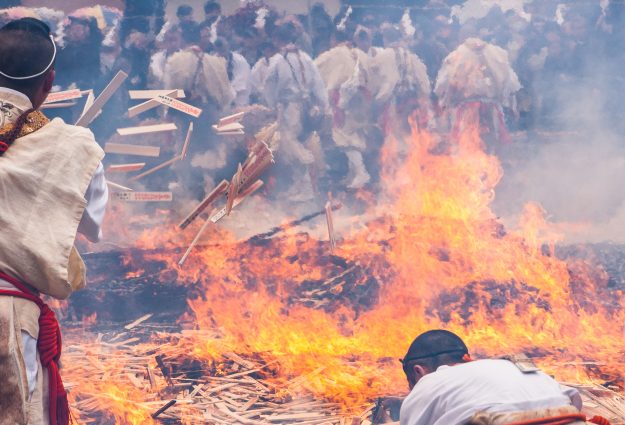
The profound connection between nature and spirituality is a cornerstone of Shugendo. With approximately 70% of Japan’s landmass comprised of mountains, these natural landscapes have long been considered spiritual domains. Yoda’s experience with yamabushi underscored the healing power of nature and the idea that the spiritual world is not distant but intimately close. "My takeaway from my time with the yamabushi is that nature can teach us and heal us, and Shugendo is one of the tools to do that," she stated.
The Lessons of Hardship and Surrender
The rigorous training undertaken by yamabushi, including practices like waterfall immersion and mountain running, is not merely a test of physical endurance but a profound spiritual discipline. These experiences cultivate humility, surrender, and a deep recognition of one’s place within a larger cosmic order. Ryojun Shionuma, a yamabushi who completed the demanding Thousand Days of Training, noted that the challenges of daily life often mirrored the difficulties faced in the mountains, suggesting that the lessons learned transcend the physical trials.
"The name yamabushi means ‘those who surrender to the mountains’," Yoda elaborated. "All the hardships of training teach you not only that nature can heal but also the importance of humility and surrender and recognizing that we’re part of something much larger. Surrender actually nourishes our sense of belonging." This sense of belonging, often diminished in urban environments, is powerfully reasserted through engagement with nature. For Yoda, hiking in the mountains provides a crucial counterbalance to the self-centered tendencies that can arise in city life, offering moments of reflection, healing, and connection.
The Itako: Mediators of Grief and Memory
Yoda’s journey also led her to meet Takiko Nakamura, recognized as the last traditional itako, or spirit medium. Historically, in rural Japan, particularly for girls who lost their sight, becoming an itako was a traditional means of livelihood, akin to a neighborhood counselor. While their role often involved communicating with the deceased, it extended to mediating disputes and offering guidance within the community.
The rarity of itako today is attributed to advancements in healthcare, which have reduced childhood blindness, and the proliferation of educational and vocational resources for the visually impaired. Nakamura, who learned her skills through oral tradition and memorization from a previous itako, represents a fading lineage of spiritual practice.

Yoda’s encounter with Nakamura was deeply impactful, particularly in her request for the medium to contact her deceased mother. "What I learned was that what she does is essentially grief care," Yoda shared. "When you lose someone very close to you, it’s easy to have all kinds of regrets: ‘I should have done this,’ ‘I should have done that,’ ‘Maybe I could have done things better.’" For Yoda, the interaction with Nakamura provided a form of closure and a powerful reminder that her mother’s presence continued within her. The message from her mother, conveyed through the itako, was to live life to its fullest, a sentiment that resonated deeply with Yoda, framing her existence as a baton passed from her mother.
The practice of the itako, Yoda noted, transcends mere belief or skepticism. "In some ways it doesn’t matter if it’s true or not. There are a lot of questions that can’t be answered just as black or white. The truth was that I missed my mother, and when I interacted with Takiko it was a form of grief care." Furthermore, the itako‘s practice itself exemplifies the hybrid nature of Japanese spirituality, incorporating elements of Shinto, Buddhism, Shugendo, and local beliefs about spirits and the afterlife. Nakamura’s altar, a testament to this syncretism, further underscored the blended nature of her spiritual work.
Lasting Impact and Universal Relevance
After more than a decade dedicated to researching and writing Eight Million Ways to Happiness, Yoda hopes her book will foster a deeper understanding of Japanese spirituality. However, she aspires for its impact to be even broader. "Japanese spirituality is radically inclusive, and it’s very flexible," she stated. "So if readers can find a spiritual tool and then borrow it or apply it to their own life to help them find happiness and healing in some way, small or large, I’ll be very happy."
The concept of "eight million" implies boundless possibilities and constant room for growth. Yoda’s personal journey of healing through spiritual exploration has led her to believe that there is a path for everyone. "Even though the book is published, I don’t feel like it’s the end," she concluded. "I feel like I’m on the starting point—there’s always room for more." This sentiment reflects the enduring and evolving nature of spirituality, a continuous exploration for meaning, connection, and ultimately, happiness.

