

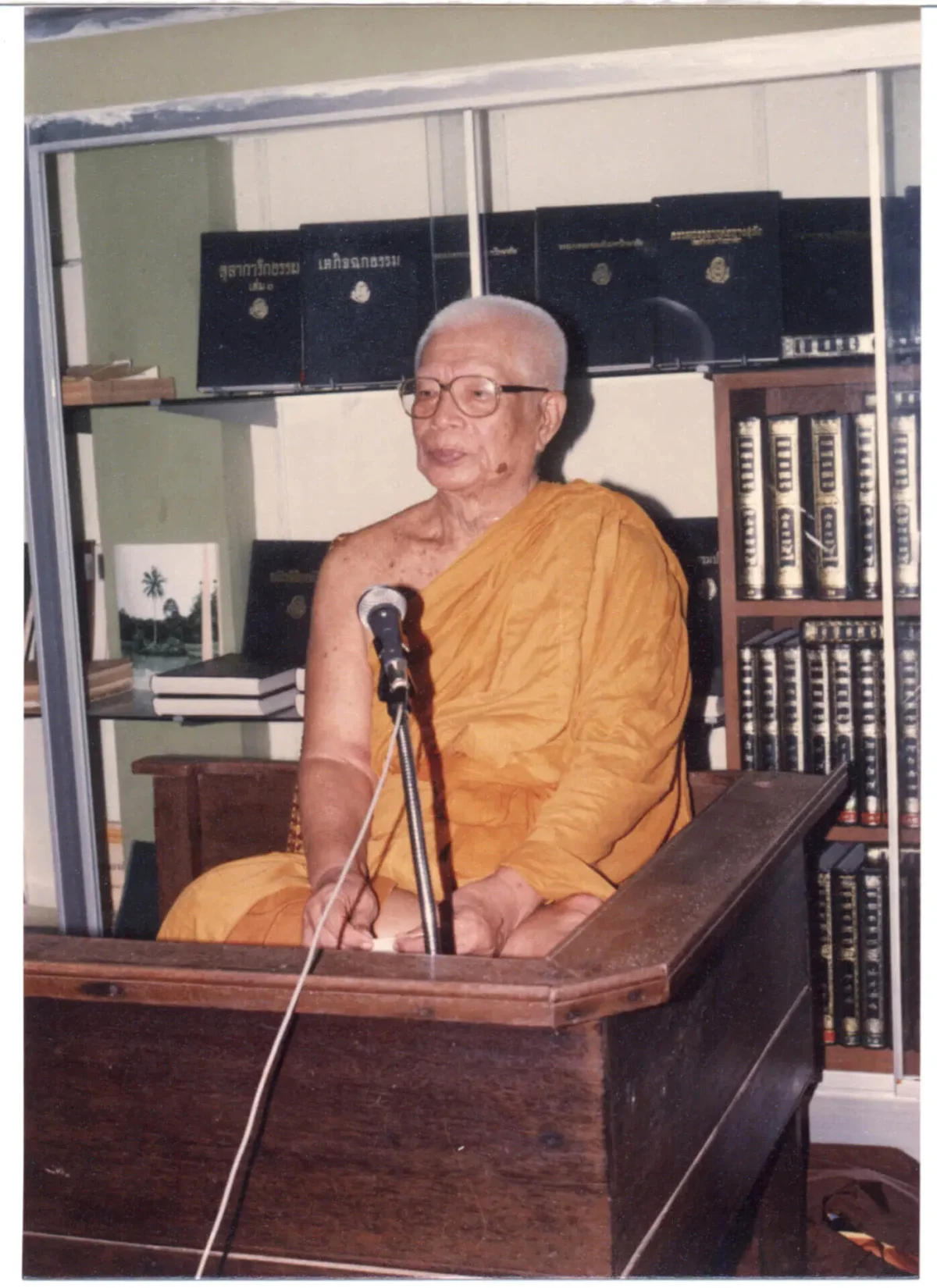
In 1965, a lecture delivered by the influential Thai forest monk and scholar Buddhadasa Bhikkhu at the Buddhist Association of Thailand ignited a firestorm. His assertion that the abhidhamma—a foundational body of canonical doctrine crucial to the monastic training of the assembled scholars—was not the direct teaching of the Buddha but a later scholastic construction, was met with shock and disbelief. For many present, this was a heretical claim, one that struck at the very heart of their understanding of Buddhist scripture. This challenge, however, was not an anomaly but a hallmark of Buddhadasa’s lifelong engagement with institutional Buddhism, a stance that cemented his position as one of the 20th century’s most polarizing and transformative figures in Thailand.
Born Ngueam Phanit in 1906 in the southern province of Phatthalung, Buddhadasa embarked on his monastic path at the age of 20, joining the Maha Nikaya, Thailand’s largest Theravada Buddhist order, in Bangkok. Yet, the rigidly hierarchical and ritualistic culture he encountered soon led to profound dissatisfaction. In 1932, seeking a more direct and contemplative approach to the Dharma, he returned to his native region to establish Suan Mokkh (the Garden of Liberation), a forest monastery dedicated to meditation practice and a simpler way of life. This marked the genesis of his reformist movement, which would ripple through Thai society for decades.
Buddhadasa’s reformist interpretations began to reach a wider audience the following year, with the launch of his quarterly journal, Buddhism. Through its pages, he systematically deconstructed long-held doctrines. A prime example was his reinterpretation of nibbana (Pali; Skt.: nirvana). Instead of portraying it as an ultimate, distant goal reserved for accomplished monastics, Buddhadasa argued that nibbana was an immediate and accessible state, present in the natural cooling of reactive emotions. Similarly, he questioned traditional cosmological narratives and the concept of rebirth, asserting that the value of any teaching lay in its capacity to address suffering in the here and now, rather than in abstract, future-oriented promises. This pragmatic, existential focus resonated with many seeking spiritual solace in a rapidly changing world.
The traditional understanding in Thailand generally posited a distinct and often hierarchical separation between Theravada and Mahayana Buddhist traditions. Buddhadasa, however, drew inspiration from both, a syncretic approach that further fueled controversy. His emphasis on chit wang, or "empty mind," was particularly contentious due to its perceived association with East Asian meditation schools. The intensity of these debates was such that one of his students felt compelled to publish a booklet titled What is Right? What is Wrong? to map the competing viewpoints. For Buddhadasa, however, these sectarian disputes were ultimately a distraction from the core spiritual insight, which he believed transcended all religious categories. He famously articulated this in a booklet that argued for "no religion" as the ultimate spiritual stance, suggesting that rigid adherence to dogma obscured the path to liberation.
Buddhadasa’s intellectual journey unfolded against a backdrop of significant political and social upheaval in Thailand. He witnessed military coups, periods of intense economic instability, the rise of military nationalism, and the pervasive pressures of the Cold War. Rather than retreating from these complex realities, he engaged them directly, meeting with intellectuals from across the political spectrum. Beginning in the 1960s, he championed the concept of "Dhammic Socialism," a vision for a society grounded in moral restraint and shared ethical principles, an alternative to the ideological competition that characterized the era. This socio-political engagement demonstrated his belief that spiritual principles should inform the organization of society and the conduct of its citizens.
In the later years of his life, Buddhadasa turned his attention to fostering women’s participation in Buddhist practice. The bhikkhuni (fully ordained female monastic) order had been officially forbidden in Thailand since the 1928 Sangha Act. Rather than directly confronting this legal prohibition, Buddhadasa proposed Dhammamata, or "Dhamma Mothers," a novel form of committed religious life for women. This initiative skillfully tapped into Thai cultural reverence for motherhood, offering a recognized and respected path for women seeking spiritual commitment within a Buddhist framework. This was a testament to his innovative approach to addressing institutional limitations through culturally sensitive solutions.
The significance of Buddhadasa’s life and work was recognized internationally. In 1990, on his 84th birthday, scholars and practitioners from around the globe contributed to Radical Conservatism, a commemorative volume. The title itself encapsulated the central paradox of his career: a monk of immense discipline and deep adherence to the dharma who arrived at interpretations that appeared revolutionary to the established Thai Buddhist order. This acknowledgment underscored his unique position as a bridge between tradition and reform.
Buddhadasa passed away in 1993, his death mourned across Thailand. His extensive writings remain widely accessible, and the legacy of Suan Mokkh continues to thrive as a center for meditation and contemplative practice. The following teachings, translated from Thai, offer a glimpse into the profound interpretations that defined his career and, for many, continued to challenge conventional Buddhist thought:

Teaching 1: Nibbana – The Immediate Coolness
In Thailand, nibbana had often been understood as a state of ultimate liberation attained only at death, a concept seemingly remote from the daily struggles of life. However, in his pamphlet Nibbana for Everyone, Buddhadasa offered a radical redefinition, presenting nibbana not as a far-off destination, but as an immediate and accessible coolness. He posited that this state of coolness, the natural subsiding of reactive emotions, was available to anyone, in any moment, irrespective of their spiritual attainment or life circumstances.
"Nibbana has nothing in the least to do with death," Buddhadasa explained. "’Nibbana’ means coolness. It meant coolness back when it was just an ordinary word that people used in their homes, and when used as dhamma language, in a religious context, it still means coolness. In dhamma language, it refers to the cooling or going out of the fires of defilement (‘kilesas,’ reactive emotions), while in ordinary people’s usage, it means the cooling of physical fires.
Any reactive emotion that arises, ceases when its causes and conditions are finished. Although it may be a temporary quenching, merely a temporary coolness, it is still nibbana, even if only momentarily. Thus, there’s a temporary nibbana for those who can’t yet avoid some defilements. It is this temporary nibbana that sustains the lives of beings who continue hanging on to defilement. Anyone can see that if the egoistic emotions existed night and day without any pause or rest, no life could endure it. If such life didn’t die, it would go crazy and then die in the end. You ought to consider carefully the fact that life can survive only because there are periods when the defilements don’t roast it. These periods outnumber the times when the defilements blaze.
These periodic ‘nibbānas’ sustain life for all of us, without excepting even animals, which have their levels of nibbana too. We are able to survive because this kind of nibbana nurtures us, until it becomes the most ordinary habit of life and of mind. Whenever there is freedom from defilement, then there is the value and meaning of nibbana. This must occur fairly often for living things to survive. That we have some time to relax both bodily and mentally provides us with the freshness and vitality needed to live."
This interpretation shifted the focus from a future reward to an immediate, experiential reality, making the teachings of the Buddha relevant to the everyday anxieties and stresses of modern life. It empowered individuals to recognize and cultivate moments of inner peace amidst their daily challenges, demystifying a concept often perceived as esoteric and unattainable.
Teaching 2: The Freed Mind – Beyond Emptiness
A common misinterpretation of chit wang, or the "empty mind," suggested a state devoid of all thought and feeling, akin to an inert object. In a passage from his writings, Buddhadasa clarified that the luminous mind, when free from hindrances, is not blank but actively engaged, albeit without the distorting lens of self-conception. He argued that the mind, in its original state, still thinks and feels, but it does so without the possessive notions of "me" and "mine."
"We need to understand that the ‘normal’ mind—the mind when there’s nothing interfering with it, when it’s without the nivaranas (the hindrances), without the kilesas (the defilements)—is ‘luminous.’ At such times, it could be called the ‘original mind,’ as it was in the womb.
The luminous, original mind still thinks and feels, too, but without the defilements. It’s naturally clean and unblemished and can think and feel in the way that is natural to it.
So the free or void mind can arise in different ways: void because of samadhi, void through vipassana, or void because it’s returned to its original state quite naturally. However, it needs to be said that the samadhi mind—the void mind fixed on an object of samadhi—still feels, so it’s not that there isn’t any thinking. At that time, there will still be feeling, so there will be some form of thinking too. The mind that is void through the power of vipassana considers, investigates, penetrates, and intuits into the reality of things, so it isn’t ‘void’ in the way that a stone, for instance, would be. The luminous, original mind still thinks and feels, too, but without the defilements. It’s naturally clean and unblemished and can think and feel in the way that is natural to it. The Pali word for ‘mind’ means ‘think,’ so if the mind can’t think, then it isn’t really a mind at all. Thus, ‘void’ here doesn’t mean that there’s no thought or feeling. It means void, or free of the sort of feeling and thinking that causes trouble, that brings upset. After all, who likes trouble and strife? The troubled mind can be compared to a fire, in that it’s hot in the way of being tense and unbalanced. Now, who likes that? Who likes stress and tension, trouble and strife, unhappiness, and depression? Nobody at all! That stress, trouble, and depression is a ‘me’ and ‘mine’ affair, and when ‘me’ and ‘mine’ are gone, then there is the ‘normal’ mind, mind without stress, without depression. This mind we call ‘void,’ but it’s not void in the same way that a stone would be. The normal mind is contented, cool, a useful mind, and, better still, it’s able to understand everything deeply."
This teaching emphasized the active, aware, and luminous quality of a mind freed from ego-driven afflictions, contrasting it with a passive or non-existent state. It provided a more nuanced understanding of mental liberation, highlighting its inherent dynamism and capacity for profound insight.
Teaching 3: Birth – The Instantaneous Mental Rebirth
The Pali scriptures describe four types of birth, with the fourth, opapatika (spontaneous birth), typically understood as the arising of supernatural beings like gods or hell-beings between lives. Buddhadasa, however, stripped this concept of its cosmological framing, reinterpreting opapatika as a continuous, mental phenomenon occurring in the present moment. For him, the mind is constantly "reborn" in each moment, adopting new identities that reflect its current mode of perception and thought.
"A fourth kind of birth is called ‘opapatika,’ which is a kind of ‘hidden birth,’ one that doesn’t need the help of a father or mother, and refers to one arisen in an already full-grown, mature condition without having had to grow up from childhood. This is known as opapatika (spontaneously arisen). There are two explanations for this word. Most commonly it’s taken to mean the birth of a supernatural being, like an angel, a god, or a peta (hungry ghost), a hell-being, or whatever. Leaving this world, one goes to be born as a god, or whatever, without having to dwell in the mother’s womb beforehand, without having to be born and go through the maturing process.
However, here we don’t explain it like that. We take it to mean birth in the mental sense, that is, there is thinking, concocting whatever way which gives rise to a ‘mental birth.’
In this understanding there’s no need for death to intervene, no need for anyone to die and then be born. Further, if the thinking is base, low thinking, for instance one is thinking like a bandit, then one is mentally ‘born’ as a bandit right there and then, while still in the same human body. So think like a robber and be born as one; think like a god and be born as a god yet while still in a human body. To achieve birth as a Brahma god, develop the mind of a Brahma, that is, concentrate it in samadhi and be immediately born as a Brahma god, and all without having had to bother with death. If mind is samadhi, then one has already been born as a Brahma.
Which of these understandings would be useful? Think about it: that in which one needs to die first and then get born as a god, a hell-being, a Brahma, or something or other in another very distant world, or the instant, mental kind of birth, where one thinks in a certain manner and however one thinks, one is born accordingly, right there and then.
The second option is frightening because it happens easily and often, yet it’s the better choice in that it’s controllable. We can restrain mind, that is, not let it think in such a way that it takes a low birth as a bad person, a robber, or anything like that. Rather, have it think in an elevated manner and be born as a good person, a wise person, or a noble one. This kind of birth is important."
This reinterpretation of birth emphasized personal agency and the immediate consequences of one’s thoughts and intentions. It suggested that liberation and spiritual advancement were not dependent on external circumstances or future rebirths, but on the continuous cultivation of one’s mind in the present moment. This perspective offered a powerful framework for ethical responsibility and self-transformation, making Buddhist teachings directly applicable to the challenges of contemporary existence.
Buddhadasa’s legacy is that of a profound spiritual innovator who, while deeply rooted in the Buddhist tradition, possessed the courage to question established norms and reinterpret ancient doctrines for a modern audience. His work continues to inspire those seeking a more direct, accessible, and relevant path to spiritual awakening, a testament to the enduring power of his radical conservatism.

