

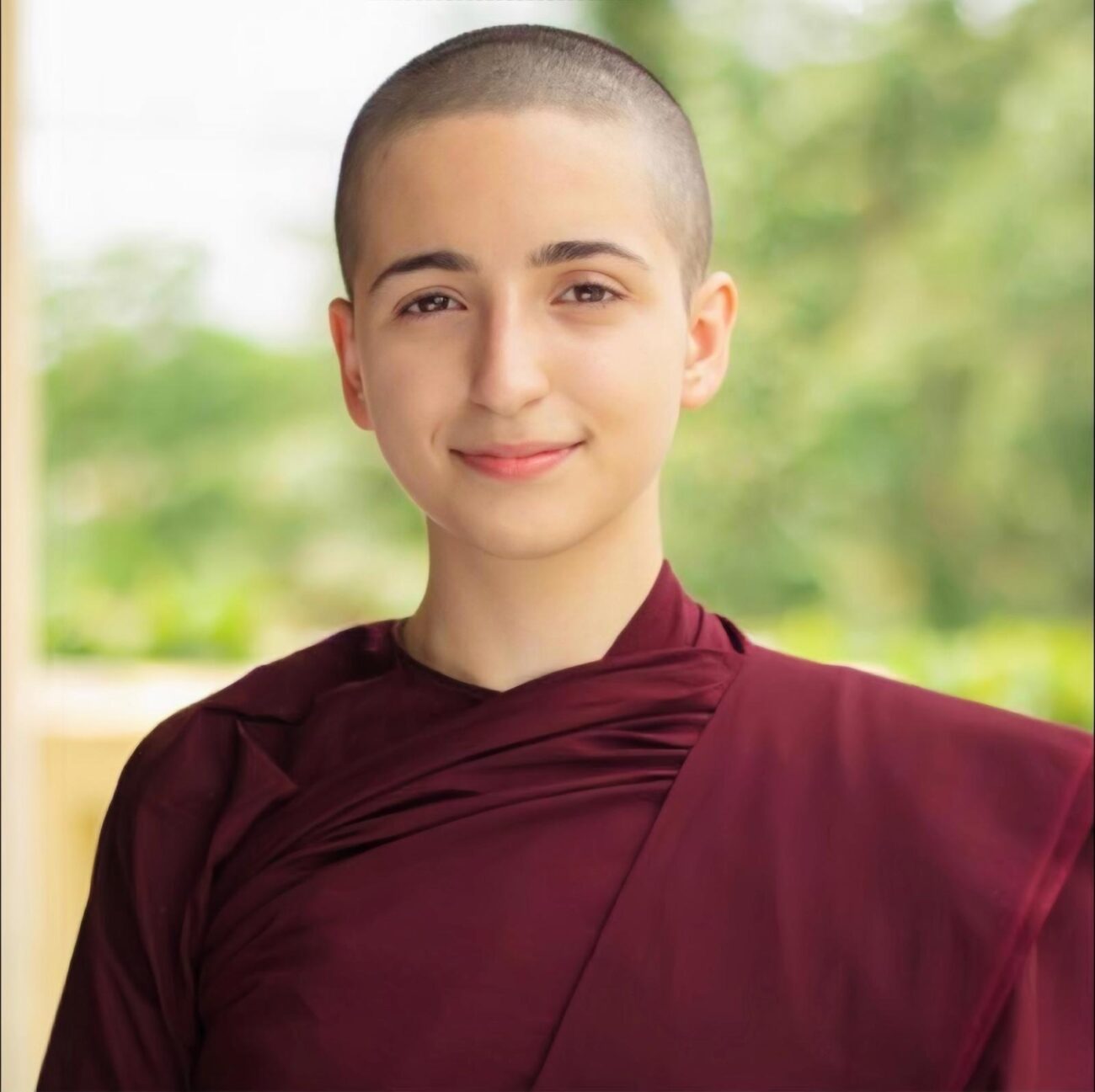
Venerable Gotami, born Martina in southern Italy in 1999, embarked on a spiritual path that defied her Catholic upbringing and challenging childhood. Now a Theravada novice nun, she has emerged as a significant voice sharing Buddhist teachings, known as the Dhamma, with a global audience, particularly young people. Her journey, marked by profound personal transformation and a deep connection to Asian spiritual traditions, culminated in her ordination in 2022. She communicates in five languages—English, Italian, Sinhala, Spanish, and Mandarin Chinese—and leverages social media platforms to reach over 300,000 followers across Facebook, TikTok, and YouTube. Her forthcoming spiritual autobiography, "Gotami: A Life Rewritten by the Dhamma," promises to offer further insight into her remarkable life.
A Childhood Drawn Eastward
Gotami’s early life in southern Italy was characterized by instability and difficulty. Raised in a Catholic family, Buddhism was not a part of her cultural landscape. Yet, from a young age, she experienced an inexplicable and powerful draw towards Asian spiritual worlds. Her dreams were filled with images of monks, temples, and distant lands, a premonition of a path yet undiscovered. This innate yearning persisted, a quiet undercurrent in her formative years.
"Even as a child, I felt a deep attraction to the East," Venerable Gotami shared. "I used to dream of monks, temples, and places I had never seen. Even today, when someone mentions Sri Lanka or Nepal, I feel emotionally moved in a way that’s hard to explain." This profound, almost intuitive connection to Eastern spirituality predated any concrete understanding of Buddhism.
The Unforeseen Encounter
Despite living in Catania, a city that housed a Sri Lankan Buddhist temple in close proximity to her home, Gotami remained unaware of its presence during her youth. The discovery of this spiritual sanctuary was almost accidental, occurring in her late teens. She learned that a high school teacher regularly visited the temple. "I couldn’t believe it—it was just minutes away," she recalled. At the age of 19 or 20, she visited the temple for the first time.
The experience was transformative. "From the very first visit, it felt like coming home," she stated. It wasn’t just the teachings that resonated; the Buddhist community itself felt immediately familiar and welcoming. This marked the beginning of her deep engagement with the Dhamma. She began attending regularly on weekends, immersing herself in the teachings of the monks, participating in dhamma school, and learning about meditation, forgiveness, metta (loving-kindness), compassion, and the intricacies of the human mind. What had once been abstract concepts began to solidify into tangible practices and profound insights.
Personal Transformation Amidst Adversity
Gotami’s engagement with Buddhism coincided with a period of significant personal struggle. Her childhood was marked by a difficult family situation, including her mother’s mental illness and her father’s absence. From a young age, she bore the responsibility of working to support herself. This environment fostered anger, resentment, insecurity, and a pervasive sense of being lost. Her academic path was also fraught with challenges, leading to multiple failures in school.
"When I started going to the temple, the monks gave me tools I had never had before," she explained. The teachings on awareness, meditation, and forgiveness provided a framework for understanding and processing her emotional landscape. Crucially, the emphasis on replacing hatred with compassion offered a radical shift in perspective. Learning about the nature of the mind – how thoughts arise and dissipate – was a revelation.
"I honestly don’t know where I would be if I hadn’t encountered Buddhism. It didn’t just help me a little—it rewrote my life," Venerable Gotami affirmed. For her, Buddhism transcended mere religion; it encompassed the community, the Sangha, and a profound sense of belonging that she had previously lacked. This spiritual grounding proved to be a lifeline, saving her from what she describes as a path of despair.
The Aspiration for Ordination
Witnessing the profound impact the monks had on the community, particularly in alleviating mental, emotional, and psychological suffering, inspired a deep desire within Gotami to contribute similarly. "I felt a strong wish to give something back. I wanted to help others in the same way they had helped me," she said. This desire gradually coalesced into the aspiration for monastic ordination.
However, Gotami’s perspective on ordination differed from a sense of renunciation as loss. "Renunciation implies giving something up with a sense of loss. I didn’t experience it that way at all," she clarified. She never felt a strong inclination towards traditional family life or marriage. Instead, becoming a nun felt like a return to her "natural state," an alignment with her innermost being.
While the idea of ordination had been present for some time, she initially contemplated pursuing it later in life, after fulfilling societal expectations of a "normal" life. However, the persistent aspiration daily fueled her resolve. "If my mind already felt ready for monastic life, why postpone it?" she questioned, a sentiment that underscores her commitment to living authentically in the present moment.
A Journey to Ordination: Myanmar and the United States
Venerable Gotami’s path to full ordination involved significant international travel and personal sacrifice. In 2022, she undertook a temporary ordination in Myanmar, a common practice there. This decision was made amidst the backdrop of a civil war, a fact she concealed from her mother to avoid causing undue distress. Looking back, she described this period as "intense and challenging," a testament to the difficulties she navigated.
Following her time in Myanmar, she traveled to the United States, where she encountered her teacher, Venerable Ashin Nayaka. Their meeting, described as almost serendipitous, revealed an immediate and profound spiritual connection. It was under his guidance that she made the definitive decision to ordain. In 2022, she formally took her vows, marking the beginning of her service as a nun and her intensified work with young people.
Reconciling with Family
The revelation of her decision to ordain was initially met with significant emotional distress by her mother. "At first, it was extremely painful for her," Venerable Gotami recounted. Her mother experienced tears, fear, and a profound sense of loss, given the already tumultuous journey they had shared. The concept of her daughter choosing a monastic life was a profound shock.
However, with the passage of time, her mother began to comprehend Gotami’s path. A significant turning point was her meeting with Venerable Ashin Nayaka. Today, their relationship is described as beautiful. This spiritual journey, Gotami observes, has not only transformed her but has also profoundly impacted her mother. Her mother has shared that the experience has compelled her to directly confront impermanence and uncertainty, leading to her own form of spiritual growth.
Bridging the Dhamma and the Digital Age
Venerable Gotami has gained considerable recognition for her adeptness in disseminating the Dhamma to young people, particularly through social media. Her engagement began even before her ordination, with weekly live talks discussing Buddhist scriptures in English. This initiative attracted an audience, especially from Sri Lanka and Myanmar.
She believes her relatability as a young spiritual figure is key to her success. "I think young people are more open to listening to someone close to their own age," she stated. "If I were much older, my story might not resonate in the same way. Being young myself, I can show that transformation is possible now, not only later in life." This contemporary approach makes the ancient teachings accessible and relevant to a generation often grappling with existential questions and digital saturation.
Her social media presence is substantial: over 97,000 followers on Facebook, 200,000 on TikTok, and 30,000 subscribers on YouTube. These platforms serve as vital conduits for sharing Buddhist philosophy, mindfulness practices, and personal reflections, fostering a global online community.
"Gotami: A Life Rewritten by the Dhamma"
The decision to pen her autobiography, "Gotami: A Life Rewritten by the Dhamma," stems from a desire to offer solace and guidance to others, especially young individuals who feel disillusioned or lost. The book promises an unvarnished account of her childhood experiences, her struggles with anger and failure, and the profound ways in which Buddhism has reshaped her existence.
"One of the most important things I learned is that thoughts do not define who we are," she emphasized. "They are phenomena that arise and pass away." Having once believed she was a "lost cause," her understanding of how to engage with her mind fundamentally altered her trajectory. The book aims to share this empowering realization, illustrating that profound change is within reach for anyone.
The Legacy of Mahaprajapati Gotami
Venerable Gotami’s monastic name, Gotami, is a direct homage to Mahaprajapati Gotami, the first woman to seek and receive ordination from the Buddha. For Venerable Gotami, Mahaprajapati Gotami embodies immense courage and leadership. She recounts the historical act of Mahaprajapati Gotami walking hundreds of kilometers barefoot with 500 women to petition the Buddha for ordination. This event is seen as a groundbreaking moment, a precursor to modern movements for equality.
"In many ways, it was the first march for women’s rights," Venerable Gotami observed. The enduring legacy of Mahaprajapati Gotami continues to inspire women to assert themselves, unite, and claim their rightful place within the spiritual landscape.
The Evolving Role of Women in Buddhism
While acknowledging the progress made, Venerable Gotami addresses the persistent challenges and forms of discrimination faced by female monastics. She advocates for actively transcending these limitations and fostering more inclusive environments. "We need to reclaim our own power," she asserts. Her perspective challenges traditional notions of femininity in spiritual contexts, suggesting that "silence is not always a virtue" and that women are not confined to being solely "sweet, quiet, and obedient." She champions the integration of strength and resilience within feminine spiritual expression.
Guidance for Aspiring Monastics and Practitioners
Venerable Gotami frequently receives inquiries from young people contemplating ordination and spiritual life. Her counsel is grounded in a pragmatic understanding of the monastic path. She cautions against pursuing ordination as an escape from pain or unresolved issues. "You only bring your unresolved issues with you," she states. Ordination, in her view, should stem from clarity, joy, and a genuine aspiration for the spiritual path, rather than from fear or a desire to flee difficulties.
She also emphasizes that monastic life is not inherently superior to lay practice. "Most people are meant to live as lay practitioners, and that is completely fine," she clarifies. "Monastic life isn’t better—it’s simply different." The paramount importance lies in self-honesty and living authentically according to one’s own path.
A Core Message of Truth and Balance
For young people today, Venerable Gotami offers a core message of living truthfully and courageously. She encourages them to forge their own paths, unburdened by parental fears or societal expectations. A life grounded in ethics, courage, and an open heart, she believes, is attainable.
Specifically for young women, she imparts a message of empowerment and integration: "You don’t have to choose between softness and strength. You can be both." This balance, she concludes, is fundamental to the spiritual journey and embodies the essence of the Dhamma’s transformative power. Her story serves as a powerful testament to the universal appeal and profound efficacy of the Buddhist path, transcending cultural and geographical boundaries to offer hope and transformation to individuals worldwide.

