

A recent clinic study involving 157 adolescents in Turkey has rigorously validated a Turkish version of the UCLA PTSD Reaction Index (PTSD-RI-5), a widely utilized questionnaire for assessing post-traumatic stress disorder (PTSD) in children and teenagers. The study, conducted by Ince et al. at a children’s hospital in Izmir, demonstrated that the translated instrument effectively differentiated between trauma-exposed adolescents diagnosed with and without PTSD. Furthermore, the research revealed a clear correlation between higher scores on the Turkish PTSD-RI-5 and increased functional impairments across various aspects of a young person’s life, including home, school, and peer relationships, as well as overall developmental progress. This critical validation marks a significant step forward in enhancing the accuracy and cultural appropriateness of mental health screening tools for adolescents in Turkey, a region where youth may be particularly vulnerable to traumatic experiences.
Understanding Post-Traumatic Stress Disorder in Youth
Post-traumatic stress disorder is a complex and debilitating mental health condition that can develop following exposure to a terrifying or profoundly harmful event. While commonly associated with adults, PTSD can significantly affect children and adolescents, manifesting as a persistent pattern of distressing symptoms. These symptoms often include unwanted, intrusive memories or flashbacks of the trauma, active avoidance of reminders related to the event, a pervasive negative mood, feelings of detachment, and heightened arousal or reactivity, such as irritability, difficulty concentrating, or an exaggerated startle response.
Globally, a substantial number of children and teens experience traumatic events, ranging from natural disasters and accidents to interpersonal violence, abuse, and exposure to conflict. While many exhibit resilience and do not develop PTSD, a significant minority do, underscoring the critical need for effective screening and diagnostic tools. The manifestations of PTSD in young people can differ from adults, often presenting with more behavioral issues, difficulty regulating emotions, or somatic complaints, which can complicate diagnosis without specialized instruments. Untreated PTSD in adolescents can lead to long-term academic struggles, social isolation, increased risk of substance abuse, and heightened vulnerability to other mental health conditions, including depression and anxiety disorders.
The UCLA PTSD Reaction Index: A Global Standard Adapted for Turkey
The UCLA PTSD Reaction Index for DSM-5 (PTSD-RI-5) stands as one of the most extensively used and well-regarded questionnaires for measuring PTSD symptoms in young populations worldwide. Its utility lies in its ability to systematically capture the spectrum of symptoms defined by the Diagnostic and Statistical Manual of Mental Disorders, Fifth Edition (DSM-5). The questionnaire is structured into three primary parts, designed to assess the presence and severity of symptoms across the core DSM-5 symptom clusters:
- Intrusion (B): Involuntary distressing memories, nightmares, flashbacks, and psychological distress or physiological reactions to trauma cues.
- Avoidance (C): Efforts to avoid distressing memories, thoughts, feelings, or external reminders of the trauma.
- Negative Alterations in Cognitions and Mood (D): Persistent inability to experience positive emotions, diminished interest in activities, feelings of detachment, negative beliefs about oneself or the world, and self-blame.
- Alterations in Arousal and Reactivity (E): Irritable behavior, exaggerated startle response, difficulty concentrating, sleep disturbance, and hypervigilance.
In addition to these core symptom groups, the PTSD-RI-5 includes four supplementary items specifically designed to cover dissociation, a phenomenon where individuals experience a sense of detachment from themselves, their thoughts, feelings, memories, or surroundings. Dissociation is increasingly recognized as a significant component of trauma response, particularly in complex or prolonged trauma exposure.
The original US validation of the PTSD-RI-5 established its efficacy in distinguishing between youth with and without a formal PTSD diagnosis when compared against structured diagnostic interviews. This foundational work also yielded a commonly adopted clinical guideline: a total score of 35 or higher on the questionnaire often suggests that a young person likely meets the full criteria for PTSD, prompting further clinical evaluation. The significance of such a validated tool cannot be overstated, as it provides clinicians with a reliable, standardized method to screen for, assess the severity of, and monitor treatment outcomes for PTSD in vulnerable populations.
Rigorous Validation for the Turkish Context: The Izmir Study
Recognizing the critical need for culturally and linguistically appropriate mental health assessment tools, researchers led by Ince et al. embarked on a comprehensive validation study of the PTSD-RI-5 for Turkish adolescents. The study, conducted at a prominent children’s hospital in Izmir, Turkey, spanned from October 2023 to August 2024. The methodology employed was meticulous, adhering to international best practices for cross-cultural adaptation of psychological instruments.
The initial phase involved a detailed translation of the original English questionnaire into Turkish. To ensure semantic and conceptual equivalence, this was followed by a rigorous back-translation into English by an independent team. This iterative process aimed to identify and resolve any discrepancies in meaning, nuance, or cultural context that might arise from direct translation. Subsequently, a draft of the Turkish version was piloted with 10 patients to gather preliminary feedback on clarity, comprehensibility, and cultural relevance before its finalization. This step is crucial for ensuring that the language resonates with the target population and accurately reflects their experiences.
The study sample comprised 157 adolescents, aged 11 to 17 years, who were seeking services at the hospital’s child and adolescent psychiatry clinic. A key inclusion criterion was that all participants had experienced at least one traumatic event, ensuring the study focused on a population for whom PTSD assessment is clinically relevant. This approach allowed the researchers to evaluate the instrument’s ability to differentiate between those who developed PTSD post-trauma and those who did not.
To establish a definitive diagnosis against which the PTSD-RI-5 scores could be benchmarked, clinicians used the PTSD section of the Kiddie Schedule for Affective Disorders and Schizophrenia (K-SADS). The K-SADS is widely considered a "gold standard" structured psychiatric interview for children and adolescents, known for its high reliability and validity in diagnosing a range of mental disorders. Through this rigorous diagnostic process, the study identified 88 adolescents who met the criteria for PTSD and 69 who did not. This clear stratification of the sample was essential for assessing the PTSD-RI-5’s diagnostic accuracy.
Beyond symptom measurement, the researchers also assessed the adolescents’ daily functioning. At the conclusion of each interview, a clinician completed questions related to impairment in the home, school, and peer environments, as well as developmental progress. Any rating indicating an issue beyond "none" was counted as an impairment in that specific area, providing a holistic view of the impact of trauma and PTSD on the adolescents’ lives.
Key Findings: Differentiating PTSD in Turkish Adolescents
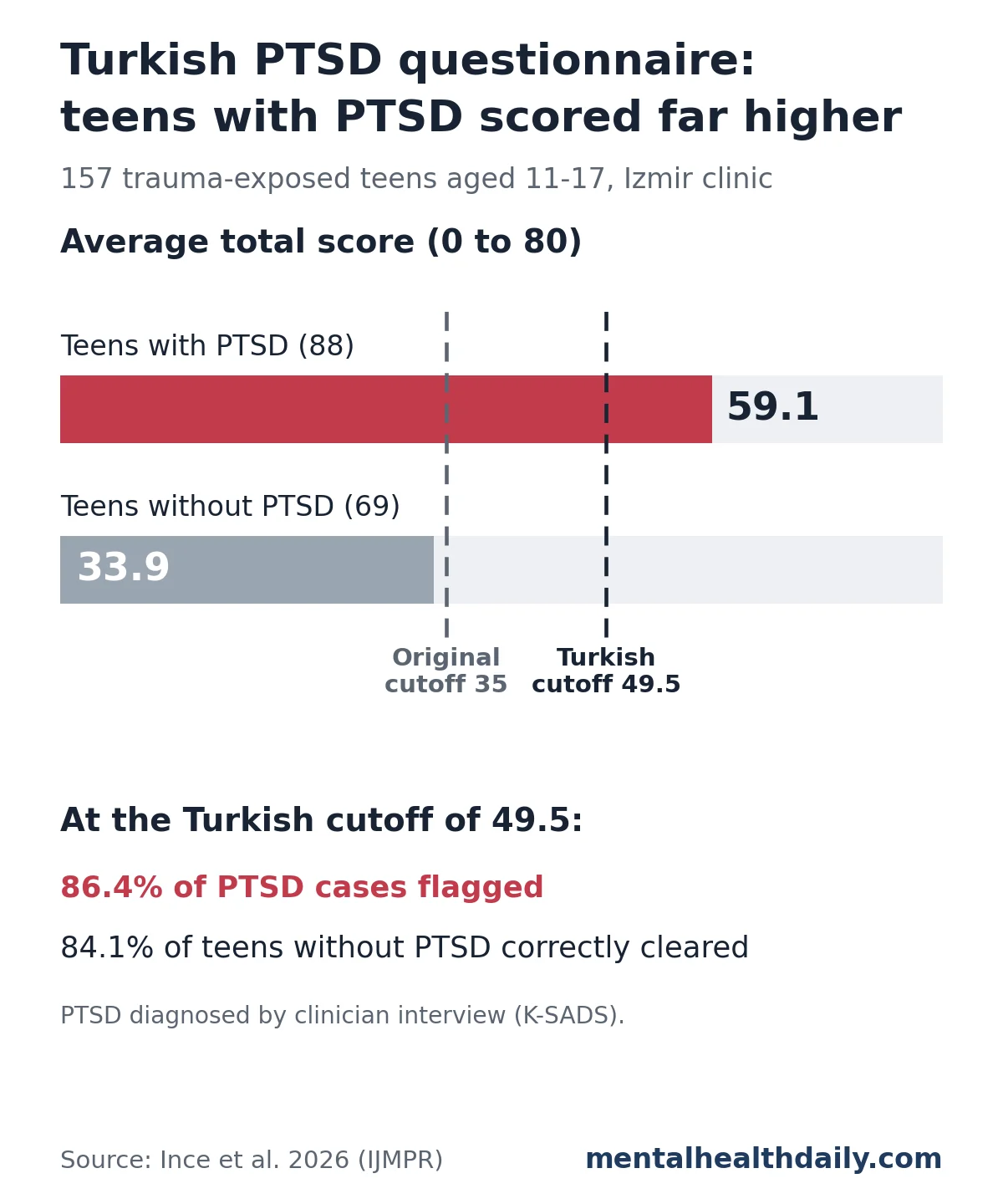
The validation study yielded compelling evidence of the Turkish PTSD-RI-5’s effectiveness. A significant difference was observed in the average total scores between the two groups: adolescents diagnosed with PTSD scored an average of 59.1 out of a possible 80 points, whereas those without PTSD scored 33.9. This represented a substantial gap of 25.2 points (with a 95% confidence interval ranging from 20.8 to 29.6), indicating a clear distinction in symptom severity as captured by the questionnaire.
To quantitatively assess the instrument’s ability to discriminate between the groups, an ROC (Receiver Operating Characteristic) analysis was performed. This statistical technique evaluates how well a diagnostic test can distinguish between two groups (in this case, with and without PTSD) across all possible cutoff scores. The area under the curve (AUC) for the Turkish PTSD-RI-5 was calculated at an impressive 0.909. In ROC analysis, an AUC of 0.5 suggests a test is no better than a random guess (like a coin flip), while an AUC of 1.0 signifies perfect discrimination. An AUC of 0.909 therefore demonstrates excellent diagnostic accuracy, positioning the Turkish PTSD-RI-5 as a highly reliable screening tool.
Establishing a Culturally Appropriate Cutoff
A crucial aspect of validating any screening tool for a new population is determining the optimal cutoff score. While the original US validation suggested a cutoff of 35, the Izmir study found that a score of 49.5 or higher provided the best balance for identifying PTSD in Turkish adolescents. At this new cutoff, the questionnaire achieved a sensitivity of 86.4%, meaning it correctly identified 86.4% of adolescents who actually had PTSD. Concurrently, it demonstrated a specificity of 84.1%, accurately clearing 84.1% of those who did not have the disorder. This balance between correctly identifying cases and correctly ruling them out is paramount for a clinically useful screening tool.
The researchers explicitly cautioned against using the original cutoff of 35 for Turkish adolescents, as it could potentially lead to an over-labeling of individuals as likely having PTSD. This finding underscores the importance of local validation studies; cultural nuances in symptom expression, reporting styles, or even different prevalence rates of trauma types can necessitate adjustments to established cutoffs. An earlier Turkish clinic study involving 208 children and teens also found high accuracy (AUC 0.94 in a subset of 64 children with diagnostic interviews) but reported a high sensitivity of 96% with a lower specificity of 75% at the 35 cutoff, further supporting the need for a re-evaluated threshold.
Interestingly, the study also explored a "symptom-rule method" for scoring the questionnaire, aligning with DSM-5 criteria rather than relying on a single total cutoff score. This method also showed robust performance, catching 80.6% of PTSD cases and correctly clearing 78.2% of teens without PTSD. While slightly less precise than the optimal cutoff score method, it offers an alternative approach for clinicians. Both the Izmir team and prior researchers emphasize that while the PTSD-RI-5 is an excellent screening and severity measure, a definitive diagnosis of PTSD must always rest on a comprehensive clinical evaluation, ideally incorporating a structured diagnostic interview like the K-SADS.
Psychometric Robustness: Reliability and Structural Integrity
Beyond its diagnostic accuracy, a robust psychological instrument must demonstrate strong psychometric properties. The Turkish PTSD-RI-5 performed well across several key measures:
- Internal Consistency: This refers to the extent to which items within a scale measure the same underlying construct. The study found high internal consistency (Cronbach’s alpha ranging from 0.774 to 0.931) for most symptom groups. The avoidance symptom group had a slightly lower alpha of 0.651, which the researchers attributed, in part, to this group having only two items, a factor that can statistically influence alpha values.
- Two-Week Retest Reliability: To assess the stability of scores over time, 30 adolescents repeated the questionnaire after two weeks. The total scores showed fair stability (Intraclass Correlation Coefficient, ICC = 0.707, where 1.0 indicates perfect identical scores). Stability was good to excellent for avoidance, negative mood, and arousal symptom clusters. However, it was only moderate for intrusion (ICC = 0.483) and dissociation (ICC = 0.436). The researchers offered a nuanced explanation for this, suggesting that intrusion symptoms like nightmares and flashbacks might naturally fluctuate more in response to recent reminders or triggers, and dissociation can also vary depending on current stress levels. They advised clinicians to focus on changes in total and group scores rather than individual item fluctuations.
- Agreement with Other Measures (Convergent Validity): The total scores on the Turkish PTSD-RI-5 correlated strongly with a separate, established PTSD severity scale (Spearman’s ρ = 0.750), demonstrating good convergent validity – meaning it measures what it’s supposed to measure in agreement with other similar instruments. Similarly, the dissociation items within the PTSD-RI-5 correlated moderately with a separate dissociation scale (ρ = 0.547), further supporting its ability to capture this specific aspect of trauma response.
- Structure (Factor Analysis): The study also examined the underlying structure of the questionnaire. A 5-factor model, encompassing the four DSM-5 symptom groups (intrusion, avoidance, negative thoughts and mood, and arousal and reactivity) plus dissociation, was found to fit the data well across most standard indices. This provides empirical support for the conceptual framework of the PTSD-RI-5 in the Turkish population.
Beyond Diagnosis: Linking PTSD Scores to Functional Impairment
One of the most impactful findings of the Izmir study was the strong link between higher PTSD scores and significant functional impairment in the adolescents’ daily lives. The researchers quantified this by showing that each 1-point increase in the total PTSD-RI-5 score was associated with higher odds of impairment across all four assessed areas: home, school, peer relationships, and development. To make this more tangible, scaling to a 10-point difference in total score revealed the following increases in the odds of impairment:
- Home problems: Odds increased by approximately 2.3 times.
- School problems: Odds increased by approximately 1.9 times.
- Peer problems: Odds increased by approximately 1.7 times.
- Developmental problems: Odds increased by approximately 1.5 times.
Further analysis delved into which specific symptom groups contributed most to these impairments. The study found that:
- Negative thoughts and mood, and arousal and reactivity symptoms were significantly linked to problems across all four domains (home, school, peers, and development). These symptoms, such as persistent negative beliefs, emotional numbing, irritability, and difficulty concentrating, profoundly disrupt a young person’s ability to engage with their environment and maintain healthy relationships.
- Intrusion symptoms were particularly associated with difficulties at home and school. Flashbacks and intrusive memories can make it hard for adolescents to focus in class or feel safe and comfortable in their home environment.
- Avoidance symptoms were specifically linked to problems at home in the Turkish sample. This finding is particularly noteworthy as it differs from a large-scale study of 3,400 Norwegian and 747 US youth aged 7 to 17, where avoidance was not specifically highlighted in relation to home problems. This discrepancy might suggest cultural differences in how avoidance manifests within family contexts or how family members interact with an adolescent’s avoidance behaviors in Turkey.
- Dissociation symptoms were not independently linked to any specific area of impairment in this study, though they remain a crucial aspect of trauma response.
The overall pattern of impairment linked to negative beliefs, emotional numbing, loss of interest, and concentration problems is consistent with previous research, highlighting the broad and pervasive impact of these core PTSD symptoms on adolescent functioning.
Critical Comorbidity: Self-Harm and Depression
The study also shed light on the high rates of comorbidity between PTSD and other severe mental health conditions in the adolescent population. Self-harm behaviors were reported by a concerning 15.9% (14 out of 88) of teens diagnosed with PTSD, compared to none of the 69 teens without PTSD. Similarly, major depressive disorder was significantly more prevalent in the PTSD group, affecting 42.0% of these adolescents, compared to only 4.3% in the non-PTSD group.
These statistics underscore the severe psychological distress experienced by adolescents with PTSD and highlight the urgent need for comprehensive mental health assessments that screen for co-occurring conditions. The presence of self-harm and major depression substantially increases the complexity of treatment and the risk of adverse outcomes, including suicide. Therefore, early identification and integrated care are paramount for these vulnerable youth. In light of these findings, it is crucial to reiterate the availability of crisis support: in the US, individuals or teens contemplating self-harm or suicide can reach out to the 988 Suicide & Crisis Lifeline; internationally, local emergency services or crisis hotlines should be contacted immediately.
Implications for Clinical Practice and Public Health in Turkey
The validation of the Turkish PTSD-RI-5 represents a significant advancement for child and adolescent mental health services in Turkey. For clinicians working in psychiatry clinics, this instrument provides a robust and well-supported method for measuring PTSD symptoms in trauma-exposed adolescents aged 11 to 17. The establishment of a new, culturally appropriate cutoff score of 49.5 or higher offers a more accurate screening threshold, signaling a strong need for a full PTSD evaluation. This tailored cutoff helps avoid both under-identification and over-diagnosis, which can have profound implications for resource allocation and patient care. The researchers’ warning against using the original 35 cutoff in this population is a critical piece of guidance that will inform clinical decision-making.
Beyond diagnosis, the study’s findings on functional impairment linked to higher scores provide clinicians with valuable information for treatment planning. Understanding that adolescents with elevated total scores, and particularly higher negative-mood and arousal scores, are more likely to be struggling at home, school, and with peers allows for more targeted interventions. For instance, therapeutic approaches might need to address specific school-related stressors or family dynamics influenced by avoidance behaviors.
From a broader public health perspective, the availability of a validated screening tool like the Turkish PTSD-RI-5 can facilitate more widespread and systematic screening efforts, especially in areas prone to trauma such as conflict zones or regions affected by natural disasters. This can lead to earlier identification of at-risk youth, enabling timely access to mental health support and potentially mitigating the long-term consequences of untreated PTSD. Training for mental health professionals on the effective use and interpretation of this new tool will be essential for its successful integration into routine clinical practice.
Addressing Limitations and Charting Future Research
While the Izmir study offers crucial insights, the researchers acknowledge several limitations that warrant consideration and point towards future research directions.
- Single-Center Study: The data was collected from a single children’s hospital in Izmir. This limits the generalizability of the findings to the broader Turkish adolescent population, particularly those in rural areas or different socioeconomic strata. Future studies should aim for multi-center designs across various regions of Turkey to enhance external validity.
- Specific Trauma Types: The study included adolescents with at least one traumatic experience but did not delve into the specific types of trauma (e.g., natural disaster, interpersonal violence, chronic abuse) or their frequency. Different trauma types might differentially impact symptom presentation and functional impairment, suggesting a need for more granular analysis in future research.
- Cross-Sectional Design: The study was cross-sectional, providing a snapshot in time. Longitudinal studies would be valuable to track symptom trajectories, assess the stability of the diagnosis, and evaluate the long-term predictive validity of the PTSD-RI-5 scores, especially regarding functional outcomes.
- Sample Size: While 157 participants provided robust data for this initial validation, larger sample sizes would strengthen the statistical power and refine the optimal cutoff score with even greater precision.
- Lack of Follow-up for Stability: While a two-week retest provided some insight into reliability, longer-term follow-up could further assess the stability of symptom clusters and the tool’s utility in monitoring treatment progress over extended periods.
These limitations do not diminish the significance of the current findings but rather provide a roadmap for continued research to further refine and broaden the application of the Turkish PTSD-RI-5.
Conclusion
The validation of the Turkish version of the UCLA PTSD Reaction Index (PTSD-RI-5) marks a critical milestone in child and adolescent mental health in Turkey. The study by Ince et al. not only confirms the instrument’s high accuracy in distinguishing between trauma-exposed adolescents with and without PTSD but also establishes a culturally appropriate cutoff score of 49.5, significantly enhancing its utility for clinical practice. The strong correlations between higher PTSD scores and pervasive impairments in home, school, and social functioning, along with the increased risk of self-harm and depression, underscore the profound impact of this disorder on young lives. This validated tool will empower clinicians in Turkey to more effectively screen, assess, and intervene, ultimately contributing to improved mental health outcomes for vulnerable adolescents. It is a testament to rigorous scientific inquiry aimed at addressing pressing public health needs, paving the way for more informed and compassionate care for young people recovering from trauma.

