

A groundbreaking 2026 interview study, conducted in October and November 2025, at a Japanese psychiatric hospital has shed light on a profound cultural shift: patients began actively requesting the care they desired, and staff responded in kind. This transformation, centered around peer support workers helping patients craft their own crisis plans, was not spontaneous. Researchers identified that this significant change in ward dynamics materialized only when three critical conditions were simultaneously present, challenging conventional notions of psychiatric care in a system often characterized by institutionalization and control.
Japan’s Unique Psychiatric Landscape: A Context for Change
Japan’s mental healthcare system stands out globally, reportedly holding the highest number of psychiatric beds per person among OECD countries. This high bed count is accompanied by alarmingly long average inpatient stays, often exceeding 260 days. For decades, international and domestic observers have voiced significant concerns regarding the prevalence of physical restraint within these facilities and the overall coercive nature of care. This context makes any positive shift towards patient autonomy particularly noteworthy.
The researchers, Ebihara et al., highlighted two systemic features perpetuating coercive care in Japan. Firstly, a pervasive culture of risk aversion, encapsulated by one head nurse’s telling quote: "The standard excuse for not acting is: ‘Who’s going to take responsibility for that?’" This deeply ingrained mentality often prevents staff from deviating from established, albeit restrictive, practices, fearing professional repercussions for any adverse outcomes. Secondly, the traditional model positions clinicians as the sole authorities in treatment planning, effectively stripping patients of their agency. In this environment, any innovation that empowers patients to dictate their own care represents a radical departure. The study posits that the very rigidity of this system made it an ideal, albeit challenging, test case for the efficacy of peer-led crisis planning.
Understanding Peer-Led Crisis Plans: Empowering Patient Voices
At its core, a crisis plan is a proactive document designed to empower individuals with serious mental illness. Written by the person themselves while they are feeling well, it details crucial information: early warning signs of a mental health crisis, what specific interventions or environments are helpful, what is unhelpful or even detrimental, and crucially, how they wish to be treated if they become unwell. This concept evolved from two foundational frameworks: the Wellness Recovery Action Plan (WRAP), a structured self-management and recovery program developed by individuals with lived experience, and psychiatric advance directives, legal instruments that grant patients a say in their future treatment decisions.
However, the original article points out a significant practical challenge: despite being conceived as a patient-authored document, crisis plans in practice often become clinician-driven. Instead of a testament to individual rights and preferences, they frequently devolve into a "symptom-management checklist" primarily focused on mitigating clinical risk from the institution’s perspective. This co-option effectively undermines the very principle of patient autonomy that the plan is designed to uphold.
This is where peer support workers become indispensable. These individuals are hired specifically because they possess invaluable lived experience of psychiatric illness and treatment themselves. Following comprehensive training, they are uniquely positioned to support others navigating similar challenges. In the context of a peer-led crisis plan, their role is transformative: they guide and assist the patient in articulating their plan in their own words, ensuring that the patient, rather than the clinician, remains the true author. This subtle yet powerful shift fundamentally alters the dynamic, re-centering the patient’s voice and agency.
The 2026 Study: Unveiling the Mechanisms of Change
The qualitative interview study involved 13 participants, including nurses, managers, and peer workers, across two single-specialty psychiatric hospitals in Japan. The interviews, averaging 44 minutes each, were conducted with a focus on understanding the lived experiences and perceptions of those directly involved in patient care. The research team employed a rigorous methodological approach, first coding the interviews from the ground up using a grounded theory approach – allowing themes to emerge directly from the data without preconceived notions. Subsequently, these emergent themes were re-sorted and analyzed using a realist framework. This framework is particularly insightful for policy and practice, as it systematically asks: "what worked, for whom, and under what conditions?" Each finding was meticulously framed as a combination of context, the specific mechanism that initiated change, and the resulting outcome. This methodical approach allowed the researchers to move beyond simply observing change to understanding how and why it occurred.
Three Pillars of Transformation: Conditions for Ward-Wide Change
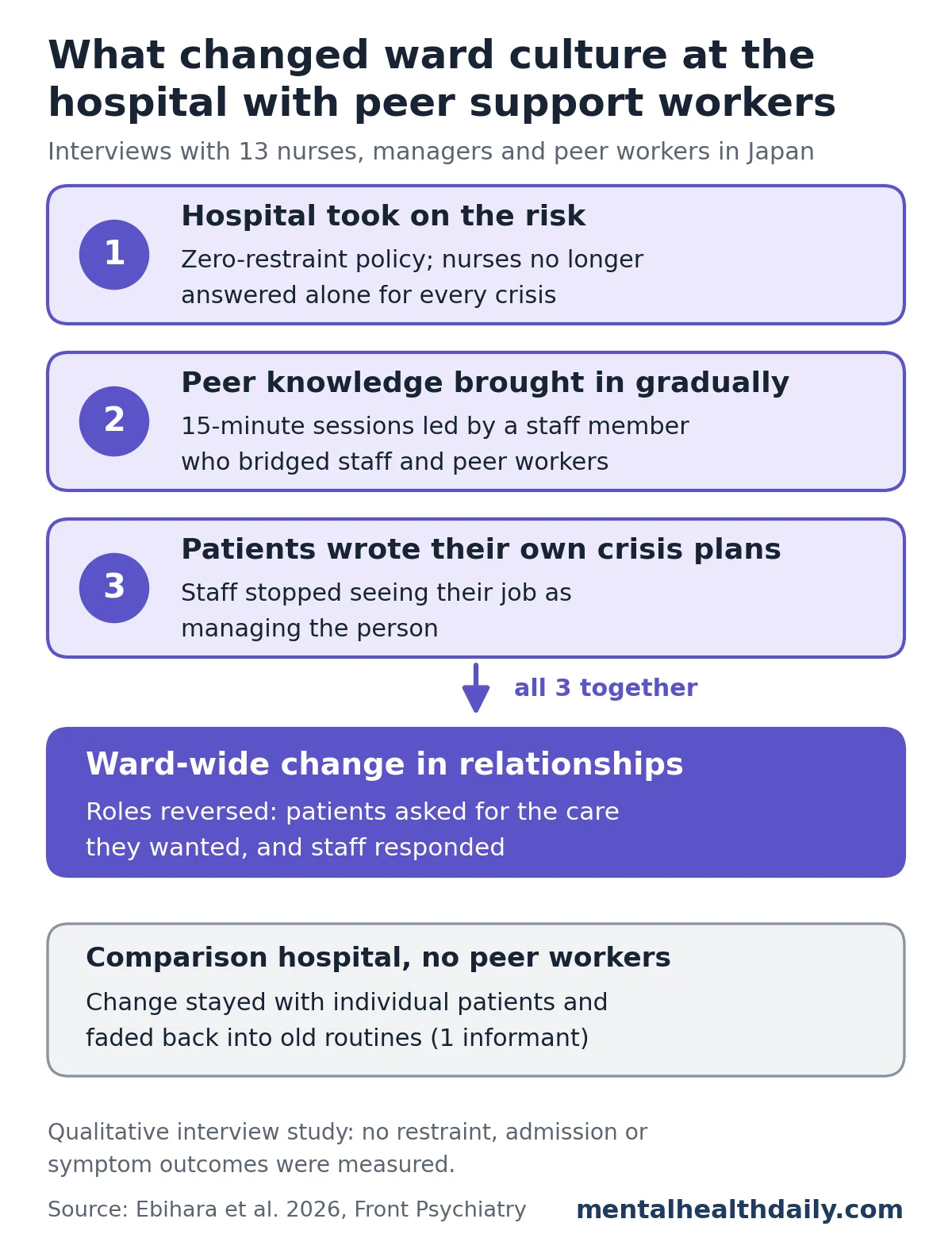
The analysis from the main hospital, where significant ward-wide transformation was observed, identified three interconnected mechanisms that operated synergistically:
-
Institutional Embrace of Clinical Risk through a Zero-Restraint Policy: This was perhaps the most audacious and foundational shift. The hospital explicitly took on greater clinical risk by implementing a zero-restraint policy. In a system historically reliant on physical restraint and deeply risk-averse, this decision signaled a profound institutional commitment to patient-centered care and a willingness to challenge established norms. It communicated to both staff and patients that the institution was serious about reducing coercive practices and prioritizing dignity. This policy shift forced staff to find alternative, more humane ways to manage distress and agitated behaviors, thereby fostering a more creative and patient-responsive environment. It required a re-evaluation of safety protocols and a trust in the potential for non-coercive approaches.
-
Gradual Integration of Peer Knowledge and Experience: The second crucial condition involved the systematic and gradual introduction of peer knowledge. This wasn’t a sudden overhaul but a carefully managed process. Peer support workers facilitated 15-minute sessions, often led by a "bridging staff member" who could effectively translate between the peer and clinical perspectives. These sessions provided invaluable insights into the patient experience, offering practical strategies and fostering empathy among clinical staff. This gradual integration allowed the existing staff to absorb new perspectives without feeling threatened or overwhelmed, building trust and understanding over time. It normalized the idea that lived experience was a legitimate and essential form of expertise.
-
Patient Authorship and a Redefined Staff Role: The third mechanism involved a fundamental redefinition of roles. As patients were genuinely empowered to write their own crisis plans, a subtle but powerful shift occurred among staff. They began to stop perceiving their primary job as "managing the person" – a paternalistic and controlling approach – and instead embraced a role of support and responsiveness. This meant moving away from an assumption of knowing what was best for the patient and towards actively listening, facilitating, and respecting patient choices. The crisis plan became a concrete tool that facilitated this shift, providing a clear articulation of patient preferences that staff could then refer to and act upon.
The researchers’ visual pathway diagram effectively illustrates that ward-wide change in relationships, characterized by patients asking for care and staff responding, only occurred when all three conditions were operating in concert. In its absence, as seen in the comparison hospital, changes remained individualized and often faded.
The Transformed Ward: A Culture of Empowerment
The impact of these combined conditions was tangible and profound. Nurses described a unit where patients enjoyed greater freedom of movement. Simple amenities, previously restricted, like a vending machine, and the ability for patients to keep their phone charging cables, symbolized a significant loosening of institutional control and a greater trust in patients’ self-management. While these were staff impressions and not quantitatively measured rates, two nurses reported a significant decrease in agitation episodes, suggesting that a more empowering and less restrictive environment may lead to reduced distress.
The study’s central and most compelling outcome was a "reversal of roles." Prior to the intervention, care was largely something "done to the patient." After patients handed over their self-authored crisis plans, the dynamic shifted dramatically: patients began to articulate their needs and desires, and psychiatrists and other staff responded as facilitators rather than directors. The lead peer support worker eloquently captured this transformation: "If you filmed it with a silent camera, you would see the same scene. But the subject had changed." Another poignant reflection from the same interview, "[The crisis plan] gave me back the pen," perfectly encapsulates the restoration of agency and control to the patient.
Peer workers also played a vital role in preventing the new practices from losing their authenticity and becoming another set of rigid rules. They identified a phenomenon they termed shiensha-shū, or "the odor of the helper" – a wariness felt by someone with lived experience when a plan, despite being written in participatory language, subtly carries the clinician’s underlying logic. The researchers argue that maintaining this healthy tension, rather than seeking to resolve it, is crucial. It acts as a continuous check against the co-option of patient-centered initiatives by the very system they aim to transform, ensuring that the new practice remains genuinely patient-led and dynamic.
The Comparison: Individual Gains vs. Systemic Change
The study also included a comparison hospital, where the day-care chief was acutely aware of the same systemic problems: the burden of individual risk placed on clinicians and the prevalence of clinician-written plans. However, without the simultaneous implementation of the three mechanisms identified in the main hospital, crisis plans, while beneficial for individual patients, failed to embed themselves into the broader hospital culture.
The chief described two illustrative cases. One patient successfully built a fuller life around his crisis plan, only to be transferred due to physical disability to a care facility where his plan held no formal recognition, effectively nullifying his gains. Another patient partially achieved two of his three goals – work and a lasting relationship – demonstrating individual progress but not systemic change within the hospital. It is important to note, as the researchers explicitly state, that these accounts came from a single informant and could not be independently verified. They serve as compelling illustrations rather than conclusive evidence, highlighting the vulnerability of individual progress when not supported by an enabling organizational environment.
Broader Evidence and Implications for Practice
This Japanese study provides invaluable qualitative insights into how organizational change happens, complementing quantitative evidence from randomized controlled trials (RCTs). While RCTs typically measure whether crisis planning changes outcomes, the Japanese interviews explain why those outcomes might vary. The existing body of evidence from crisis plan trials is largely positive, indicating that crisis plans can indeed improve outcomes for individuals. However, the Japanese study strongly suggests that a crisis plan’s impact is significantly diminished when the organizational context surrounding it does not actively support and integrate it. This highlights a crucial gap in understanding: simply introducing a tool is not enough; the environment must be conducive to its success.
Limitations and Future Directions
The researchers are transparent about the inherent limitations of their study design. As a qualitative interview study with a small sample size (13 participants across two hospitals), its findings are not generalizable to all psychiatric settings. The study focused on understanding mechanisms and perceptions rather than measuring hard outcomes such such as restraint rates, admission rates, or symptom reduction. It offers a detailed exploration of a specific context in Japan, making direct replication in vastly different cultural or healthcare systems challenging without careful adaptation.
Despite these limitations, the study offers powerful, actionable insights for psychiatric hospitals globally. The researchers propose four tentative, yet robust, conditions for making peer-led crisis plans sustainable and effective:
- Senior Leadership Commitment: Explicit commitment from senior leadership is paramount. This signals institutional backing, allocates necessary resources, and provides a top-down mandate for cultural change, overcoming resistance and the "responsibility culture."
- Explicit Risk-Taking: Hospitals must be willing to explicitly take on clinical risk. This involves challenging traditional risk-averse practices, such as routine restraint, and fostering an environment where innovation and patient autonomy are prioritized over perceived safety at all costs.
- Comprehensive Staff Training: All staff, from nurses to psychiatrists and administrators, require training not just on the mechanics of crisis plans, but on the philosophical underpinnings of patient empowerment, the role of peer support, and how to respond to patient requests rather than dictate care.
- Integration of Peer Workers: Peer support workers must be fully integrated into the care team, not merely as an add-on. Their unique lived experience must be valued, respected, and utilized to bridge communication gaps and ensure that patient voices remain central to care planning.
For patients and their families, the overarching message from this study is one of profound empowerment: a crisis plan is fundamentally meant to be authored by the person who may experience the crisis. Peer support workers emerge as crucial allies in making this authorship a reality, ensuring that individuals retain control over their mental health journey even during times of vulnerability. This study offers a compelling blueprint for transforming psychiatric care from a system of control to one of genuine collaboration and respect.

