


The profound wisdom of Buddhist teachings, particularly those articulated by the Venerable Thich Nhat Hanh, offers a powerful antidote to the pervasive anxieties of modern life. At its core lies the revolutionary concept of engaging fully with the present moment, not as a passive observer but as an active participant in the unfolding tapestry of existence. This principle, deeply rooted in ancient scriptures like the Avatamsaka Sutra, asserts that true peace, joy, liberation, and even Buddhahood are not distant aspirations but immediate realities accessible right here, right now.
The Impermanence of Time and the Steadfastness of Now
The conventional understanding of time as a linear progression—a relentless march from past to future—is challenged by Buddhist philosophy. The Avatamsaka Sutra, a foundational text in Mahayana Buddhism, posits a radical interdependence of time and space. Time is not merely a measure of duration but is intrinsically woven into the fabric of space, and vice versa. This concept is illustrated by the simple observation that while spring graces one hemisphere, winter grips the other. The temporal experience of "spring" is inseparable from the spatial reality of a particular location on Earth. This insight underscores the interconnectedness of all phenomena, a recurring theme in Buddhist thought.
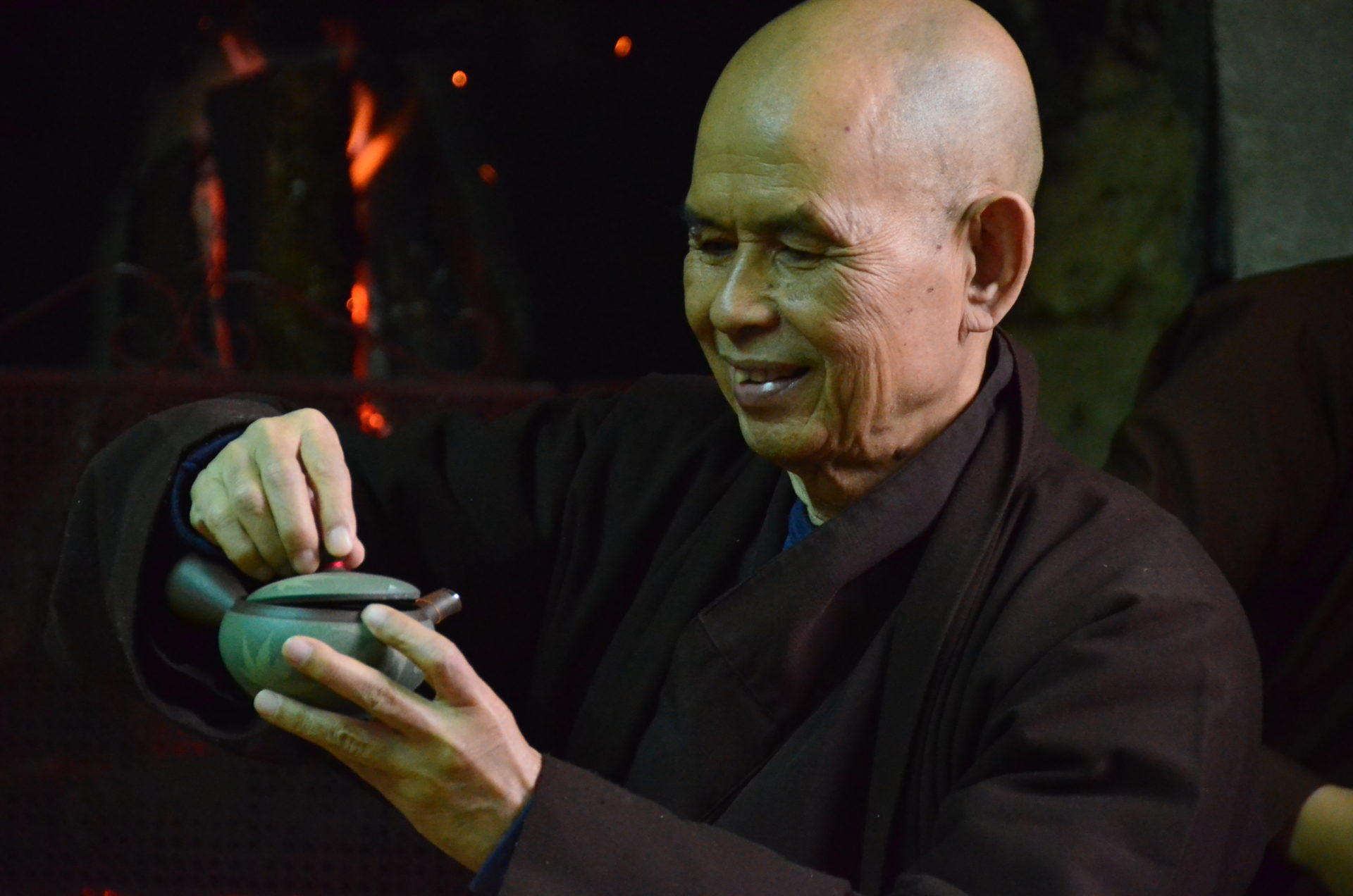
In practice, this understanding is cultivated through mindful engagement. A simple tea meditation, as described by Thich Nhat Hanh, encapsulates this practice. Participants, before savoring their tea, engage in a collective recitation of a gatha (a short verse):
"This cup of tea in my two hands—
mindfulness is held uprightly.
My mind and body dwell
in the very here and now."
This ritual serves as a powerful anchor, grounding the participants in the immediate sensory experience of the tea. The warmth of the cup, the aroma, the taste—all become vivid and profound when the mind is fully present. This is not merely about enjoying a beverage; it is about making contact with life itself. When the mind is liberated from the distractions of past regrets and future anxieties, the simple act of drinking tea becomes an extraordinary encounter with existence, a moment where "life is really present."
Aimlessness: The Path to Unburdened Presence
The pursuit of happiness, peace, and liberation often leads individuals to fixate on future goals, inadvertently neglecting the richness of the present. Buddhism identifies this tendency as a primary source of suffering, advocating for "aimlessness" (apranihita) as a crucial practice. Aimlessness, sometimes equated with "wishlessness," is one of the "three doors of liberation," alongside emptiness (sunyata) and signlessness.
The essence of aimlessness lies in releasing the compulsive drive to attain future states or outcomes. By ceasing the pursuit of what lies ahead, practitioners can realize that the very qualities they seek—peace, joy, and awakening—are already present within them, accessible in the current moment. Life, in this view, is not a destination to be reached but a path to be walked. The practice of walking meditation, for instance, emphasizes the journey itself, with each step capable of yielding peace and liberation. There is no separate "way to liberation"; rather, peace and joy are the way. The appointment with ultimate fulfillment, whether termed Buddhahood or profound happiness, is not scheduled for some distant future but is happening now, in this very moment.
The Unity of Body and Mind: Cultivating Deep Awareness
The foundation of this present-moment awareness is the cultivation of the "oneness of body and mind." This state of integrated consciousness is fostered through practices like mindful breathing, as taught in the Anapanasati Sutta (Sutra on the Full Awareness of Breathing). This ancient text provides a systematic approach to observing the breath, a constant and immediate bodily process, as a gateway to inner calm and clarity.
However, returning to the present does not imply succumbing to the immediate sensations or circumstances without discernment. The Buddha’s teachings emphasize deep observation, a practice of looking into the present moment with profound awareness to discern both its suffering and its wonders. This is to be done with mindfulness, maintaining a vigilant awareness that prevents being swept away by desire or aversion. The Sutra on Knowing the Better Way to Live Alone offers a poignant distillation of this principle:
"Looking deeply at life as it is
in the very here and now,
the practitioner dwells
in stability and freedom."
"Stability and freedom" refer to a state of unshakeable equanimity and liberation from the tyranny of external circumstances. This state is characterized by contentment and tranquility, a refusal to be tossed about by the impermanent flux of existence. The Pali terms asankuppam (unwavering, unshakable) and asamhiram (not folded together, not restrained, not carried away) vividly describe this unperturbed state. It signifies a profound inner steadfastness, an inability to be easily agitated or imprisoned by the vicissitudes of life.
Impermanence and Selflessness: The Pillars of Existence
A crucial element in cultivating this stability is the deep recognition of impermanence (anicca) and selflessness (anatta). These are not seen as bleak pronouncements of nihilism but as the fundamental nature of reality, the very bedrock upon which existence is built. Impermanence is the ceaseless transformation of all things; without it, life as we know it would be impossible. Selflessness, on the other hand, points to the interdependent nature of all phenomena. As the saying goes, "Without interdependence, nothing could exist. Without the sun, the clouds, and the Earth, the tulip could not be."
The human tendency to suffer arises from a misperception of these truths—mistaking the impermanent for the permanent, and the selfless for something with an inherent, fixed self. This clinging to illusory permanence fuels attachment and, consequently, suffering.
Consider the simple act of observing a rose. Its delicate petals, its vibrant color, its ephemeral bloom—all speak to its impermanent nature. Yet, it is precisely this fragility that often enhances its beauty and preciousness. The transient nature of a rainbow, a sunset, or a night-blooming cereus cactus magnifies their allure. The Buddha himself, upon beholding the sunrise over Vulture Peak or the golden fields of ripe rice, recognized the inherent beauty of these transient phenomena without succumbing to despair at their eventual transformation.
By embracing impermanence and selflessness, individuals can transcend despair and discover the profound preciousness of everyday miracles: a glass of clear water, a gentle breeze, a freely taken step. These simple, fleeting experiences are indeed wonderful, precisely because they are impermanent and selfless.
The Paradox of Suffering and Compassion
Life, in its fullness, encompasses both suffering and wonder. Inevitable experiences such as sickness, old age, death, accidents, and natural disasters are part of the human condition. However, a deep understanding and a liberated mind can enable acceptance of these realities with tranquility, thereby significantly diminishing their sting.
Crucially, acknowledging suffering is not an invitation to turn away from it. On the contrary, direct engagement with suffering serves as the fertile ground for cultivating compassion (karuna). It is through witnessing and understanding the pain of others—and indeed, our own—that our innate capacity for love and empathy blossoms. Suffering, when met with awareness, becomes a catalyst for compassion, not a source of fear. A heart filled with love and compassion naturally impels individuals to alleviate the suffering of others.
The progress of the human species, it can be argued, is intrinsically linked to this capacity for love and compassion. By learning from compassionate beings and developing the practice of deep observation for the benefit of others, we can share the path of present-moment living and the insight into impermanence and selflessness, thereby lightening the burden of suffering for all.
Living Authentically: Healing Through Present-Moment Awareness
The fear of the unknown and the unexpected often compels individuals to lead constricted and anxious lives. While the future remains inherently uncertain, the practice of living an "awakened" life—deeply engaging with each moment and treating loved ones with gentleness and understanding—leaves no room for regret, regardless of what transpires.
By anchoring ourselves in the present, we reconnect with the life-affirming phenomena that surround us. These experiences—the simple joys, the moments of beauty, the quiet strength found within—possess a remarkable healing quality, capable of mending our inner wounds. Each day, lived consciously and with openheartedness, can lead to a profound sense of renewal, freshness, and well-being. The appointment with life, with peace, and with profound happiness is not a future event but an ongoing invitation, available to all who choose to embrace the richness of the here and now.

