

A significant stride in the quest for objective diagnostic tools for Attention-Deficit/Hyperactivity Disorder (ADHD) has been reported, with machine-learning models successfully sorting children with and without the condition based on brain-wave recordings. In a pivotal 2026 study involving 121 children aged approximately 7 to 12, these sophisticated algorithms achieved an impressive accuracy of about 81%. This research, published in a leading scientific journal, marks a crucial step forward in potentially supplementing traditional ADHD evaluations with quantifiable neurological data, offering new hope for earlier and more precise diagnoses.
The study, conducted by Gutiérrez-Jácome et al., meticulously reanalyzed an existing public dataset, demonstrating a rigorous approach to validation. Crucially, the machine-learning models were subjected to a stringent testing protocol: each child’s data was evaluated by a model that had never encountered that child’s specific brainwave recordings during its training phase. This method, known as subject-wise cross-validation, is paramount in machine learning research to prevent data leakage and ensure that the model’s performance is genuinely predictive for new, unseen individuals, rather than simply recognizing patterns it has already learned from the same subjects. The implications of this rigorous validation are profound, suggesting that the reported 81% accuracy is a more robust and realistic estimate for the potential application of such technology in diverse clinical settings.
The Enduring Challenge of ADHD Diagnosis and the Promise of EEG
ADHD is a complex neurodevelopmental disorder characterized by persistent patterns of inattention, hyperactivity, and impulsivity that interfere with functioning or development. Its diagnosis currently relies heavily on subjective reports from parents, teachers, and clinical observations by psychiatrists, guided by criteria from the Diagnostic and Statistical Manual of Mental Disorders (DSM-5). While these methods are well-established, they can be time-consuming, susceptible to biases, and sometimes challenging to apply consistently across different contexts or cultures. The lack of a definitive biological marker has long spurred research into objective diagnostic aids.
Electroencephalography (EEG), a non-invasive and relatively inexpensive technique, measures the brain’s electrical activity via electrodes placed on the scalp. Its advantages—painless application, suitability for children, and real-time data capture—have made it a perennial candidate for providing objective information in neurological and psychiatric evaluations. For decades, researchers have explored EEG’s potential to identify unique brainwave patterns associated with ADHD. Early explorations often focused on specific EEG markers, such as the theta/beta ratio, which some studies suggested was elevated in individuals with ADHD. However, these markers often proved inconsistent across studies or faded under closer scrutiny, highlighting the need for more advanced analytical techniques. The advent of machine learning has revitalized this field, offering powerful tools to discern subtle, complex patterns within EEG data that might elude traditional statistical analyses.
Decoding Brainwaves: The Methodology Behind the 2026 Study
The Gutiérrez-Jácome et al. study meticulously detailed its methodology, providing transparency into how children’s EEG data was transformed into predictive models. The researchers utilized a public dataset comprising 121 children: 61 previously diagnosed with ADHD by an experienced psychiatrist according to DSM-IV criteria, and 60 neurotypical children with no reported psychiatric disorders, epilepsy, or high-risk behaviors. This well-defined cohort provided a solid foundation for training and testing the machine-learning algorithms.
During the recording phase, 19 scalp electrodes captured the brain’s electrical rhythms, sampled 128 times per second. To elicit relevant brain activity, each child was tasked with counting cartoon characters (ranging from 5 to 16 per picture) displayed on a screen. This specific cognitive task is designed to engage attention and executive functions, areas often impacted by ADHD.
Following data acquisition, the recordings were segmented into overlapping 4-second slices. For each electrode within these slices, the researchers extracted a suite of "features," including the signal’s average amplitude, its spread (variability), and its power across three key rhythm bands: delta (1-4 Hz), theta (4-8 Hz), and alpha (8-12 Hz). These features collectively generated 95 numerical values per slice, forming the input for the machine-learning models.
Four distinct types of classifiers were trained on this feature set: Random Forest, a Support Vector Machine (SVM), Gradient Boosting, and Logistic Regression. Each of these algorithms employs different mathematical approaches to learn patterns and classify examples into groups (in this case, ADHD or non-ADHD). The selection of diverse models helps to assess the robustness of the findings and identify which computational approach might be most effective.
Preventing Data Leakage: A Cornerstone of Robust Research
A critical aspect of the study’s design was its stringent approach to preventing "data leakage." In machine learning, data leakage occurs when information from the test set inadvertently seeps into the training set, leading to an artificially inflated perception of model accuracy. In EEG studies, where multiple data slices are often taken from the same individual, it’s common for slices from a single child to be split between training and testing sets. This can lead a model to learn to recognize that particular child’s unique brainwave signature rather than the underlying neurological patterns of ADHD.
To circumvent this, the researchers implemented subject-wise cross-validation. The 121 children were divided into five distinct groups. For each iteration of testing, a model was trained exclusively on data from four of these groups and then tested solely on the fifth, ensuring that no child’s data ever appeared in both the training and test sets for the same model. Every child’s EEG slices were kept together, either entirely in the training set or entirely in the test set. This rigorous methodology ensures that the reported accuracy reflects the model’s ability to generalize to completely new individuals, making the findings far more clinically relevant and trustworthy. This methodological commitment sets the 2026 study apart from many earlier investigations that, as later analyses revealed, often overestimated accuracy due to less stringent cross-validation techniques.
Performance Metrics: Random Forest Leads, Others Close Behind
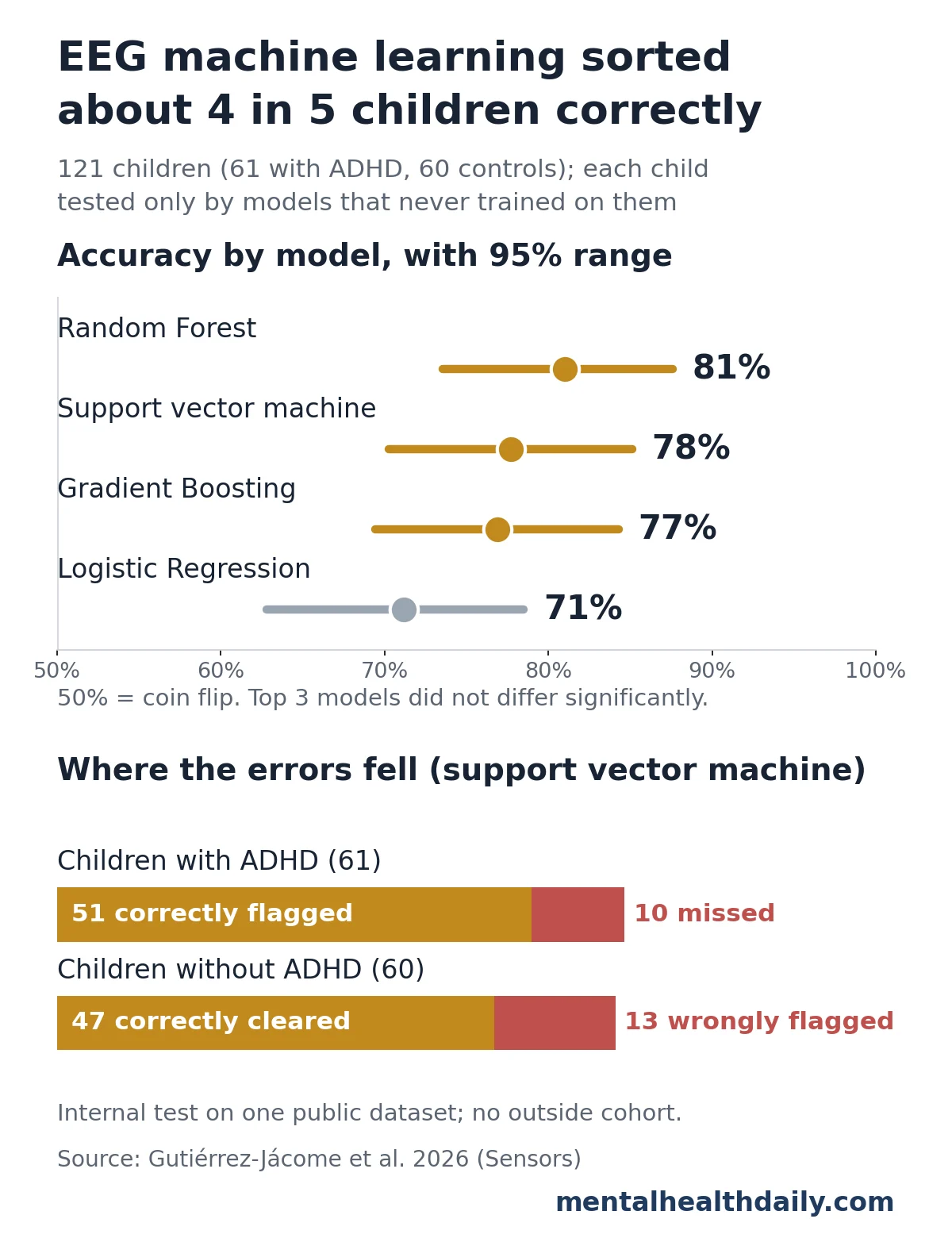
Among the four machine-learning models tested, Random Forest emerged with the best overall performance, achieving an impressive 81% accuracy. Its performance was further characterized by 84% sensitivity (meaning it correctly identified 84% of children with ADHD) and 78% specificity (correctly clearing 78% of children without ADHD). The bootstrap 95% confidence interval for Random Forest’s accuracy ranged from 74% to 88%, indicating a relatively stable performance.
The Support Vector Machine (SVM) demonstrated a slightly higher sensitivity at 85%, indicating its strong ability to detect ADHD cases, and achieved the highest Area Under the Curve (AUC) score of 0.85. AUC is a comprehensive measure of a model’s ability to distinguish between classes across all possible classification thresholds, where 0.5 represents a random guess and 1.0 signifies perfect discrimination. This suggests the SVM was particularly good at ranking children according to their likelihood of having ADHD.
Gradient Boosting also performed strongly, while Logistic Regression showed comparatively lower performance. A statistical comparison using a Friedman test confirmed a significant overall difference among the four models (p = 0.0046). Pairwise tests further clarified that this difference was primarily driven by Logistic Regression trailing Random Forest (p = 0.0047) and the Support Vector Machine (p = 0.0114). Importantly, Random Forest, the Support Vector Machine, and Gradient Boosting were found to be statistically tied in their performance, suggesting that while Random Forest had slightly better overall numbers, the other two advanced models were nearly as effective.
Delving into child-by-child errors, a separate leave-one-child-out test using the Support Vector Machine revealed that the model correctly classified 98 out of 121 children. It missed 10 out of 61 children with ADHD (false negatives) and incorrectly flagged 13 out of 60 children without ADHD (false positives). These error rates, while present, are within an acceptable range for an exploratory diagnostic aid and provide crucial insights into areas for future model refinement.
Pinpointing Brain Activity: The Role of Frontal Electrodes
One of the study’s compelling findings related to the brain regions most influential in the models’ classifications. The researchers queried the Random Forest model to identify which electrodes carried the most weight in its predictions. The Fz electrode, located on the midline of the front of the scalp, ranked first in importance. It was closely followed by F3, Fp1, and F7, all situated on the left frontal region of the head. Electrodes Fp2, F4, and F8, located on the right frontal side, ranked lower.
This emphasis on frontal electrodes aligns well with current neuroscientific understanding of ADHD. Frontal brain regions, particularly the prefrontal cortex, are intimately involved in executive functions such as attention, planning, impulse control, and working memory—precisely the cognitive domains most affected in ADHD. The software’s reliance on these regions, therefore, provides an intuitive and biologically plausible basis for its classifications.
However, the researchers themselves included a crucial caveat: these rankings reflect what the software found useful for discrimination, not necessarily direct measurements of underlying brain activity. Furthermore, they highlighted the "eye-movement caveat." The EEG data pipeline used in the study did not incorporate advanced cleanup techniques like independent component analysis (ICA), which can isolate and remove artifacts from eye blinks and forehead muscle tension. Since eye blinks and muscle tension are most prominent at frontal electrodes, some of the signal attributed to these regions could potentially reflect such artifacts rather than pure brain rhythms. This underscores the need for further studies employing more sophisticated artifact removal techniques to refine the signal analysis.
Interestingly, this finding contrasts with a 2025 Korean study involving 168 children (107 with ADHD, 61 without). That study’s model, built on resting eyes-closed EEG data, primarily relied on beta activity at O1, an electrode located over the back of the head. This divergence highlights a critical point in EEG research: different tasks, recording setups, and age groups can lead models to identify very different "important" regions or frequency bands. This variability emphasizes the importance of standardized protocols and cross-validation across diverse datasets.
Contextualizing Accuracy: Why 81% is a Realistic and Important Figure
The 81% accuracy achieved in the 2026 study, while seemingly modest compared to some earlier reports, is significant precisely because of its methodological rigor. Previous EEG models for ADHD have sometimes reported much higher accuracies, ranging from 86% to 96%. However, as the 2026 researchers point out, these figures were often derived from "looser testing," such as scoring individual EEG slices rather than entire children.
A landmark 2017 analysis by Saeb et al. elucidated why such distinctions matter profoundly in clinical machine learning. Splitting individual records (like EEG slices) from the same person into both training and test sets, rather than splitting entire people, can lead to a substantial overestimation of how well a model will perform on a genuinely new, unseen individual. This methodological flaw, known as data leakage, inflates accuracy by allowing the model to "peek" at aspects of the test data during training. The 81% figure from the 2026 study, derived from a design that strictly controlled for subject-wise data leakage, is therefore a far more realistic and reliable estimate of the model’s potential performance on new children from similar datasets.
It is also important to note that even with strict testing, higher accuracies can be achieved in different samples. The aforementioned 2025 Korean study, for instance, also employed a leave-one-child-out cross-validation approach and reported an accuracy of 90.81% within its own clinic sample. However, that study utilized different equipment, recorded resting eyes-closed EEG, and included a slightly different age range (8 to 15 years). This highlights that while 81% is robust for the specific dataset and methodology of the 2026 study, further research and replication across diverse populations and recording protocols are essential. Crucially, neither model has yet been tested on the other’s children, a critical step for validating generalizability.
The Broader Quest for Objective ADHD Markers and Past Challenges
The pursuit of objective ADHD markers has a long and often challenging history. One of the best-known EEG markers historically proposed for ADHD was the theta/beta ratio—the balance between slower theta waves and faster beta waves. For a period, an elevated theta/beta ratio was considered a promising candidate biomarker, leading to the development of neurofeedback interventions aimed at normalizing this ratio.
However, subsequent rigorous studies and meta-analyses, such as those by the Strzelczyk team, have cast doubt on the reliability of the theta/beta ratio as a standalone diagnostic marker. These teams traced apparent differences in the ratio to confounding factors, including background (aperiodic) EEG activity and, crucially, each person’s individual alpha frequency (IAF)—the exact speed of their dominant alpha rhythm. If the fixed frequency bands (e.g., 4-8 Hz for theta, 13-30 Hz for beta) used in ratio calculations do not align with an individual’s unique brain rhythms, the results can be misleading.
The 2026 Sensors study, learning from these historical lessons, also investigated individual alpha frequency. It found that the average IAF was nearly identical in both groups (8.83 Hz with ADHD, 8.88 Hz without). Furthermore, redefining each child’s frequency bands around their individual alpha frequency actually lowered accuracy for every model; Random Forest, for example, dropped from 81% to 73%. This finding further supports the notion that simple fixed-band ratios may not be robust markers and that more complex, data-driven approaches like machine learning are needed to uncover meaningful patterns.
Implications for ADHD Diagnosis and Clinical Practice: Not Yet a Diagnostic Tool
Despite the promising accuracy achieved, the researchers of the 2026 study are clear: an EEG test cannot yet diagnose ADHD. ADHD diagnosis remains a clinical process, relying on comprehensive interviews, detailed reports from parents and teachers, and adherence to DSM-5 criteria. The current framework developed in this study is described as exploratory, not diagnostic. This distinction is vital for managing expectations and ensuring responsible application of emerging technologies in healthcare.
The findings, however, lay important groundwork for the future. Such machine-learning models could eventually serve as valuable adjuncts to the clinical diagnostic process. They might help clinicians identify children who warrant further evaluation, provide objective data to support a diagnosis, or even assist in differentiating ADHD from other conditions with overlapping symptoms. The potential for earlier, more consistent, and less subjective identification of ADHD could significantly improve outcomes for affected children by facilitating timely interventions and support.
Limitations and Future Directions
The 2026 study, while methodologically robust, has inherent limitations that pave the way for future research. Firstly, it utilized a single existing dataset, meaning its findings need to be replicated and validated across diverse populations and clinical settings. The generalizability of the model to children from other clinics, using different EEG equipment, and varied task paradigms is crucial.
Secondly, the study focused on children already diagnosed with ADHD or confirmed as neurotypical. The next critical step involves testing the same pipeline on more complex cohorts, including unmedicated children (as medication can alter EEG patterns) and children with other co-occurring conditions, which are common in ADHD populations (e.g., anxiety, depression, learning disabilities, autism spectrum disorder). Differentiating ADHD from these comorbid conditions using EEG would be a significant advancement.
Thirdly, the feature extraction was based on relatively simple EEG characteristics (average, spread, power in rhythm bands). Future research could explore more advanced feature engineering, incorporating measures of brain connectivity, nonlinear dynamics, or time-frequency representations to potentially enhance model performance. The eye-movement caveat also highlights the need for advanced artifact removal techniques to ensure the frontal electrode findings are purely brain-derived.
Finally, while the 81% accuracy is encouraging, the goal for clinical diagnostic tools is often much higher, ideally approaching 90-95% or more, especially for a condition with lifelong implications. Continued refinement of algorithms, larger datasets, and multimodal approaches (combining EEG with other neuroimaging, genetic, or behavioral data) will be essential to push these accuracy rates higher and closer to clinical utility.
The Broader Impact and Ethical Considerations of AI in Healthcare
The 2026 study stands as a testament to the transformative potential of artificial intelligence and machine learning in healthcare. As AI increasingly permeates medical diagnostics, from radiology to pathology, its application in neurodevelopmental disorders like ADHD carries both immense promise and significant ethical considerations. The development of objective, data-driven tools could reduce diagnostic delays, minimize misdiagnoses, and alleviate the burden on healthcare systems.
However, the integration of AI into sensitive areas like child diagnostics requires careful oversight. Issues of data privacy, algorithmic bias (ensuring models perform equally well across different demographic groups), and the interpretability of AI decisions are paramount. Clinicians must understand how these models arrive at their conclusions, and the technology should always remain a tool to augment, rather than replace, human expertise and compassionate care. The cautious and incremental approach taken by the Gutiérrez-Jácome et al. team, acknowledging limitations and calling for further validation, sets a responsible precedent for the ongoing development and eventual deployment of AI-powered diagnostic aids in mental health. The journey from exploratory research to clinical application is long, but this 2026 study represents a substantial and robust step forward.

