

A recent Italian study conducted in 2026 has provided significant new insights into the long-observed difficulties children with Attention-Deficit/Hyperactivity Disorder (ADHD) face in mathematics. Contrary to previous hypotheses, the research indicates that these struggles may not stem from a diminished intuitive "number sense" – the fundamental ability to quickly estimate quantities without explicit counting. The findings suggest that the cognitive roots of math challenges in ADHD differ from those seen in specific learning disorders like dyscalculia, pointing towards alternative explanations centered on broader executive functions.
The Persistent Challenge of Math in ADHD
It is well-established that children diagnosed with ADHD frequently encounter greater hurdles in academic performance, with mathematics often presenting a particularly pronounced challenge. This difficulty extends beyond simple arithmetic to more complex problem-solving and conceptual understanding. The educational and psychological communities have long sought to understand the specific mechanisms underlying this math gap, aiming to develop more targeted and effective interventions.
ADHD, a neurodevelopmental disorder characterized by persistent patterns of inattention, hyperactivity, and impulsivity, affects millions of children worldwide. According to the Centers for Disease Control and Prevention (CDC), approximately 6 million children in the United States have received an ADHD diagnosis. While the core symptoms are widely recognized, their downstream effects on various cognitive domains, including academic skills, are still being meticulously explored. Math difficulties, for instance, are not merely a secondary consequence of inattention during lessons; research, including a comprehensive 2015 systematic review, has consistently linked ADHD symptoms, particularly inattention, to lower mathematical ability. This connection spurred researchers to investigate whether a more fundamental cognitive deficit might underpin these struggles.
Unpacking the "Number Sense" Hypothesis
The concept of "number sense" refers to an innate, intuitive capacity to approximate quantities without the need for precise enumeration. It’s the ability to glance at a crowd and estimate "hundreds" rather than "thousands," or to judge a handful of objects as "about ten" instead of "three." This foundational cognitive skill is believed to be crucial for the development of formal mathematical abilities. A landmark 2008 study, for example, demonstrated a strong correlation between a more precise number sense in 14-year-olds and higher scores on standardized math tests stretching back to kindergarten, highlighting its predictive power for mathematical achievement.
Given this established link, and the fact that children with dyscalculia – a specific learning disorder characterized by severe difficulties in learning or comprehending arithmetic – often exhibit a blunted or impaired number sense, an obvious hypothesis emerged: perhaps children with ADHD also struggle with math because they, too, possess a weaker number sense. If this were the case, it would imply a shared cognitive root for math difficulties across these distinct neurodevelopmental conditions. Conversely, if number sense in ADHD children proved to be intact, it would necessitate a search for different explanatory mechanisms for their math struggles. This divergence in potential underlying causes carries significant implications for diagnostic differentiation and the design of educational support strategies.
Methodology of the 2026 Italian Study
To rigorously test this hypothesis, a team of researchers led by Giovanni Anobile et al. at the University of Florence and the Stella Maris research hospital in Pisa conducted a detailed case-control study. The research, published in 2026, involved two distinct groups of children:
- ADHD Group: Comprising 20 children diagnosed with ADHD.
- Control Group: Consisting of 43 typically developing children without an ADHD diagnosis.
The study employed a carefully designed methodology to assess the children’s quantity estimation abilities, ensuring that explicit counting was inhibited. Each participant was tasked with providing a spoken estimate for a range of 10 to 15 items presented in three different sensory formats:
- Dots: Children were shown a series of quickly flashed arrays of dots on a screen. The rapid presentation was designed to prevent individual counting.
- Flashes: Participants observed sequences of visual flashes, again presented at a speed that precluded precise counting.
- Finger Taps: Children were asked to estimate the number of self-generated finger taps they performed, preventing auditory counting by requiring them to concurrently repeat the syllable "ba" as fast as possible throughout the task. This dual-task paradigm is a standard technique used to engage verbal working memory and inhibit verbal counting strategies.
The researchers meticulously scored two primary metrics from these estimation tasks:
- Precision (Weber Fraction): This measure quantifies the consistency and refinement of an individual’s estimations. A lower Weber fraction indicates higher precision, meaning the individual can more accurately differentiate between similar quantities. For example, someone with a low Weber fraction might easily distinguish between 10 and 11 items, whereas someone with a high Weber fraction might struggle to tell the difference between 10 and 15 items.
- Accuracy (Average Estimation Error): This metric reflects how close the children’s spoken estimates were to the actual number of items presented. A lower average error indicates higher accuracy.
In addition to the number sense tasks, all children underwent age-standardized math tests to quantify their mathematical abilities. To account for general cognitive capacity, two reasoning tests – one verbal and one visual – were also administered. This comprehensive approach allowed the researchers to control for various confounding factors and isolate the specific contribution of number sense.
Key Findings: A Math Gap, But Intact Number Sense
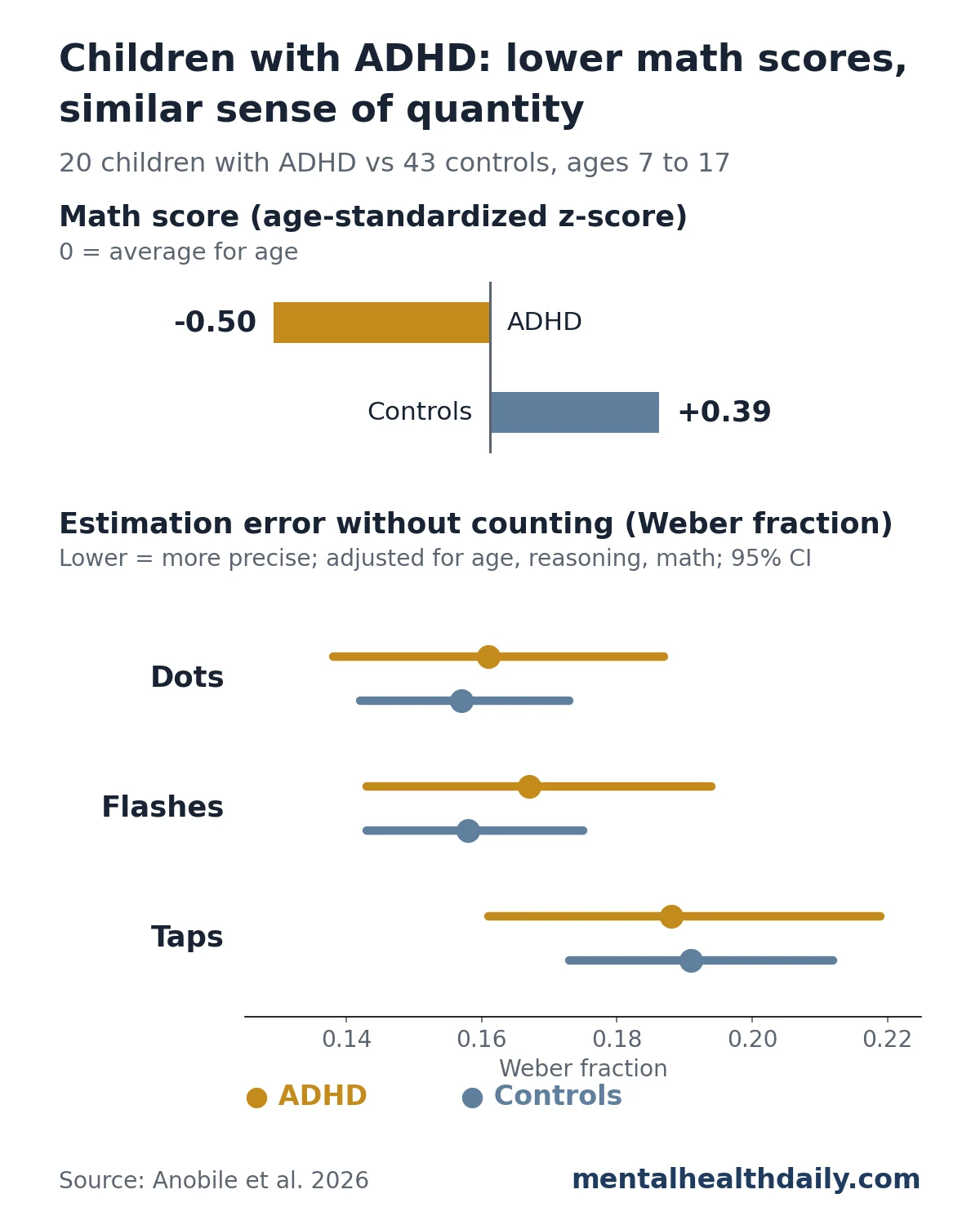
The results of the 2026 study revealed a clear discrepancy in mathematical performance between the two groups, consistent with prior research. On the standardized math tests, the ADHD group’s combined math score averaged –0.50, placing them half a standard deviation below the age norm. In stark contrast, the control group achieved an average score of +0.39. The ADHD group also scored lower on both the verbal and visual reasoning tests, indicating some generalized cognitive differences.
However, when it came to the core measure of intuitive quantity estimation – the number sense tasks – a different picture emerged. Despite the significant math gap, the precision of estimation between the two groups was remarkably similar. After statistically adjusting for age, reasoning abilities, and overall math skill, the two groups’ Weber fractions were nearly identical across all three tasks:
- Dots: ADHD group: 0.161 vs. Control group: 0.157
- Flashes: ADHD group: 0.167 vs. Control group: 0.158
- Taps: ADHD group: 0.188 vs. Control group: 0.191
The confidence intervals for these measures heavily overlapped, strongly suggesting no statistically significant difference in precision once confounding factors were controlled. While there was a slight difference in overall precision before adjustment (average Weber fraction 0.188 for ADHD vs. 0.16 for controls, p = 0.027), a Bayesian analysis indicated this gap was merely anecdotal evidence, not robust statistical proof of a difference. Furthermore, no single task showed a significant difference after correcting for multiple comparisons. Regarding accuracy, the average estimation error was approximately 1.2 items in both groups, with no detectable difference in any analysis.
Crucially, the researchers also addressed the potential influence of co-occurring dyscalculia. Three children within the ADHD group also had a diagnosis of dyscalculia. Even when these participants were excluded from the analysis, the results remained unchanged, further solidifying the conclusion that ADHD itself, in the absence of dyscalculia, does not appear to be associated with a blunted number sense.
Math Skill, Not ADHD Diagnosis, Predicts Estimation Abilities
A particularly insightful finding emerged when the researchers analyzed the data across all 63 children, irrespective of their diagnosis. They discovered that higher math scores were significantly correlated with more precise (p = 0.002) and more accurate (p = 0.03) quantity estimations. Additionally, older children tended to be more precise in their estimates. Importantly, once these factors (math skill and age) were included in the statistical model, the ADHD diagnosis itself added no further predictive power regarding estimation abilities. This suggests that while math skill and age are indeed linked to number sense precision, ADHD status is not an independent predictor.
These findings are not entirely novel; they build upon earlier work by the same research group. A 2022 study, also by Anobile et al., similarly found that 20 children with ADHD performed as well as 20 control children in non-symbolic quantity comparison tasks (e.g., picking which of two dot clouds held more dots), despite exhibiting weaker symbolic math skills. The 2026 study expands this evidence by extending the finding from quantity comparison to absolute quantity estimation, and from visual dots to auditory flashes and kinesthetic actions, demonstrating a consistent pattern across different modalities.
Implications for Understanding ADHD and Math Difficulties
The results of this Italian study carry significant implications for our understanding of ADHD-related math difficulties and for the development of targeted educational interventions. By ruling out a fundamental deficit in number sense, the research points away from a shared cognitive root with dyscalculia. This suggests that while both conditions can manifest as math struggles, their underlying mechanisms are distinct.
For educators and clinicians, this differentiation is critical. If a child with ADHD struggles with math, this study suggests that interventions focused on strengthening their basic intuitive grasp of quantities might not be the most effective approach. Instead, the researchers propose that the math gap in ADHD is more likely linked to broader "general thinking skills" or executive functions. These include:
- Attention: The ability to sustain focus during multi-step problems or complex calculations.
- Working Memory: The capacity to hold and manipulate information in mind while solving problems (e.g., remembering intermediate steps in an equation).
- Self-Monitoring: The skill of checking one’s work for errors, identifying when a strategy is not working, and correcting course.
Children with ADHD often face challenges in these very areas due to the core symptoms of their condition. Difficulties in sustaining attention can lead to missed steps in a problem, while limitations in working memory can make it hard to manage multiple variables or recall previously learned formulas. Impaired self-monitoring can result in repeated errors without recognition or correction. While the 2026 study did not directly measure these executive functions, its findings indirectly support their potential role by excluding number sense as the primary culprit.
Limitations and Future Research Directions
As with any scientific study, the 2026 Italian research has its limitations. This was a relatively small case-control study, involving 20 children with ADHD and 43 controls. While the findings are robust within this sample, the size means it cannot definitively rule out the existence of a small number-sense deficit in a broader ADHD population. Larger, more extensive studies would be needed to detect such subtle differences, if they exist.
Furthermore, the study’s design focused specifically on number sense and did not directly assess the executive functions (attention, working memory, self-monitoring) that researchers now hypothesize as the more likely culprits. Future research should aim to integrate measures of these cognitive skills alongside number sense and math performance. This would allow for a more comprehensive model of how various cognitive factors contribute to math difficulties in children with ADHD. Longitudinal studies tracking the development of these skills over time would also provide valuable insights into the trajectory of math learning in ADHD.
Conclusion: Charting a New Path for Support
The 2026 Italian study represents a significant step forward in understanding the complex interplay between ADHD and mathematical ability. By demonstrating that children with ADHD, in the absence of dyscalculia, possess an intuitive number sense comparable to their typically developing peers, the research redirects attention towards other cognitive mechanisms. It reinforces the idea that ADHD-related math difficulties are distinct from those observed in dyscalculia, where number sense deficits are a hallmark.
For children with ADHD who find mathematics challenging, this study offers a crucial perspective: their struggles are unlikely to stem from a fundamental inability to intuitively grasp quantities. Instead, the focus for educators and parents should shift towards supporting the executive functions that are often impaired in ADHD – attention, working memory, and self-monitoring. By strengthening these broader cognitive skills, and developing instructional strategies that accommodate these challenges, it may be possible to bridge the math gap and unlock greater academic success for children with ADHD. The journey to fully unravel the specific causes of math difficulties in ADHD continues, but this research provides a clearer roadmap, emphasizing the need for targeted interventions informed by a nuanced understanding of neurodevelopmental differences.

