

A comprehensive eight-year study conducted at Balikesir Atatürk City Hospital in Turkey has revealed that daily fluctuations in weather conditions and air pollution levels do not directly correlate with the frequency of suicide-attempt related emergency visits. The research, which analyzed 1,413 emergency presentations between January 2017 and December 2024, found no significant short-term predictive power of environmental variables such as temperature, humidity, precipitation, sunlight, or various air pollutants (PM2.5, sulfur dioxide, ozone) on daily suicide attempt counts. However, the study did identify distinct seasonal and weekly rhythms in these visits, with peaks observed in spring, June, and December, suggesting more complex, long-term influences rather than immediate environmental triggers.
In-depth Look at the Balikesir Study: Methodology and Scope
The investigation, led by Duygu Kavuncuoglu et al., meticulously compiled data from every emergency presentation coded as intentional self-harm at Balikesir Atatürk City Hospital over the specified eight-year period. To ensure the integrity and relevance of their findings, researchers focused exclusively on residents of Balikesir, systematically removing duplicate or incomplete records. This rigorous filtering process yielded a robust dataset of 1,413 unique visits spanning 2,922 days, providing a substantial foundation for their analysis. The study employed an ecological time-series design, a methodological approach well-suited for examining population-level trends and correlations over time within a defined geographical area. This means the research sought to identify whether periods of increased hospital visits for suicide attempts coincided with specific environmental conditions across the entire city, rather than investigating the individual circumstances or exposures of each patient. While this design can reveal broad patterns, it inherently cannot attribute the cause of any single individual’s hospital visit to specific environmental factors.
Balikesir’s Climate and Environmental Profile
Balikesir, strategically located in western Turkey, boasts diverse coastlines on both the Marmara and Aegean seas. This unique geographical positioning bestows upon it a temperate, transitional climate, characterized by warm, dry summers and mild, wet winters. The city experiences a wide range of meteorological conditions throughout the year, from abundant sunshine and higher temperatures in the warmer months to cooler, cloudier, and more humid periods during winter. Alongside these natural climatic variations, Balikesir, like many urban centers, experiences varying levels of air quality influenced by industrial activities, transportation, and seasonal atmospheric conditions. For each day within the study period, the research team carefully matched the recorded counts of suicide-attempt visits with local environmental readings. These included a comprehensive suite of meteorological data—daily average temperature, humidity, precipitation, and total sunlight hours—as well as crucial air quality parameters, specifically PM2.5 (fine particulate matter), sulfur dioxide (SO2), and ozone (O3) concentrations. This detailed environmental dataset allowed for a thorough examination of potential short-term correlations.
The Uncoupling of Daily Environment and Suicide Attempts
To rigorously test for immediate, short-term environmental effects, the researchers first constructed a baseline Autoregressive Moving Average (ARMA) model. This sophisticated statistical model is designed to capture the inherent "memory" of a time series, predicting each day’s count of visits based on recent past counts and recent prediction errors. By doing so, the ARMA model effectively accounts for the natural, slow drifts and fluctuations within the series itself, establishing a robust baseline against which the influence of external factors could be measured. The study found that the series exhibited a strong "memory," indicated by an autoregressive coefficient of 0.992, implying that daily visit counts were heavily influenced by the preceding days’ counts. However, even this baseline model, despite its strong autoregressive component, only explained approximately 1.4% of the day-to-day variation in suicide-attempt visits (adjusted R² = 0.014). This low R-squared value suggests that the vast majority of daily fluctuations remained unpredictable by the measured factors, including the series’ own past behavior.
Subsequently, the researchers systematically introduced each environmental variable—temperature, humidity, precipitation, sunlight, PM2.5, SO2, and O3—into the model, incorporating lags of 1 to 7 days to account for potential delayed effects. Additionally, seasonal indicators for winter, spring, and summer were included to capture broader seasonal influences. The pivotal finding was that none of these environmental variables, regardless of the lag period, significantly improved the model’s ability to predict daily suicide-attempt visits. This consistent lack of predictive power across all tested environmental factors strongly indicates that, at a daily resolution in Balikesir, these elements do not serve as direct, short-term triggers for suicide attempts leading to hospital presentations. The researchers also noted the relatively low daily counts of visits, with the hospital averaging roughly one visit every two days. They acknowledged that with such small numbers, detecting a modest environmental effect—even one of the size observed in larger, multi-city studies—would be inherently challenging. This limitation underscores the difficulty of discerning subtle influences within highly localized datasets.
Unveiling Seasonal and Weekly Rhythms of Distress
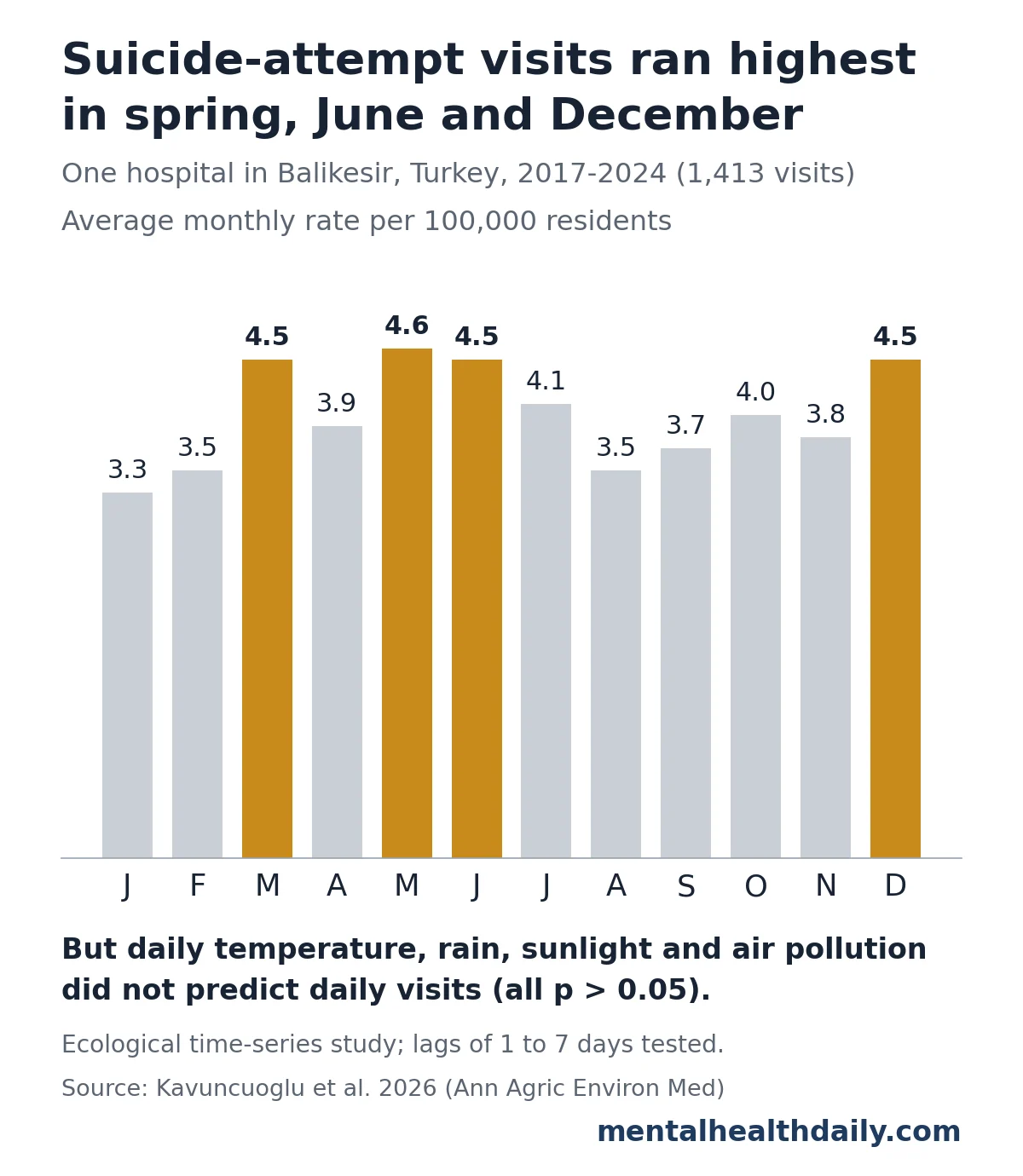
Despite the absence of daily environmental predictability, the study uncovered clear and significant seasonal and weekly patterns in suicide-attempt visits. Monthly averages revealed two distinct peaks across the year. Rates were highest in late spring and early summer, specifically in May (4.6 per 100,000 residents) and June (4.5 per 100,000). A second significant rise occurred in December (4.5 per 100,000), while the lowest rates were recorded in January (3.3) and August (3.5). March also showed a notable increase at 4.5 per 100,000.
These two annual peaks presented under markedly different environmental conditions. December, for instance, typically experienced the worst air quality of the year in Balikesir, with PM2.5 concentrations averaging 27.4 µg/m³, coupled with the least amount of sunshine, averaging only 4.0 hours per day. Conversely, the May and June peaks occurred after the winter pollution had largely dissipated, characterized by longer daylight hours and generally warmer, more pleasant weather. The stark contrast in these environmental conditions between the two peak periods further reinforced the researchers’ conclusion that no single weather or pollution measure could account for both surges in visits. The seasonal indicators themselves, when included in the time-series model, did not achieve statistical significance, leading the researchers to posit that seasonal variations in suicidal behavior are likely far more intricate than simple, direct climate effects. Instead, they suggest that these patterns are influenced by a complex interplay of psychosocial factors, cultural rhythms, and potentially indirect environmental impacts over longer durations.
Beyond the seasonal trends, the study also identified a distinct weekly pattern in emergency presentations. Visits were notably higher on Wednesdays, Fridays, and Saturdays, while showing a marked decrease on Thursdays. This observation stands in contrast to the commonly reported Monday peak in suicide-related presentations in other regions. The researchers speculated that these local weekly variations could be attributed to specific social routines, cultural practices, or weekly patterns in access to mental healthcare services within Balikesir. Understanding these local rhythms is crucial for optimizing the allocation of resources and staffing for crisis intervention services.
Demographic Insights and Shifting Trends in Suicide Attempts
While the primary focus was on environmental correlations, the study also provided valuable insights into the demographic characteristics of individuals presenting with suicide attempts and the overall trends in these visits over the study period. The yearly rates of suicide-attempt visits demonstrated variability but exhibited a general downward trend across the eight years, declining from a high of 64.8 per 100,000 residents in 2019 to 37.0 per 100,000 in 2024. For broader context, Turkey’s official suicide death rate in 2021 was reported as 4.9 per 100,000, with Balikesir’s rate slightly higher at 5.7 per 100,000. It is important to distinguish between suicide attempts, which are the focus of this hospital-based study, and completed suicides, as the former typically occur at a much higher frequency than the latter. The observed decline in attempt rates, if sustained, could signify positive shifts in local mental health initiatives or societal factors, though further research would be needed to ascertain the contributing causes. The study also implicitly collected data on patient demographics such as age and gender, which, while not detailed in the provided content, are typically crucial for understanding risk profiles and tailoring prevention strategies.
Broader Scientific Context: Global Research on Environmental Factors
The findings from Balikesir, particularly the absence of a direct daily link between environmental factors and suicide attempts, present an interesting counterpoint to a growing body of global research. Numerous large-scale, multi-city studies, predominantly tracking suicide deaths rather than attempts, have indeed identified statistically significant, albeit small, correlations between environmental variables and suicide rates. For instance, studies conducted across vast geographical regions, including Europe, North America, and parts of Asia, have reported:
- Heatwaves and Temperature: Increased temperatures and heatwaves have been linked to a rise in suicide rates, with some analyses suggesting a percentage increase for every degree Celsius rise above a certain threshold. The proposed mechanisms include the exacerbation of psychiatric symptoms, disruption of sleep patterns, and increased impulsivity due to thermal stress.
- Air Pollution: Elevated levels of various air pollutants, including PM2.5, NO2, and SO2, have also been associated with a modest increase in suicide deaths. Hypothesized pathways involve neuroinflammation, oxidative stress, and direct impacts on neurotransmitter systems in the brain, potentially influencing mood and cognitive function.
- Sunlight and Seasonal Affective Disorder: While not always directly linked to suicide, changes in sunlight exposure are known to influence mood and mental health, particularly in the context of seasonal affective disorder (SAD). However, the relationship with suicide is complex and not uniformly observed across all regions or seasons.
It is critical to understand that these pooled effects, derived from very large datasets encompassing millions of individuals and extensive geographical areas, are typically small on a per-day basis. Their statistical significance often emerges precisely because of the sheer volume of data, which allows for the detection of subtle influences that might be imperceptible in smaller, more localized studies. The Balikesir study, with its 1,413 visits over eight years at a single hospital, represents a much weaker statistical test for such small, nuanced effects. Therefore, the absence of a detected effect in Balikesir can comfortably coexist with the presence of a small, statistically significant effect in larger, aggregated datasets. This highlights the importance of scale and statistical power in environmental epidemiology studies related to mental health.
Acknowledging Study Limitations
Like all research, the Balikesir study is subject to certain limitations that warrant consideration when interpreting its findings:
- Single-Center Data: The study was confined to data from a single hospital in Balikesir. While comprehensive for that specific institution, the findings may not be generalizable to other hospitals, cities, or regions within Turkey or globally, which may have different demographic profiles, socioeconomic conditions, mental health service structures, or climatic characteristics.
- Ecological Design: As an ecological time-series study, it examined population-level trends rather than individual patient exposures. This means it can identify correlations between environmental conditions and the number of suicide-attempt visits, but it cannot establish causation at the individual level. It cannot explain why any particular person sought emergency care.
- Focus on Attempts: The study focused specifically on emergency presentations for suicide attempts. It did not capture all instances of suicidal ideation or non-hospital-presenting attempts, nor did it directly address completed suicides. The factors influencing attempts versus completions can differ, and therefore, the findings may not fully extend to completed suicide rates.
- Unmeasured Variables: The study, by its nature, could not account for a myriad of other complex factors that influence suicidal behavior, such as socioeconomic status, access to mental healthcare, individual psychiatric history, social support networks, cultural influences, or major life events. These unmeasured confounding variables could play a significant role in daily and seasonal fluctuations.
- Data Resolution: While daily environmental data was used, the resolution of human behavior and its underlying drivers is often more granular or, conversely, more long-term than daily environmental shifts. The choice of 1-7 day lags for environmental variables might not capture all relevant timeframes of influence.
- Low Daily Event Counts: As noted by the researchers, the relatively low average daily count of visits (approximately one every two days) inherently limits the statistical power to detect subtle environmental effects. Large daily variations or infrequent events can obscure true but small associations.
Implications for Public Health and Suicide Prevention Strategies
The findings from Balikesir offer critical insights for public health officials, mental health service providers, and policymakers, particularly at the local level:
- Daily Weather as a Weak Local Predictor: The study strongly suggests that, in a localized context like Balikesir, daily meteorological conditions and air pollution levels are weak predictors of the immediate incidence of suicide-attempt visits. This implies that relying on daily weather forecasts or air quality alerts for short-term staffing adjustments in crisis services may not be an effective strategy. The researchers’ conclusion that environmental influences, where they exist, are likely more slow-acting or indirect, rather than immediate triggers, shifts the focus from reactive daily responses to more systemic and long-term prevention efforts.
- Leveraging Seasonal and Weekly Rhythms for Planning: Despite the lack of daily environmental correlation, the clear identification of seasonal and weekly rhythms remains invaluable for operational planning. Emergency and crisis services in Balikesir, and potentially in other regions with similar patterns, can proactively adjust staffing levels, allocate resources, and intensify outreach efforts during predictable peak periods, such as late spring, June, and December. Similarly, understanding weekly peaks (Wednesdays, Fridays, Saturdays) can inform scheduling decisions for mental health professionals and support staff. It is crucial, however, to continuously reinforce that these population-level patterns inform resource allocation but do not predict individual risk.
- Prevention Still Centers on People, Not Forecasts: The core message from this study reinforces that effective suicide prevention remains fundamentally person-centered. Recognizing signs of distress, actively reducing barriers to accessing mental healthcare, fostering robust social support networks, and ensuring comprehensive follow-up care after an attempt are the bedrock of suicide prevention strategies. Environmental factors, even where globally correlated, are likely distal influences compared to the immediate psychological, social, and clinical factors that drive an individual to attempt suicide. Local mental health campaigns should focus on destigmatizing mental illness, promoting help-seeking behaviors, and strengthening community resilience rather than emphasizing environmental triggers.
- The Need for Multi-Faceted Research: The contrast between local and global findings underscores the need for a multi-faceted research approach. While large-scale studies provide a macro-level understanding of environmental impacts, localized studies like Balikesir’s are vital for understanding the unique dynamics and specific challenges faced by individual communities. Future research could explore longer-term environmental exposures, the interplay of environmental factors with socioeconomic stressors, and the nuanced psychological pathways through which climate and pollution might indirectly affect mental well-being in specific populations.
If you or someone you know is struggling, help is available. In the United States, call or text 988 to reach the 988 Suicide & Crisis Lifeline. Elsewhere, please contact your local emergency services or a local crisis line for immediate support.

