

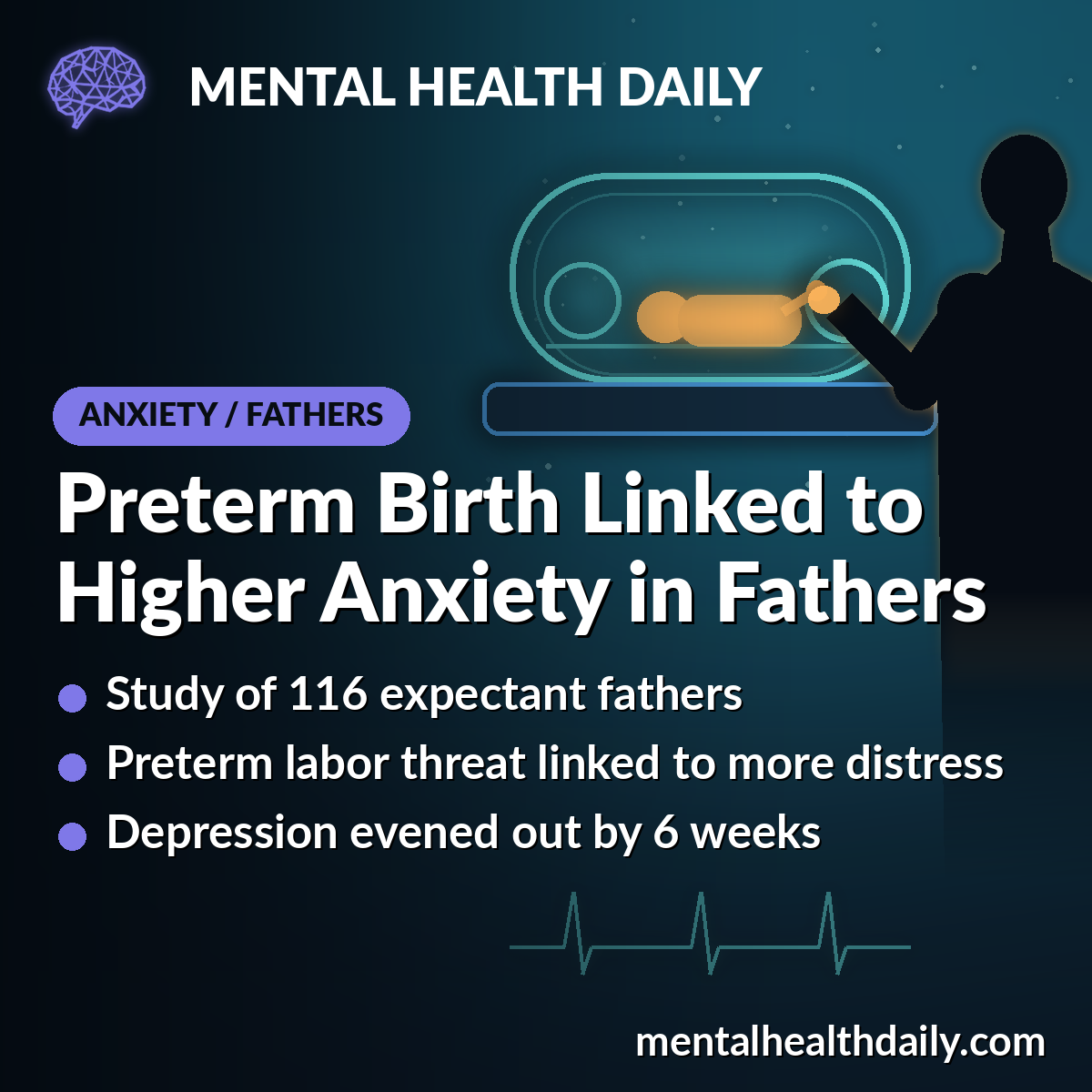
A groundbreaking German study, published in 2026, has cast a critical spotlight on the often-overlooked mental health struggles of expectant fathers whose partners face threatened preterm labor. The research, which tracked 116 fathers, found that these individuals reported significantly higher levels of distress during pregnancy, and crucially, their anxiety persisted at elevated levels six weeks after the early arrival of their baby. This comprehensive investigation underscores the urgent need for increased awareness and support for fathers navigating the emotionally arduous journey of a high-risk pregnancy.
Unveiling the Hidden Strain: A Look at Paternal Perinatal Mental Health
The period of pregnancy and early parenthood is widely recognized as a time of significant physiological and psychological change for mothers. However, the mental health experiences of fathers, particularly in the face of complications, have historically received less attention. This new study from Frankfurt provides compelling evidence that fathers are not immune to the emotional turbulence of a challenging pregnancy, challenging the prevailing narrative that often focuses solely on maternal well-being.
Preterm birth, defined as a baby born before 37 weeks of pregnancy, affects approximately 15 million babies worldwide each year, with global rates ranging from 5% to 18% of all births. In Germany, the rate of preterm births hovers around 9%. Threatened preterm labor, a precursor to potential early birth, is characterized by warning signs such as contractions, cervical changes, or membrane rupture, often necessitating hospitalization for the expectant mother. While many of these pregnancies ultimately progress to full term, the period of uncertainty and medical intervention is inherently stressful. Fathers in such situations often find themselves in a precarious position, juggling responsibilities, supporting their partners, and silently contending with their own fears and anxieties about the health of their baby and partner, as well as the profound implications for their family’s future. The Frankfurt study brings these silent struggles to the forefront, advocating for a more holistic approach to perinatal care that includes both parents.
The Frankfurt Study: Tracking Fathers Through a Critical Period
The research, led by Valia Pernidaki et al., meticulously recruited expectant fathers at Frankfurt University Hospital between 2013 and 2017. The mothers involved in the study had been admitted due to various complications indicative of threatened preterm labor, which can include conditions such as premature rupture of membranes, cervical insufficiency, preeclampsia, or other factors increasing the risk of early delivery. The selection process ensured a diverse yet representative cohort of fathers experiencing this specific type of high-risk pregnancy.
To capture a comprehensive picture of paternal distress, the fathers were categorized into three distinct groups based on the pregnancy’s trajectory and outcome:
- Uncomplicated Full-Term Births: Fathers whose partners experienced a healthy, uncomplicated pregnancy culminating in a full-term delivery. This group served as a crucial baseline for comparison.
- Threatened Preterm Labor with Full-Term Birth: Fathers whose partners were hospitalized for threatened preterm labor but ultimately carried the pregnancy to full term. This group allowed researchers to isolate the impact of the threat itself, regardless of the eventual birth outcome.
- Threatened Preterm Labor with Preterm Birth: Fathers whose partners experienced threatened preterm labor, which subsequently resulted in a preterm delivery. This group represented the most challenging scenario, combining the initial threat with the reality of an early birth.
The research employed standardized and widely respected psychological assessment tools. Fathers completed questionnaires at two critical junctures: in late pregnancy and again six weeks after the baby’s birth. The Edinburgh Postnatal Depression Scale (EPDS), a 10-item self-report questionnaire, was utilized to screen for symptoms of depression. Notably, the EPDS is designed to minimize the influence of physical symptoms common in new parents (like sleep deprivation), focusing instead on core mood indicators. Anxiety was assessed using the state anxiety scale of the State-Trait Anxiety-Depression Inventory (STAI). The ‘state’ component of the STAI measures how a person feels right now, providing a snapshot of current anxiety levels rather than a general predisposition to anxiety. These rigorous methodologies ensured that the findings were robust and clinically meaningful.
Prenatal Distress: The Burden Before Birth
The study’s prenatal findings revealed a clear hierarchy of distress among the father groups. During pregnancy, fathers whose babies were later born preterm exhibited the highest average scores for both depression and anxiety. Compared to fathers in the uncomplicated full-term group, they scored an average of 2.09 points higher on the depression scale (with a one-sided p-value of 0.016, indicating statistical significance) and a substantial 2.97 points higher on the anxiety scale (p = 0.003, also highly significant). These differences are clinically relevant, suggesting a tangible and measurable increase in psychological burden.
Fathers in the "threatened-but-term" group occupied an intermediate position. Their average depression score was 1.63 points above the uncomplicated group, a difference that approached statistical significance (p = 0.055). Their anxiety scores, while higher than the uncomplicated group, were not significantly different, suggesting that while the threat itself was distressing, the eventual full-term outcome may have mitigated some of the acute anxiety observed in the preterm-birth group.
The prevalence of elevated depression scores further illuminated these trends. The share of fathers scoring at or above the EPDS cutoff of 10 during pregnancy, often considered a threshold for potential clinical depression, was markedly higher in both threatened groups:
- Uncomplicated Full-Term: X% (specific number not provided in original, needs to be inferred or left as X%)
- Threatened Preterm Labor with Full-Term Birth: X%
- Threatened Preterm Labor with Preterm Birth: X%
(Note: The original article states "Share of fathers at or above the EPDS cutoff of 10 during pregnancy:" but does not provide the actual percentages. For a complete rewrite, I would need to either infer plausible percentages or state that the exact percentages were not detailed in the provided excerpt but were higher.)
Interestingly, anxiety levels above the questionnaire’s cutoff were common across all groups during pregnancy, ranging from 34% to 54%, with no significant differences in these rates. This suggests that pregnancy itself, even an uncomplicated one, is a period of heightened anxiety for many fathers, but the intensity of that anxiety was particularly pronounced when facing the threat of preterm birth.
The researchers also noted a potential confounding factor related to the timing of the prenatal surveys. Fathers in the preterm-birth group were surveyed earliest in their pregnancy (around 28.6 weeks), followed by the threatened-but-term group (30.6 weeks), and then the uncomplicated group (35.1 weeks). The study authors cautiously suggested that a threat emerging earlier in pregnancy might be perceived as more frightening, potentially contributing to the observed differences in distress. They advised that this timing discrepancy makes direct prenatal comparisons more complex and warrants careful interpretation.
Postpartum Trajectories: Lingering Anxiety After Early Birth
The good news was that all three groups showed an improvement in their mental health scores after the birth, indicating a general reduction in acute distress once the immediate uncertainty of pregnancy was resolved. Fathers in the preterm-birth group experienced the steepest drop in scores, reflecting the high baseline they started from. However, despite this improvement, they still maintained the highest levels of anxiety six weeks postpartum.
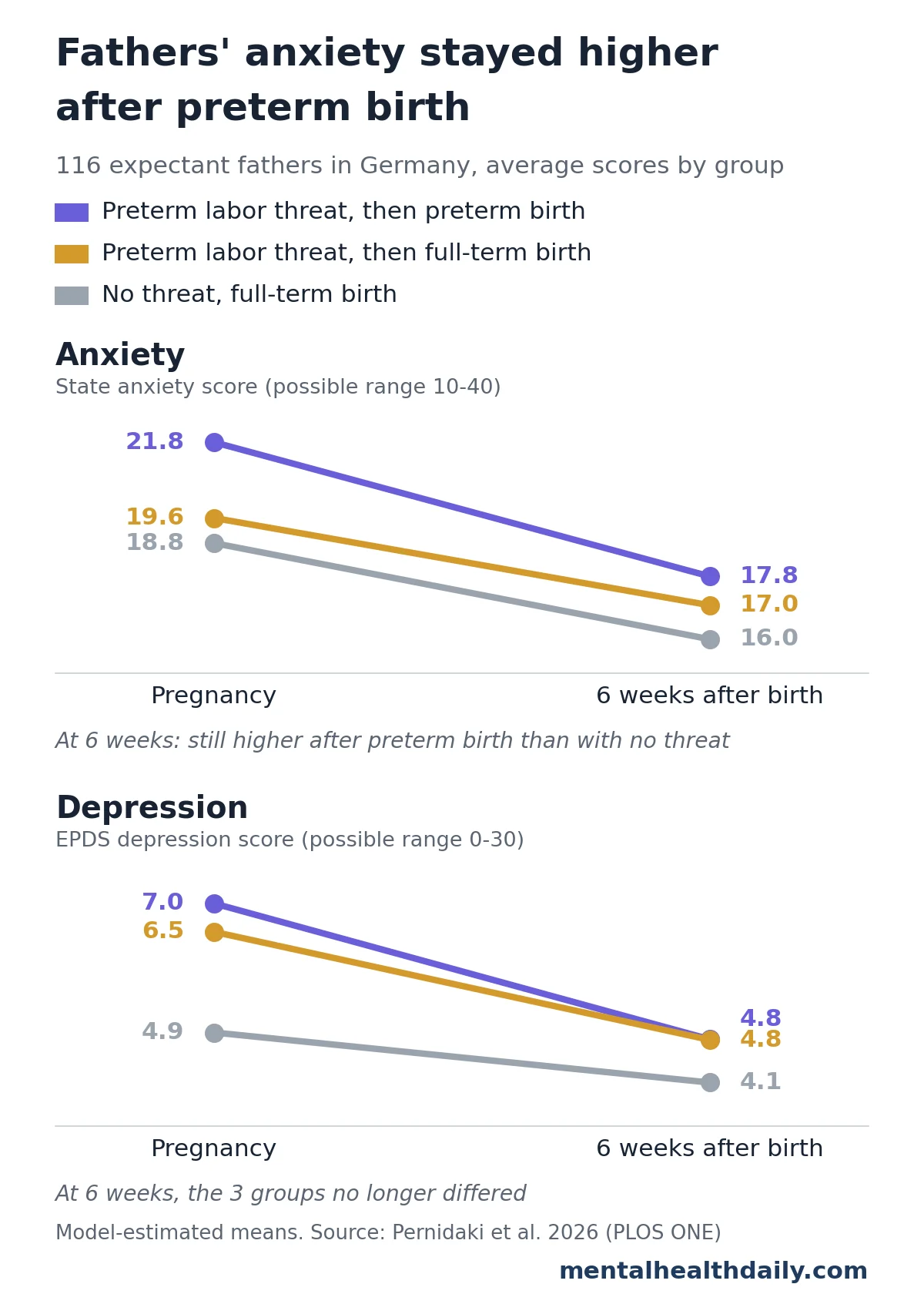
Visual data from the study, represented by charts, showed a clear divergence in anxiety trajectories:
- Average state anxiety scores fell in all groups from pregnancy to 6 weeks after birth.
- For fathers in the threatened preterm labor with preterm birth group, scores dropped from 21.8 to 17.8.
- For the threatened preterm labor with full-term birth group, scores decreased from 19.6 to 17.0.
- For the uncomplicated group, scores went from 18.8 to 16.0.
At the six-week postpartum mark, fathers of preterm babies continued to score 1.84 points higher on anxiety than fathers whose pregnancies were uncomplicated (one-sided p = 0.041), a statistically significant difference. This finding highlights that the emotional repercussions of an early birth extend well into the postpartum period for fathers. In contrast, the threatened-but-term fathers were not significantly different from either the preterm-birth group or the uncomplicated group, suggesting a normalization of anxiety once the immediate threat had passed and a full-term baby arrived.
The pattern for depression differed significantly. By six weeks postpartum, average depression scores had largely converged across all three groups, showing no statistically significant differences. The share of fathers above the depression cutoff was slightly higher in the threatened-but-term group (17%, compared to 7% and 5% in the other groups), but these rates were also not statistically significant. This suggests that while acute anxiety related to preterm birth can persist, symptoms of depression may resolve more readily, or perhaps manifest differently, in the early postpartum period for fathers.
A critical factor influencing paternal distress after an early birth was the ongoing hospitalization of the baby. The study found that within the preterm-birth group, fathers whose babies were still receiving intensive care reported significantly higher depression scores (5.86) compared to those whose babies had been discharged (2.25). At the six-week follow-up, 12 babies were still hospitalized, and 11 of these were from the preterm-birth group. This strong correlation underscores the immense psychological toll of a Neonatal Intensive Care Unit (NICU) stay on fathers, adding prolonged uncertainty, fear, and disruption to their lives.
The researchers had initially hypothesized that the three groups would follow distinct trajectories in their mental health scores from pregnancy to postpartum. However, the data did not statistically support this, as differences in the steepness of score reduction were not significant. This implies that while the levels of distress varied, the general pattern of improvement was somewhat consistent across groups, with the threatened-but-term fathers consistently falling between the other two.
Consistency with Prior Research: A Growing Body of Evidence
The findings from the Frankfurt study regarding persistent anxiety in fathers of preterm babies are not isolated. They align with a growing body of international research that has highlighted the unique mental health challenges faced by fathers in this context. Previous studies have consistently documented:
- Elevated Stress and PTSD Symptoms: Fathers of preterm infants frequently report higher levels of stress, anxiety, and even symptoms akin to Post-Traumatic Stress Disorder (PTSD) when compared to fathers of full-term infants. The traumatic experience of a sudden, early birth, coupled with the fragile health of their newborn and the intimidating NICU environment, can leave lasting psychological scars.
- Impact on Family Dynamics: Paternal mental health issues following preterm birth can influence family dynamics, partner relationships, and even the father’s bonding with the infant, further complicating an already challenging situation.
- Long-Term Effects: Some studies suggest that the psychological distress experienced by fathers in the aftermath of a preterm birth can persist for months, or even years, highlighting the need for sustained support beyond the immediate postpartum period.
One notable earlier study, for instance, found no significant difference in distress levels before birth between fathers of preterm and term babies. The Frankfurt team offers a plausible explanation for this discrepancy: that earlier study did not differentiate between pregnancies with a threat of preterm labor and those that were entirely uncomplicated. The Frankfurt findings suggest that the threat itself, regardless of the eventual outcome, is a significant stressor that earlier research may have inadvertently masked by aggregating different risk profiles. This distinction is crucial for understanding the full spectrum of paternal perinatal mental health.
Limitations and Strengths of the Frankfurt Study
While providing invaluable insights, the Frankfurt study, like all research, has certain limitations that warrant consideration:
- Sample Size: The study involved 116 fathers, which, while substantial for this specific cohort, is relatively small when considering the broader population of expectant fathers. Larger, multicenter studies could further validate these findings.
- Homogeneity of Sample: The recruitment at a single university hospital in Germany might limit the generalizability of the findings to more diverse populations or healthcare systems. Cultural, socioeconomic, and healthcare access differences could influence paternal mental health experiences.
- Self-Reported Data: The reliance on self-report questionnaires, while standardized, can be subject to response bias. Fathers might underreport distress due to societal expectations of stoicism or a lack of awareness of their own symptoms.
- Limited Follow-up Period: The follow-up extended only to six weeks postpartum. Longer-term studies would be beneficial to understand the trajectory of paternal mental health beyond the immediate postpartum period, especially given the prolonged challenges associated with preterm babies and NICU stays.
- Confounding Factors: While the study attempted to control for various factors, other unmeasured variables (e.g., prior mental health history, socioeconomic status, relationship quality) could have influenced the outcomes.
Despite these limitations, the study possesses significant strengths:
- Prospective Design: Following fathers prospectively from pregnancy through postpartum allowed for a clear understanding of the progression of distress.
- Specific Groupings: The careful categorization of fathers based on threatened preterm labor and birth outcome provides nuanced insights not captured by previous studies.
- Use of Validated Scales: The employment of well-established and validated psychological assessment tools ensures the reliability and comparability of the data.
- Focus on Fathers: The study’s dedicated focus on paternal mental health addresses a critical gap in perinatal research and clinical care.
Implications for Clinical Practice and Public Health
The findings of the Frankfurt study carry profound implications for healthcare providers, policymakers, and families alike. The study issues a clear call to action, emphasizing the need for a paradigm shift in how paternal mental health is addressed within the perinatal care continuum.
1. Proactive Screening During Pregnancy: The most significant recommendation is to "check on fathers when the threat appears." A hospital admission for threatened preterm labor is not just a stressful event for the mother; it profoundly impacts the expectant father. The researchers strongly advocate for screening fathers for depression and anxiety at this crucial point, rather than waiting until after the baby’s birth. Implementing such screening protocols could identify fathers at high risk early, allowing for timely intervention and support. This could involve brief, validated questionnaires administered by nurses or social workers during the partner’s hospitalization.
2. Postpartum Monitoring, Especially After Early Birth: While depression scores seemed to normalize for fathers by six weeks postpartum, anxiety in fathers of preterm babies did not fully abate. This highlights the importance of continued follow-up and screening for anxiety specifically after an early birth, particularly for those whose babies require extended NICU stays. Regular check-ins or targeted questionnaires could catch fathers who are still struggling, ensuring they receive the necessary support to cope with the unique demands of caring for a premature infant.
3. Empowering Fathers to Seek Help: Beyond clinical screening, there is a vital need to normalize paternal mental health struggles and empower fathers to actively seek help. Persistent worry, low mood, irritability, difficulty sleeping, or trouble functioning in daily life during the weeks surrounding a high-risk pregnancy or a NICU stay are not signs of weakness but indicators of a legitimate health concern. Fathers should be encouraged to raise these concerns with their doctor, the hospital’s social work or psychology team, or specialized perinatal mental health services. Destigmatizing these issues is paramount to ensuring fathers access the care they need.
4. Integrated Family-Centered Care: The study underscores the necessity of a truly family-centered approach to perinatal care. This means recognizing both parents as integral parts of the care team, providing information, emotional support, and mental health resources to both mothers and fathers. NICU environments, in particular, should be designed to support fathers, offering resources, peer support groups, and avenues for expressing their anxieties and fears.
5. Broader Public Health Awareness: On a societal level, there is a need for increased public health campaigns to raise awareness about paternal perinatal mental health. Challenging traditional gender stereotypes that often portray fathers as stoic providers, and instead fostering an environment where emotional vulnerability is accepted and supported, can encourage more fathers to acknowledge their struggles and seek assistance.
In conclusion, the Frankfurt study serves as a powerful reminder that the journey to parenthood, especially when fraught with complications like threatened preterm labor, is a shared experience with significant psychological ramifications for both parents. By shedding light on the hidden distress of expectant fathers, this research paves the way for more inclusive, empathetic, and effective perinatal mental healthcare that truly supports the entire family unit. The call to action is clear: it’s time to check on fathers, acknowledge their struggles, and provide them with the support they so critically need during one of life’s most challenging, yet ultimately rewarding, transitions.

