

The profound genius of the Buddha extended beyond his acute understanding of existence to a remarkable capacity for envisioning entirely new ways of being. This imaginative faculty, at the core of his insight, offers a powerful lens through which to examine our own lives and the challenges we face. His teachings emerged from the fertile ground of fifth-century BCE India, a period marked by immense societal, political, economic, and religious flux. In this turbulent landscape, the Buddha’s message was not merely a response to existing conditions but a radical proposal for navigating them, offering a path that moved against the prevailing currents of instability.
This innovative spirit is underscored by the declaration in early Buddhist texts, "This is a teaching which has never been heard before." While this might be dismissed as rhetorical flourish, it points to a genuine departure from established traditions. The Buddha did not simply refine existing doctrines; he forged a new framework for understanding and engaging with the world. This groundbreaking approach suggests that overcoming the frustrations, paralysis, and hindrances that impede our progress and collective flourishing requires more than just cultivating mindfulness and resolve. It necessitates the active engagement of our creative imagination.
In this context, suffering, or dukkha, is reframed not as an intractable problem to be eradicated, but as a potent source of transformative power. By embracing it, rather than recoiling, we can creatively reshape it into a pathway towards a richer, more meaningful existence. This reorientation has profound implications, particularly when viewed through the lens of art and aesthetic engagement, which have historically served as crucial conduits for processing human suffering.
The Art of Embracing Suffering: A Historical Perspective
Across cultures and throughout history, art has provided a vital space for confronting and transforming suffering. From the dramatic tragedies of ancient Greece to the enduring imagery of the Christian tradition, artistic expressions have grappled with the darker aspects of the human experience. The Western artistic tradition, deeply influenced by its post-Classical roots, offers particularly potent examples.
Within Christianity, the crucifix stands as a powerful symbol of suffering elevated to devotional art. Depictions, often hyperrealistic in their portrayal of pain and sacrifice, are prevalent in churches across the globe. In countries like Mexico and Spain, these images can be stark and visceral, confronting viewers directly with the raw reality of dukkha. While Northern European Protestant traditions may present a more sanitized aesthetic, the fundamental elevation of suffering within the Christian artistic canon remains undeniable. This artistic focus on pain, regardless of theological interpretation, highlights a recurring human impulse to engage with suffering through creative expression.
This perspective resonates with the observations of J. W. N. Sullivan, a prominent British writer on science and culture in the early 20th century. In his seminal 1927 work, Beethoven: His Spiritual Development, Sullivan opens with the profound assertion: "Few men have the capacity fully to realize suffering as one of the great structural lines of human life." Sullivan posited that suffering is not merely an incidental hardship but a fundamental element that shapes and defines human existence. He believed this understanding was central to Ludwig van Beethoven’s worldview, who saw suffering not only as an unavoidable condition but also as a source of illumination.
Sullivan’s view, though secular, shares a common ground with a more contemporary interpretation of Buddhist principles. While traditional Buddhism often emphasizes liberation from suffering, Sullivan’s Beethoven, and indeed many contemporary secular Buddhist practitioners, advocate for an unconditional embrace of suffering. This embrace is not for the purpose of overcoming it, but for accepting it as it is, free from the distortions of greed, hatred, or confusion. This unconditioned acceptance is the fertile ground from which transformative insight and creative expression can emerge.
Artistic Manifestations of Unconditional Acceptance
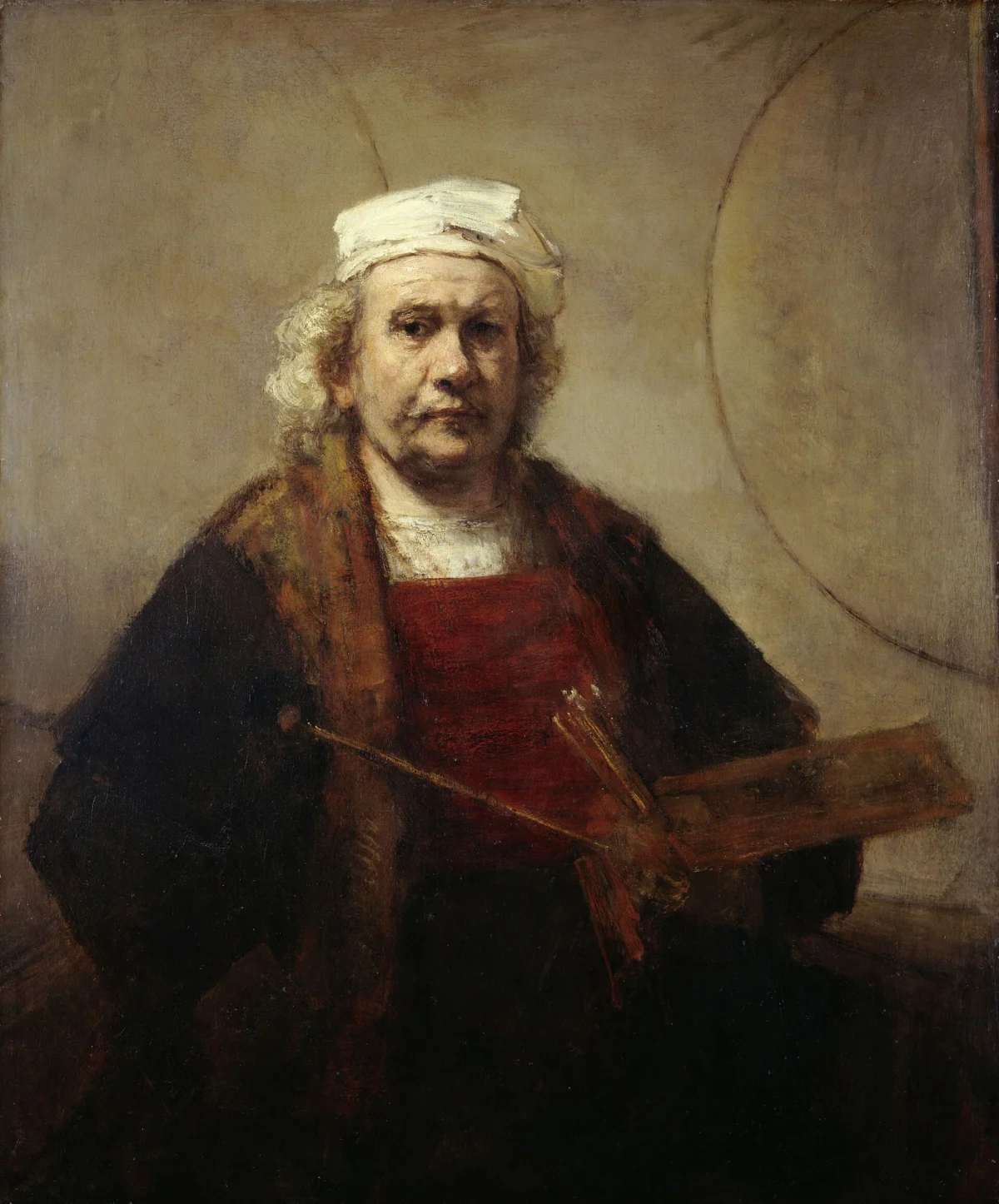
The history of art is replete with examples of this unflinching acceptance. For many, the late self-portraits of Rembrandt van Rijn offer a poignant testament to this. As he aged, and faced significant personal and financial hardship – including bankruptcy and the loss of his studio – Rembrandt turned his gaze inward, confronting his aging visage with stark honesty. His self-portraits from this period, such as those housed in London’s Kenwood House and the National Gallery, are not merely likenesses but profound meditations on the human condition, rendered with a disarming vulnerability. They capture a man grappling with loss and decline, yet resolutely facing the mirror and translating his experience into enduring art.

Similarly, the work of the Japanese Zen master Hakuin Ekaku (1686–1769) demonstrates this contemplative practice through rapid, expressive brushstrokes. His self-portraits, imbued with a palpable sense of grief, sorrow, and bewilderment, showcase a profound engagement with inner turmoil. Despite the speed of their execution, these works possess a depth that speaks to a long tradition of finding aesthetic meaning in the face of life’s difficulties, a practice also found within the Buddhist tradition.
For those moved by music, the works of Franz Schubert and the late string quartets and piano sonatas of Beethoven offer profound explorations of suffering transformed by serenity. Sullivan eloquently describes these compositions: "These works have a serenity which contains within itself the deepest and most unforgettable sorrow. And yet a sorrow which is transformed by its inclusion in that serenity." These musical pieces, infused with tragedy and loss, reveal a striking phenomenon: beauty born from pain, where suffering and aesthetic transcendence are not in opposition but inextricably intertwined.
The Aesthetic Practice: Cultivating Inner Radiance
It is through the courageous act of embracing suffering, rather than evading or denying it, that the potential for profound beauty unfolds. The stillness and equanimity cultivated through meditation are not intended for a self-indulgent retreat from reality. Instead, they create the internal space necessary to confront what might otherwise be overwhelming. By dwelling in stillness, we can observe the often-unsettling realities of our existence with a quiet affirmation: "Yes, this is the state of our existence."
As our ingrained reactivity begins to subside, a sense of wonder and the miraculousness of the world emerges. This phenomenon is often observed during silent retreats. When the mind quiets, the external world can appear to gain a new vibrancy, becoming radiant. By slowing down, stopping, and simply observing, listening, and hearing, one can be struck by the subtle beauty of a leaf’s color or the intricate patterns of nature. Contemplative practice, in essence, renews our awareness, allowing us to perceive the sublime – that which inspires both awe and a touch of unease.
This contemplative experience is multi-faceted. It is not solely cognitive, deepening our understanding, nor is it exclusively affective, fostering emotions like love or compassion. Crucially, it is also aesthetic, deeply connected to beauty. The haiku by the Japanese Zen monk Bashō, "Departing spring / Birds crying / Tears in the eyes of fish," encapsulates this aesthetic dimension of meditative experience. It evokes a poignant sense of transience and sorrow, a feeling echoed in T.S. Eliot’s concept of the sublime, describing "an infinitely gentle, infinitely suffering thing."
The Goldsmith’s Art: A Metaphor for Transformation
Deeper exploration of early Buddhist texts reveals the inherent aesthetic sensibility of the path. A discourse recounts an encounter between the Buddha and a seeker named Pukkusāti, in which the Buddha employs a metaphor that vividly illustrates the role of the aesthetic and creativity in spiritual development. He compares the process of spiritual refinement to that of a goldsmith at work.
The Buddha describes a goldsmith who meticulously prepares a furnace, heats a crucible, and then, using tongs, places a piece of gold within. The goldsmith skillfully manipulates the fire, sometimes blowing on it, sometimes adding water, and at other times stepping back to observe the process. Through this careful, attentive work, the gold is purified, rid of impurities, becoming malleable and radiant, ready to be fashioned into any desired ornament.
This metaphor of the creative artisan equips Pukkusāti, and by extension all practitioners, to engage creatively with life’s circumstances. The Buddha’s teaching of awakening and human flourishing is thus presented not as a passive or rote application of mindfulness, but as an active, skillful engagement with our inner and outer worlds. Much like the goldsmith employs her tools, materials, and expertise, we can coordinate our equanimity, focus, and energy to transform the "raw materials" of our practice – the five aggregates of form, feeling, perception, mental formations, and consciousness. Through this creative practice of the dharma, we can actively shape ourselves into the individuals we aspire to be, much like the goldsmith transforms purified gold into exquisite ornaments. This approach underscores the Buddha’s radical vision: a path that not only illuminates the nature of reality but also empowers us to creatively reimagine and actively construct a more flourishing existence, for ourselves and for the world.

