

Adults holding contrasting beliefs about sex and gender each demonstrated a statistically significant alignment with a different form of authoritarian thinking, according to two preregistered surveys conducted in the United States and the United Kingdom. Specifically, a binary, fixed view of sex and gender was found to be strongly linked to right-wing conventionalism, while a nonbinary, changeable view correlated significantly with left-wing anti-conventionalism. These groundbreaking findings challenge simplistic narratives that often attribute authoritarian tendencies to only one side of the political or social debate, suggesting instead that rigid moral certainty and the desire for societal conformity can manifest across ideological divides. The research, spearheaded by Alex Bertrams and Ann Krispenz of the University of Bern, offers crucial insights into the psychological underpinnings of contemporary social polarization, particularly within highly contentious discussions surrounding sex and gender identity.
Unpacking the Study: Methodology and Participant Demographics
The investigation comprised two distinct studies, meticulously designed and preregistered to ensure methodological rigor and transparency, a practice increasingly valued in psychological research to combat publication bias and questionable research practices. Study 1 gathered data from a representative sample in the United States, while Study 2 replicated the design with a separate cohort in the United Kingdom, thereby strengthening the generalizability of the findings across two culturally similar yet distinct Western democracies.
Participants for both studies were recruited through Prolific, a reputable online research platform known for its ability to provide diverse samples that closely match national demographics. This approach aimed to minimize biases inherent in convenience sampling and enhance the external validity of the results. The US study enlisted 1,431 adults, while the UK study involved 1,390 adults, ensuring robust sample sizes for statistical analysis. The preregistration of both studies, including their hypotheses and analytical plans, underscores a commitment to scientific transparency and replicability, crucial in a field often subject to public scrutiny.
Measuring Beliefs on Sex and Gender
To comprehensively assess participants’ beliefs regarding sex and gender, researchers employed a dual-pronged approach. Firstly, a semantic differential scale was utilized, presenting participants with a series of bipolar adjective pairs (e.g., "fixed-changeable," "biological-socially constructed," "natural-artificial") and asking them to rate the concepts of "sex" and "gender" along these continua. This method allowed for a nuanced understanding of individuals’ perceptions beyond a simple categorical choice.
Secondly, and perhaps more directly, participants were presented with a single, forced-choice question designed to capture their fundamental stance: "How many genders are there?" with options such as "only 2 genders" or "not only 2 genders." This straightforward query provided a clear demarcation between those holding a strictly binary view and those acknowledging a broader spectrum. The responses revealed a notable trend: 57% of US participants and 68% of UK participants opted for "only 2 genders," indicating a prevalent binary perspective within these populations, though the UK sample leaned more heavily towards it. This foundational measurement was critical in correlating specific sex and gender beliefs with broader authoritarian tendencies.
Defining Authoritarianism in a Modern Context
In the realm of psychological science, authoritarianism transcends mere political affiliation, describing a complex set of personality traits and social attitudes. It is fundamentally characterized by a strong desire for conformity within a group, a pronounced deference to established authorities, and a willingness to punish individuals who deviate from perceived group norms or values. Historically, research on authoritarianism largely focused on its right-wing manifestations, but recent advancements have broadened this understanding to include its left-wing counterparts.
The current study utilized established psychological scales to measure authoritarianism on both sides of the political spectrum, recognizing that the desire for moral purity and societal order can manifest through different ideological lenses.
Right-Wing Authoritarianism (RWA)
Right-Wing Authoritarianism, building on Altemeyer’s foundational work, typically comprises three interconnected dimensions:
- Conventionalism: A rigid adherence to traditional values, norms, and social conventions, often accompanied by a belief that these traditions are divinely ordained or inherently correct.
- Authoritarian Aggression: A general aggressiveness directed toward people who are perceived to be deviating from conventional norms and values. This can manifest as support for punitive measures against non-conformists.
- Authoritarian Submission: A high degree of submission to perceived legitimate authorities in society, such as religious leaders, government officials, or traditional institutions.
An example item from the conventionalism scale used in the study illustrates this perspective: "The radical and sinful new ways of living and behaving of many young people may one day destroy our society." This statement clearly reflects a concern for traditional societal structures and a fear of their erosion.
Left-Wing Authoritarianism (LWA)
The concept of Left-Wing Authoritarianism, while debated for decades, has recently gained robust empirical grounding. The 2022 project by Costello et al. was instrumental in developing and validating a measure that identifies three parallel dimensions on the left:
- Anti-Conventionalism: A fervent rejection of traditional norms, values, and institutions, often viewing them as oppressive or outdated. This is coupled with a strong desire for progressive social change.
- Anti-Hierarchical Aggression: An aggressive stance towards individuals, groups, or institutions perceived as upholding oppressive hierarchies or conventional power structures. This can involve advocating for the dismantling of existing systems.
- Anti-Hierarchical Submission: A willingness to submit to authorities or ideologies perceived as legitimate within the left-wing framework, particularly those advocating for revolutionary change or social justice.
The parallel to the RWA conventionalism scale is evident in an LWA anti-conventionalism item: "Radical and progressive moral values can save our society." This statement, while ideologically opposed to the RWA example, similarly expresses a strong desire for a specific set of moral values to be universally applied for societal salvation.
Both RWA and LWA scales typically run from 1 to 7, with higher scores indicating stronger authoritarian tendencies within that ideological framework. Across both the US and UK samples, the average scores for both RWA and LWA dimensions ranged between approximately 3.2 and 3.6, suggesting that while authoritarian tendencies exist, the samples as a whole did not lean excessively to one extreme. Crucially, a high score on either scale reflects the strength of a person’s desire for their own moral views to be universally adopted, irrespective of the specific content of those moral views regarding sex and gender.
The Mirroring Results: Sex and Gender Beliefs Tied to Specific Authoritarianism
The study’s results were remarkably consistent across both the US and UK samples, validating the researchers’ preregistered predictions. The data revealed a clear and strong correlation between specific sex and gender beliefs and distinct forms of authoritarianism.
- Binary, Fixed View and Right-Wing Conventionalism:
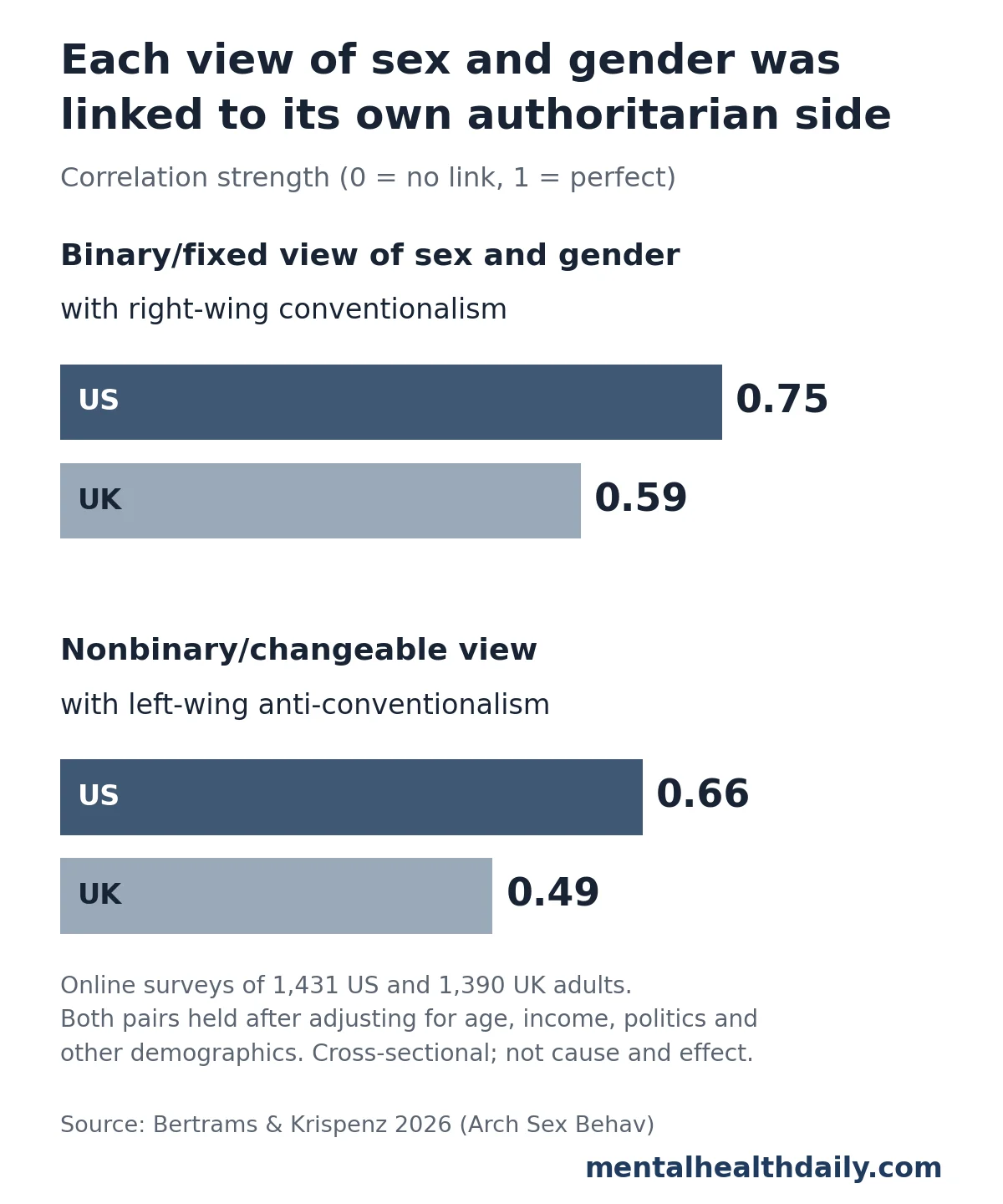
- In the US, the belief in a binary, fixed view of sex and gender correlated with right-wing conventionalism at a robust r = 0.75.
- In the UK, this correlation remained strong at r = 0.59.
- Nonbinary, Changeable View and Left-Wing Anti-Conventionalism:
- In the US, the belief in a nonbinary, changeable view of sex and gender correlated with left-wing anti-conventionalism at r = 0.66.
- In the UK, this correlation was also significant at r = 0.49.
Understanding correlation strength is vital for interpreting these figures. The absolute value of the correlation coefficient, ‘r’, ranges from 0 (indicating no link) to 1 (representing a perfect match). Recent guidelines for effect size in individual differences research categorize values of 0.30 and above as "strong." By this metric, all four primary correlations observed in the study unequivocally qualify as strong, underscoring the substantive nature of these linkages. Even the single-question measure ("only 2 genders" vs. "not only 2 genders") exhibited the same pattern, albeit with slightly weaker yet still significant correlations ranging from r = 0.40 to 0.57.
A particularly compelling aspect of the research was the rigorous control for demographic factors. It is often hypothesized that age might explain such correlations, with younger individuals more inclined towards nonbinary views and left-wing authoritarianism, and older individuals towards binary views and right-wing authoritarianism. However, the researchers meticulously accounted for various demographics, including age, income, and political orientation, by incorporating them into their statistical models. Despite these controls, both the observed links between sex/gender beliefs and their respective forms of authoritarianism remained statistically significant in both countries, demonstrating that these connections are not merely artifacts of demographic differences.
To illustrate the practical implications, consider the findings from the UK study:
- Each 1-point increase on the left-wing anti-conventionalism scale was associated with approximately double the odds (odds ratio 2.22) of a participant answering "not only 2 genders" to the single-question measure.
- Conversely, each 1-point increase on the right-wing conventionalism scale corresponded to about one-third the odds (odds ratio 0.34) of giving that same answer, meaning a significantly higher likelihood of answering "only 2 genders." These odds ratios provide a tangible sense of how strongly these authoritarian tendencies predict an individual’s core beliefs about sex and gender.
Conventionalism: The Driving Force Behind the Link
The UK study provided an even deeper dive into the specific facets of authoritarianism, going beyond the conventionalism scales to measure other dimensions of authoritarianism (e.g., aggression, submission) on both sides, as well as social dominance orientation (SDO), which reflects a preference for group-based hierarchy. This comprehensive approach allowed the researchers to ascertain whether sex and gender beliefs were tracking authoritarianism in a general sense or specifically aligning with its conventionalism/anti-conventionalism dimensions.
The results strongly indicated the latter. When all right-wing authoritarian measures were included in a single model, they collectively explained 41% of the variation in sex and gender beliefs. Similarly, all left-wing measures together accounted for 29% of the variation. Crucially, within each of these models, the conventionalism (or anti-conventionalism) scale consistently carried the most statistical weight. The standardized weights (β values), which indicate the strength of a link after accounting for other measures in the model, were highest for the conventionalism scales. This suggests that the core desire for societal adherence to either traditional or progressive moral values is the primary psychological mechanism linking authoritarianism to sex and gender beliefs.
One intriguing, albeit unexpected, finding emerged regarding left-wing anti-hierarchical aggression (support for overthrowing current power structures). On its own, this dimension showed a slight positive correlation with the nonbinary view (r = 0.14). However, once left-wing anti-conventionalism was statistically accounted for, its direction reversed, and it became linked to the binary view (β = 0.30). The researchers prudently flagged this as a "side finding" that necessitates further investigation rather than a definitive conclusion, highlighting the complexities inherent in dissecting such psychological constructs.
A Timeline of Authoritarianism Research and This Study’s Contribution
The historical trajectory of authoritarianism research provides crucial context for understanding the significance of the 2026 study. For decades, the psychological investigation into authoritarianism was predominantly focused on its right-wing manifestations.
- 1950s: Theodor Adorno and his colleagues introduced the concept of the "authoritarian personality" in their seminal work, primarily linking it to right-wing political ideologies and anti-democratic tendencies in the wake of World War II.
- 1980s: Bob Altemeyer refined the concept with his work on Right-Wing Authoritarianism (RWA), developing a robust scale that became widely adopted. His research consistently linked RWA to a strong adherence to traditional values, aggression towards out-groups, and submission to authority.
- Early 2000s – Present: Subsequent research using Altemeyer’s RWA scale frequently explored its connections to social attitudes. These studies consistently found links between right-wing authoritarianism and a binary view of sex and gender, as well as less favorable attitudes toward transgender and nonbinary individuals. This body of work solidified the understanding that a desire for social order and conventionalism often translates into rigid views on gender roles and identity.
- 2000s – 2010s: While the concept of "left-wing authoritarianism" was periodically debated and explored in academic circles, a widely accepted and empirically validated measure remained elusive, leading to a gap in comprehensive understanding.
- 2022: A pivotal moment occurred with the publication of research by Costello et al., who successfully developed and rigorously tested a measure of Left-Wing Authoritarianism (LWA) across six diverse samples totaling 7,258 individuals. This project not only identified three distinct yet related dimensions of LWA (anti-conventionalism, anti-hierarchical aggression, anti-hierarchical submission) but also demonstrated that LWA, RWA, and social dominance orientation share a common psychological core, suggesting underlying personality traits or cognitive styles that predispose individuals to authoritarian tendencies regardless of ideological content.
- 2026 (Current Study): The research by Bertrams and Krispenz marks a significant milestone as the first study to apply the newly validated left-wing authoritarianism measure to the domain of sex and gender beliefs. By doing so, it successfully replicates the established pattern for right-wing authoritarianism and, crucially, adds the "matching half" by demonstrating a parallel link for left-wing authoritarianism. This provides a more balanced and complete picture of how authoritarian tendencies operate across the political spectrum in relation to contemporary social issues.
Broader Implications: Challenging Narratives and Fostering Nuance
The findings of this study carry profound implications for understanding current societal debates, particularly those fraught with polarization over sex and gender. They compel a more nuanced approach to political psychology and public discourse, moving beyond simplistic accusations.
Neither Belief Is Inherently Authoritarian
A crucial clarification offered by Bertrams and Krispenz is that neither the belief in a binary, fixed view of sex and gender nor the belief in a nonbinary, changeable view is, in itself, authoritarian. The researchers explicitly state that such an interpretation would be "obviously absurd," as it would logically imply that everyone holds authoritarian tendencies. Instead, the observed links are attributed to individuals who not only hold a particular view on sex and gender but also score relatively high on the corresponding authoritarian scale. It is essential to recognize that many people on both sides of the sex and gender debate maintain their beliefs without any desire to impose them on others, scoring low on authoritarianism. The study identifies a correlation between the extremity of belief and the desire for social enforcement, not an inherent quality of the belief itself.
Rigid Moral Certainty Manifests on Both Sides
Perhaps the most salient takeaway is the demonstration that "rigid moral certainty shows up on both sides." The individuals in these samples who expressed the strongest insistence that everyone should conform to their moral values were found among both those who adhere to a binary, fixed view of sex and gender and those who embrace a nonbinary, changeable perspective. This finding directly challenges one-sided arguments that attempt to link authoritarianism exclusively to one political or social ideology. It underscores a fundamental psychological drive—the wish for societal conformity to one’s own deeply held moral principles—that can be expressed through diverse ideological frameworks.
The Distinction Between Belief and the Desire to Impose
The research effectively disentangles holding a belief from the desire to impose that belief on others. An individual can firmly believe in a binary understanding of sex and gender, or equally firmly believe in a nonbinary spectrum, without simultaneously wishing to enforce that view on the entire populace. What the surveys meticulously tracked was precisely this "wish to impose." On the right, this desire was significantly correlated with the binary view; on the left, it was correlated with the nonbinary view. This distinction is critical for fostering constructive dialogue, as it suggests that disagreement on a fundamental belief does not automatically equate to an authoritarian stance unless coupled with the desire for widespread enforcement.
Not Exact Mirror Images, Not a Test of "Horseshoe Theory"
While the findings reveal parallel structures of authoritarianism on the left and right, the researchers caution against viewing the two sides as exact mirror images. They note that the questionnaires used for right-wing and left-wing authoritarianism were developed separately and may employ different language. For instance, some left-wing items use harsher language toward opponents (e.g., "All political conservatives are fools"), which might affect how responses are interpreted or compared directly across scales. Furthermore, the study explicitly states that its results do not constitute a test of "horseshoe theory," the speculative idea that political extremes converge in their methods or outcomes. The research focuses on identifying psychological correlates within distinct ideological frameworks, rather than assessing their ultimate convergence.
Limitations of the US and UK Gender Belief Surveys
While offering significant insights, the study, like all empirical research, is subject to certain limitations that warrant consideration:
- Self-Report Data: All measures relied on self-reported questionnaires, which can be susceptible to social desirability bias, where participants might respond in ways they perceive as socially acceptable rather than fully accurate.
- Correlational Nature: The study establishes correlations, not causation. While the links are strong, it cannot definitively conclude that authoritarian tendencies cause specific sex/gender beliefs, or vice versa, or that a third, unmeasured variable influences both.
- Online Panel Demographics: Although Prolific aims for national demographics, online panels may still differ in subtle ways from the general population, potentially affecting the precise generalizability of the findings.
- Cultural Specificity: While conducted in the US and UK, the findings may not directly translate to cultures with vastly different political landscapes, social norms, or understandings of sex and gender.
- Specific Measures: The study used particular scales for authoritarianism and sex/gender beliefs. Different operationalizations or measures might yield slightly varied results, emphasizing the need for replication and varied methodological approaches.
Conclusion: A Call for Nuance in Polarized Debates
The University of Bern study represents a pivotal contribution to the understanding of political psychology and the dynamics of social polarization. By systematically demonstrating that rigid moral certainty and the desire for social conformity—hallmarks of authoritarianism—are robustly linked to opposing views on sex and gender across the political spectrum, the research compels a re-evaluation of how these contentious issues are framed and debated.
The findings urge commentators, policymakers, and the public to move beyond simplistic accusations that attribute authoritarianism solely to one ideological camp. Instead, they highlight a shared psychological predisposition, manifesting differently based on ideological content. Recognizing that the drive to impose one’s values on others can emerge from both right-wing conventionalism and left-wing anti-conventionalism is crucial for fostering more balanced analyses of contemporary social movements and political discourse. This research not only enriches our understanding of the complex interplay between individual beliefs and societal pressures but also serves as a potent reminder that navigating deeply entrenched moral disagreements requires a profound commitment to psychological nuance and an acknowledgment of the shared human tendency towards certainty and conformity. Future research building on these insights will be vital in further dissecting these intricate relationships and informing strategies for reducing ideological entrenchment.

