

A groundbreaking 2026 study involving 296 Norwegian university students has revealed a profound and unique link between an individual’s negative metacognitive beliefs about worry – specifically the conviction that worry is uncontrollable and dangerous – and the personality trait of neuroticism. This significant finding persists even after meticulously accounting for the influence of the other four major personality traits within the widely accepted Big Five framework. While the cross-sectional nature of the survey means it cannot definitively establish cause and effect, an exploratory model strongly suggests a directional influence from these worry beliefs towards neuroticism, offering a novel perspective on a trait often considered a fixed predisposition.
The Genesis of the Research: Unpacking Neuroticism and Metacognition
Neuroticism, a fundamental dimension of personality, describes an individual’s propensity to experience negative emotions such as anxiety, sadness, irritability, and vulnerability to stress. It is a cornerstone of the Big Five personality model, alongside Openness, Conscientiousness, Extraversion, and Agreeableness. Decades of psychological research have consistently identified neuroticism as the personality trait most robustly linked to various mental health conditions. A comprehensive meta-analysis of 175 studies, for instance, found that individuals diagnosed with anxiety disorders, depressive disorders, and substance use disorders consistently scored remarkably high on neuroticism (with an average Cohen’s d of 1.65, indicating a very large effect size), often coupled with lower scores in conscientiousness. Traditionally, neuroticism has been viewed as a relatively stable and inherent risk factor, a lens through which individuals process the world, making them more susceptible to psychological distress.
However, the emerging field of metacognition offers a more nuanced understanding. Metacognitive beliefs are, at their core, beliefs about one’s own thinking processes. Psychologist Adrian Wells’ influential metacognitive model, formally known as the Self-Regulatory Executive Function (S-REF) model, posits that negative metacognitive beliefs about worry are central to the perpetuation of psychological distress. These beliefs manifest as convictions such as "once I start worrying, I can’t stop," or "my worrying could make me lose my mind," framing worry itself as an uncontrollable and dangerous mental activity. According to Wells’ model, these beliefs lock individuals into a "cognitive attentional syndrome," a self-sustaining cycle characterized by persistent worry and rumination, hyper-vigilance for perceived threats, and maladaptive avoidance coping strategies. If an individual believes their worry is beyond their control, they are unlikely to attempt alternative strategies for managing it, thereby reinforcing the pathological cycle.
To measure these crucial beliefs, researchers frequently utilize the Metacognitions Questionnaire-30 (MCQ-30). This 30-item self-report scale comprises five subscales, each with six items. The subscale specifically targeting negative beliefs about the uncontrollability and danger of worry yields scores ranging from 6 to 24, with higher scores indicating a stronger endorsement of these problematic beliefs.
The Study’s Rigor: Advanced Methodology Uncovers Unique Links
The recent investigation was conducted by a team of researchers led by Henrik Nordahl, affiliated with the Norwegian University of Science and Technology and the University of Manchester, and notably included Adrian Wells himself. The study leveraged an anonymous pen-and-paper survey administered to students enrolled in an introductory personality psychology course, providing a naturalistic sample for exploring these complex relationships.
Previous studies had explored the connection between negative metacognitive beliefs and neuroticism, often relying on shorter personality scales and simpler correlational analyses. While these earlier efforts hinted at a relationship, they were limited in their ability to disentangle the unique contributions of individual personality traits from their inherent overlaps. The 2026 study significantly advanced this line of inquiry by employing a long-form personality inventory and two sophisticated statistical analyses specifically designed to isolate each trait’s distinct link to worry beliefs, minimizing confounding factors.
The first analytical technique was a partial-correlation network. In this model, each of the six measures (the five Big Five traits and negative worry beliefs) is represented as a "node." A line connecting two nodes signifies a "partial correlation"—the strength of their co-movement after statistically controlling for the influence of the other four measures. A rigorous statistical penalty was applied to effectively prune weak or insignificant links, allowing only the most robust and salient connections to emerge.
The second, even more advanced, method was a directed acyclic graph (DAG). This computational approach systematically explored numerous potential arrangements of one-way arrows among the six measures, ultimately selecting the configuration that best explained the observed patterns of conditional independence among the variables. To bolster the reliability of these directional inferences, the researchers repeated this process on 10,000 resampled versions of the data, retaining only those arrows that appeared in approximately half or more of the simulated networks. This resampling technique enhances confidence in the stability of the inferred directions.
Key Findings: Worry Beliefs at the Core of Neuroticism’s Web
The results of the partial-correlation network analysis were striking. The connection between negative worry beliefs and neuroticism stood out as the thickest and most potent, registering a partial correlation coefficient of .55. This is particularly significant considering the plain correlation between these two variables before any adjustments for other traits was .63, indicating that the vast majority of this strong link held firm even after meticulously controlling for the influence of extraversion, openness, agreeableness, and conscientiousness. For comparison, the next strongest link observed in the network, between openness and extraversion, was considerably weaker at .32.
Beyond this primary finding, the study also revealed smaller, yet statistically significant, positive links between worry beliefs and conscientiousness, and between worry beliefs and openness. These nuanced findings diverge from some earlier studies that, using simpler correlations, had reported negative associations with extraversion, agreeableness, and conscientiousness, and no link with openness. This highlights the value of the advanced network analysis in uncovering more precise and potentially counter-intuitive relationships.

In the context of network analysis, researchers often assess the "centrality" of each node to understand its overall importance within the system. While a stability check on "expected influence" (a measure of centrality) yielded a value of 0.44, prompting the researchers to advise caution regarding the precise hierarchical ranking of nodes, the robust and unique connection between worry beliefs and neuroticism remained indisputable.
Interpreting Direction: A Hypothesis for Future Research
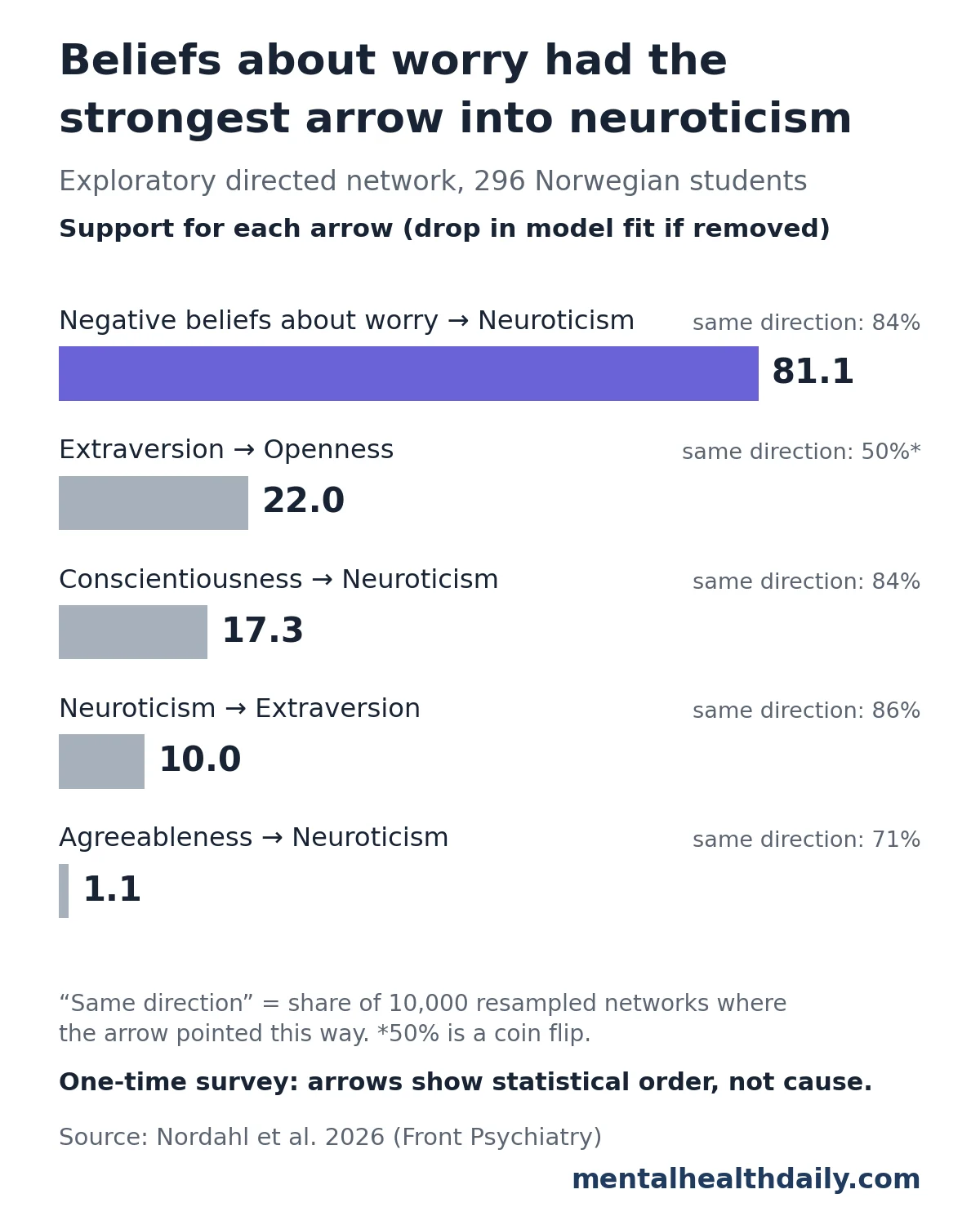
While partial-correlation networks illuminate connections, they do not inherently reveal the direction of influence. This is where the DAG analysis provided a critical layer of insight. The DAG attempts to infer the most probable directionality among interconnected variables. The analysis indicated that, among the many arrangements explored, the model that best fit the data posited a direct arrow running from negative beliefs about worry to neuroticism. This specific arrow demonstrated the strongest support within the model, with its removal significantly deteriorating model fit (an 81.1 change, nearly four times more impactful than removing the next strongest arrow) and appearing in 84% of the resampled networks.
Interestingly, the DAG also identified other notable directional links, with arrows pointing into neuroticism from conscientiousness (84% support) and agreeableness (71% support). Neuroticism, in turn, appeared to influence extraversion (86% support), which then connected to openness. The direction of the extraversion-to-openness arrow, however, was evenly split across resampled networks, rendering its direction inconclusive.
It is crucial to reiterate, as the researchers themselves emphasized, that interpreting a DAG as definitive proof of cause and effect requires stringent assumptions that cannot be fully verified with a single cross-sectional survey. These assumptions include the absence of any unmeasured confounding variables, the perfect specification of the model, and the lack of any unmeasured factors driving both sides of a relationship. Therefore, the observed direction from worry beliefs to neuroticism should be understood as a strong hypothesis generated by the data, aligning with the predictions of the S-REF model, rather than a definitive causal statement. Neuroticism could indeed foster negative worry beliefs, or a third, unmeasured factor could contribute to both. The study’s authors framed these directional findings as a compelling framework for future longitudinal or experimental investigations.
A Broader Timeline: From Theory to Therapeutic Application
The trajectory of research leading to these findings underscores the growing recognition of metacognitive processes. Adrian Wells’ S-REF model, developed over decades, provided the theoretical foundation. Preceding the 2026 study, earlier research had already begun to lay the groundwork. A 2019 study by a similar research group, for instance, involved 982 participants who completed measures of metacognitive beliefs and trait anxiety, with 425 of them repeating the measures eight weeks later. This longitudinal component, though short-term and not encompassing the full Big Five, demonstrated that metacognitive beliefs accounted for a substantial 83% of the variation in anxiety-proneness at a single time point. More critically, negative metacognitive beliefs were found to predict later trait anxiety and depression-proneness, suggesting a temporal influence.
These insights have profound implications for clinical psychology, particularly in the realm of therapeutic interventions. Metacognitive Therapy (MCT), pioneered by Adrian Wells, directly targets these problematic metacognitive beliefs. Unlike traditional Cognitive Behavioral Therapy (CBT), which often challenges the content of worries (e.g., "Is it really likely that X will happen?"), MCT focuses on changing the process of worrying and the beliefs about worry. For example, to challenge the belief that worry is uncontrollable, MCT patients might be instructed to postpone worry to a specific "worry time" each day, thereby demonstrating to themselves that they can indeed exert control over when and how they engage with worry.
Clinical trials have consistently demonstrated the efficacy of MCT across a range of mental health conditions. It has shown significant effectiveness in treating generalized anxiety disorder (GAD), post-traumatic stress disorder (PTSD), and major depressive disorder. These successful outcomes in changing worry beliefs and subsequently alleviating symptoms provide compelling evidence that modifying these metacognitive patterns can indeed lead to measurable improvements in psychological well-being, which aligns with the idea that changing worry beliefs could indirectly impact neuroticism. While the 2026 study did not directly test treatment, and its cross-sectional data cannot prove that changing these beliefs would fundamentally alter personality, the cumulative evidence from MCT trials strongly supports this hypothesis.
Limitations and Future Horizons
Despite its robust methodology, the 2026 study carries inherent limitations. As previously noted, its cross-sectional design precludes definitive causal conclusions. The sample comprised university students, which, while offering a relatively homogeneous group, may limit the generalizability of the findings to broader, more diverse populations. Furthermore, the reliance on self-report measures for both personality traits and metacognitive beliefs introduces the potential for response biases, such as social desirability.
Nonetheless, the implications of these results for understanding and addressing neuroticism are substantial. Neuroticism, often perceived as a largely immutable risk factor for anxiety and depression, may be more amenable to intervention than previously thought. This study zeroes in on a specific and modifiable belief—the conviction that worry is uncontrollable and harmful—as one of the most powerful and unique correlates of this pervasive personality trait.
The clear next step for researchers is to conduct rigorous longitudinal studies that repeatedly measure both worry beliefs and personality traits over extended periods. Such studies would be instrumental in disentangling the temporal order of these phenomena, providing stronger evidence for whether changes in metacognitive beliefs precede and potentially drive changes in neuroticism, or vice-versa. Additionally, experimental interventions specifically designed to alter worry beliefs, followed by assessments of long-term changes in neuroticism, would provide the most direct evidence of causality.
In conclusion, the 2026 Norwegian study offers a compelling new lens through which to view neuroticism. By highlighting the unique and powerful link between negative metacognitive beliefs about worry and this core personality trait, the research not only enriches our theoretical understanding but also reinforces the immense potential of targeted psychological interventions like Metacognitive Therapy. The paradigm shifts from viewing neuroticism as a fixed destiny to seeing it as a dynamic trait potentially influenced and modulated by specific cognitive patterns, opening new avenues for prevention, treatment, and fostering greater psychological resilience.

