

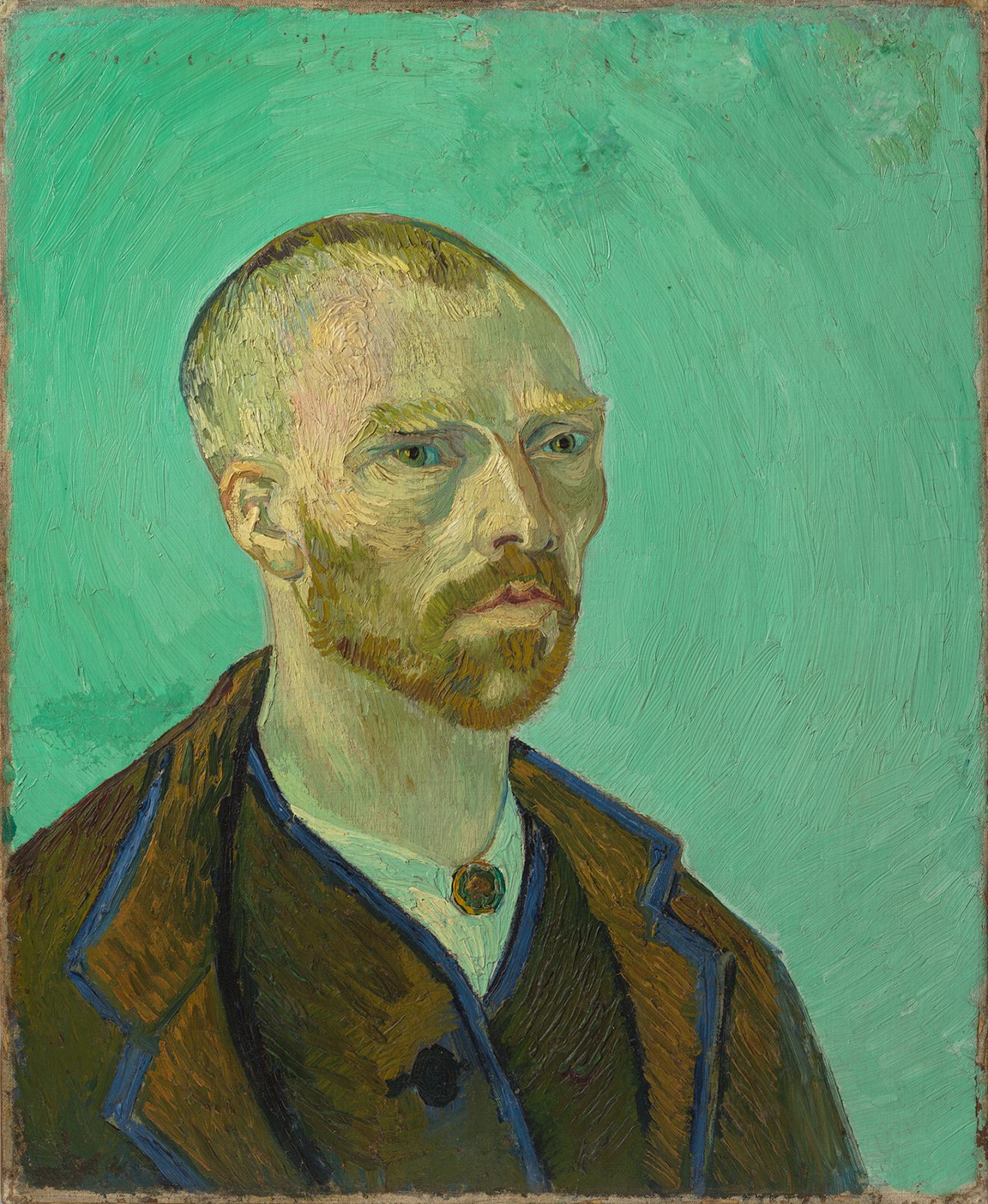
The profound impact of Van Gogh’s self-portrait at the Harvard Art Museum serves as a powerful metaphor for the human capacity for reverence, a vital response often overlooked in contemporary society. This iconic artwork, a gift originally intended for Paul Gauguin, eventually found its way to Harvard, where its radiant presence commands attention, even amidst masterpieces by Cézanne, Monet, and Picasso. The painting’s Veronese green backdrop accentuates a face that radiates light, fervor, and an undeniable human singularity. It imposes itself as an "uncapturable phenomenon," opening a spiritual dimension and revealing the artist’s extraordinary perception, transmuting the ordinary into the extraordinary, and humbling the viewer with its profound evidence. This inherent human response of reverence, the article posits, is crucial for attuning ourselves to excellence, transcendence, and the sublime, qualities that uplift and inspire but remain ultimately beyond full assimilation.
Reverence, as explored in the text, is not merely a passive admiration but an active engagement that sacralizes moments and organizes our world according to a scale of values, defining our "sacred horizon." Without it, humanity risks reverting to mere "reproductive organisms, genetic transmitters, survival machines." This innate capacity, a subterranean spring, purifies perception and ennobles our relationships when it encounters the sublime. However, it is frequently stifled, mistrusted, and derided, dismissed as naive or a sign of subservience. Recognizing and refining this primordial capacity is presented as integral to the Buddhist life and essential for any connection with the transcendent. In today’s "deconsecrated world," this virtue is seldom valued, leading to a potential void in recognizing higher value or glory.
The article critically examines contemporary targets of reverence, such as pop stars, politicians, and influencers. While these figures might embody certain values, they often fall short of sustaining the depth and scope of true reverence, leading to disappointment and cynicism. This disillusionment can diminish our willingness to trust our reverential impulses. Reverence is therefore framed not as a luxury but as a necessity for meaningful human flourishing. The absence of reverence, the argument continues, leads to a world devoid of a hierarchy of values, where choices are ranked by whim rather than merit, resulting in a lack of "call and response." The consuming gaze, in contrast, is depicted as inherently reductive, flattening and brutalizing the transcendent by trivializing the uncontainable and relegating icons to mere signs. Reverence, conversely, aligns with the sacred, allowing its grandeur to unfold and making the transcendent perceptible. It is a mode of perception that reveals what is vast, wondrous, and awe-inspiring, bringing into awareness what is supremely valuable. Through reverence, individuals offer themselves in service to the ideal, becoming conduits through which the sacred finds expression, not as an object, but as the very context for perception, meaning, and value.
Personal Journeys into Reverence
The author recounts a personal awakening to reverence, beginning with their first visit to a Buddhist center. The customary ritual acts of bowing, offering incense, and performing puja (supreme worship) initially felt awkward and compelling. Despite an estrangement from their reverential sensibility, a sense of being summoned persisted. This estrangement was partly attributed to childhood church experiences, where the perceived absence of the sacred left a lingering scent of "elsewhere" without any genuine connection. The author describes feeling clumsy and self-conscious, their gestures of reverence feeling "bogus" and directionless.
A pivotal moment occurred when the author, as a regular at the Leeds Buddhist Centre, received a small brass Buddha image from a fellow philosophy student. This gift inspired the creation of a personal shrine, where the Buddha image was placed amidst other valued, though now forgotten, items. The practice of bowing before this image, while cherished as a manifestation of the sacred, was accompanied by a sense of artificiality and a hazy intuition of what the sacred truly signified.
Several years later, during preparation for ordination into the Triratna Buddhist Order, the author engaged in the practice of "going for refuge" and prostration. This involved visualizing a "refuge tree"—a symbolic representation of sacred values and lineage—and physically prostrating before it, followed by absorbing blessings through the medium of light. While this practice, rooted in Tibetan Buddhism, is a "root practice" (mula yoga), the initial experience was marked by resistance, irritation, and boredom rather than reverence. Nevertheless, the practice worked "underground," gradually redirecting volition and shaping the author’s response towards an encounter with the three jewels.
A significant shift occurred in 2016 during an ordination retreat near Alicante, Spain. Following the recitation of the "Salutation to the three jewels," the participants performed the panchang pranam, a "five-point salutation" involving kneeling and touching the forehead and palms to the ground three times—a standard Indian gesture of profound respect. The author resolved to integrate this practice into their daily routine. While moments of self-consciousness and doubt ("Do I really mean this? What am I bowing to anyway?") still arose, the persistence of the gesture began to break down resistance and cynicism. This practice, the author reflects, has worn down pride and clinging to self-power, enabling a rendering of the self and providing a "language with which to intuit the transcendent."
Reverence in the Buddhist Tradition
The article emphasizes that Buddhism acknowledges an innate human capacity for admiration and an impulse to look upward. This capacity, which responds to what is worthy, noble, and exalted, is a treasure to be refined, not repressed, as it expresses the urge to reach toward infinite value or to allow infinite value to reach us. Newcomers to Buddhism are sometimes surprised by devotional acts, associating them with blind belief or subservience, but the article clarifies the profound rationale behind these practices.
The primary object of reverence in Buddhism is the Buddha: the pathfinder, exemplar, and guide. The Buddha embodies the highest possibilities of human existence—enlightenment—a state attainable by all. Reverence is presented as the mechanism through which individuals enter into relationship with this possibility, bridging the gap between it and their current consciousness.
Reverence is portrayed as integral to the Buddhist life, providing a means to intuit the sacred. Counterintuitively, the more spiritually advanced a being becomes, the greater their capacity for reverence. This is illustrated by the example of the great bodhisattva Dharmakara (who would become Amitabha Buddha) in the Larger Pure Land Sutra, who vows that beings in his Pure Land will be able to honor all buddhas everywhere and at all times.
The Buddha himself underscored the importance of reverence, valuing its ritual embodiment in devotional acts. A pivotal discourse in the Pali canon, the Garava Sutta, reveals the centrality of reverence in the Buddhist worldview. Reflecting on his awakening, the Buddha states, "One experiences suffering if dwelling without reverence or deference." The term dukkha, translated as "suffering," can also mean "dissatisfaction" or "lack." The term for "reverence," garava, encompasses "admiration," "amazement," and "delight" in the existence of those superior in creative ability or spiritual attainment. This is akin to vandana (salutation) and puja (worship), expressing skillful emotions connected to engaging with what is worthy and magnificent, and embodying sensitivity to values beyond the mundane self.
"Deference," or patissa, stems from a root meaning "to listen or hear," signifying careful attention to counsel, particularly within the teacher-disciple relationship. According to the Buddha, living without reverence and deference invites suffering because it implies recognizing nothing beyond oneself—no higher point of reference than one’s egocentric will. This perspective, while potentially appealing to extreme narcissists, is profoundly insufficient for most of humanity. As Sangharakshita states, "To live without looking up to anyone represents an impoverishment of one’s emotional life and, indeed, an impairment of one’s very humanity."
The human psyche requires something to look up to—a transcendent orientation that inspires the actualization of deepest aspirations. Without it, a sense of emptiness and depression can prevail. Recognizing that one has not yet reached the pinnacle of noble potential, and that admirable qualities and actions are possible, underscores the importance of garava and patissa as affirmations of our capacity to recognize and respond to more complete and refined manifestations of our highest ideals.
When lived with integrity, the Buddhist (Dharma) life embodies the principle of reverence or devotion. This does not necessarily mandate constant ritualistic performance but can be expressed through simple, everyday actions: cleaning a shrine room, making tea for a respected friend, or offering a small gift. The entire practice, including meditation, becomes a quiet offering of attention and presence.
The Mandala of Reverence: Mapping True Value
The article proposes a "spiritual inventory of reverence" as a means to gain clarity on one’s most prized values. This involves examining how and toward what reverence is expressed in one’s life, and discerning whether the focus is mundane—an "improper focus for our most sacred praise," termed idolatry by theologian Paul Tillich—or something that inspires self-transcendence and corresponds to one’s "ultimate concern." Henry Corbin’s perspective is cited: idolatry arises from an inability to see an idol as transparent, to discern the "hidden invitation that it offers to go beyond it." The opposite of idolatry, therefore, is rendering the idol transparent, "transmuting the idol into an icon."
The concept of a "mandala of reverence" is introduced, where a mandala serves as a map of value. What is placed at the center signifies what one truly values—what one "goes for refuge to." This exercise can reveal whether prioritized values are mundane. The distinction between false or limited refuges and the ultimate, true refuge is crucial. For Buddhism, the three jewels (Buddha, Dharma, Sangha) represent the most complete refuge and the transcendental object. If the three jewels are not at the center of one’s mandala of reverence, it constitutes a form of idolatry, characterized by settling for a limited refuge, remaining alienated from one’s ultimate concern and the true significance of life.
Through devotional acts and attitudes directed toward the three jewels, individuals can restore and celebrate their connection with their ultimate concern, allowing it to bless their existence. To "go for refuge to the Buddha" means to comport oneself toward the Buddha as a focus of devotion, inspiration, and aspiration, converting the Buddha image into an icon and committing to minimizing the gap between one’s own mind and the Buddha’s mind. Ultimately, this signifies the aspiration to become the Buddha. Through reverence, individuals permit the transcendent to reconstitute them, yielding to the "weight of its glory, which fills me with blessing."
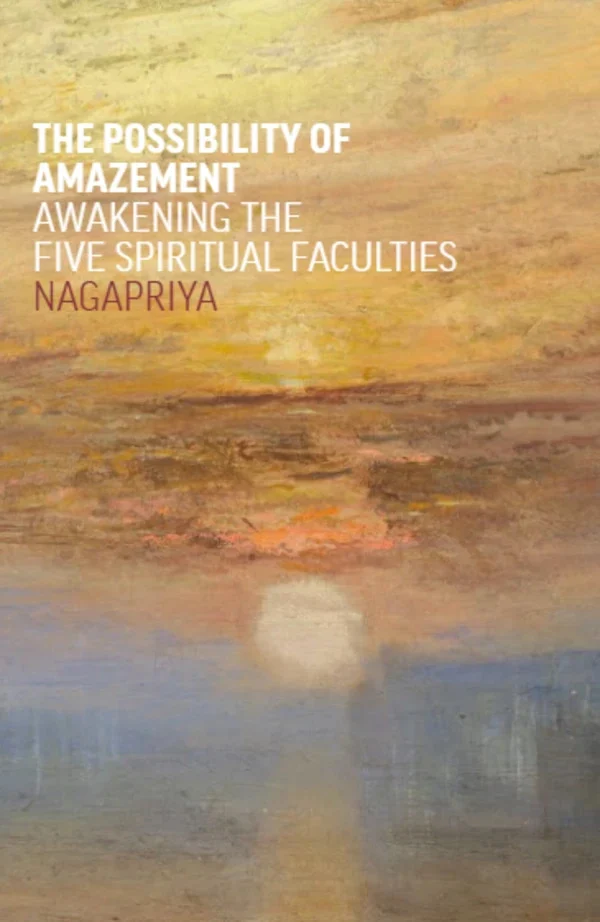
The article concludes with an image of the book The Possibility of Amazement: Awakening the Five Spiritual Faculties by Nagapriya, reprinted with permission from Windhorse Publications, suggesting that the exploration of reverence is intrinsically linked to the awakening of profound human capacities for wonder and spiritual insight.

