

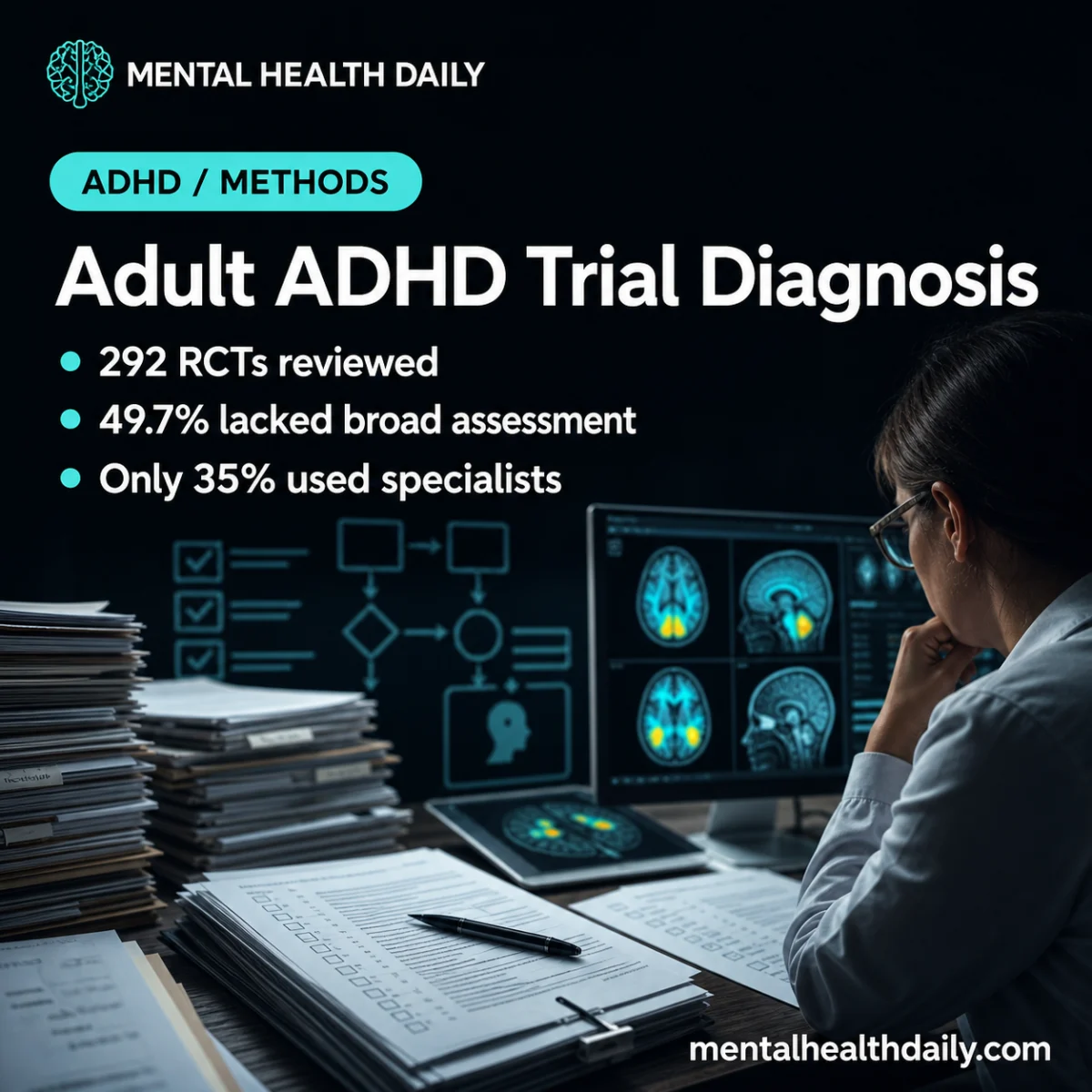
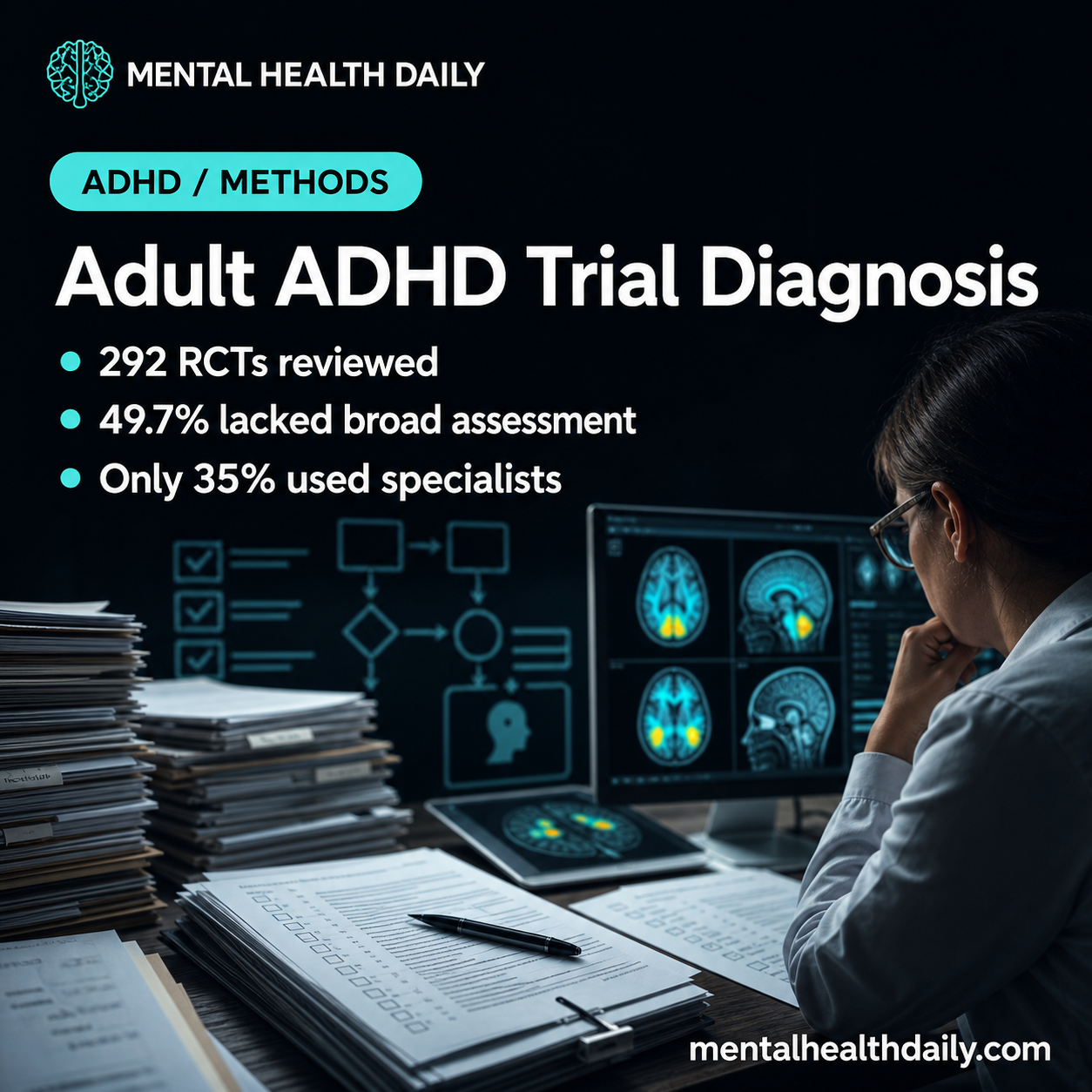
A landmark 2025 scoping review of 292 randomized controlled trials (RCTs) investigating adult Attention-Deficit/Hyperactivity Disorder (ADHD) has cast a critical light on the diagnostic methodologies employed in foundational research. The comprehensive analysis, led by Studart et al., uncovered that a significant 49.7% of these trials allocated an ADHD diagnosis without incorporating a general psychopathology assessment, a crucial step for distinguishing ADHD from other conditions with overlapping symptoms. Furthermore, only 35% of the reviewed studies explicitly reported that the ADHD diagnosis was assigned by a qualified psychiatrist or psychologist, raising concerns about the expertise behind these critical evaluations. These findings suggest that a substantial portion of the evidence base guiding adult ADHD treatment may be built upon samples whose diagnostic integrity is not sufficiently documented, potentially impacting the generalizability and reliability of their reported outcomes.
The Evolving Landscape of Adult ADHD Diagnosis
For decades, ADHD was primarily conceptualized as a disorder of childhood, with diagnostic criteria heavily focused on observable behaviors in school-aged children. However, clinical understanding has significantly evolved, leading to the formal recognition of adult ADHD. The Diagnostic and Statistical Manual of Mental Disorders (DSM), particularly from DSM-IV onwards and solidified in DSM-5, introduced criteria for adult presentations, including the requirement for symptoms to have been present in childhood and to cause significant impairment in adulthood. This shift has led to a dramatic increase in adult ADHD diagnoses globally, driven by greater awareness among both the public and clinicians, and a growing body of research into its adult manifestations.
The complexity of diagnosing ADHD in adults stems from several factors. Unlike children, adults often present with more internalized symptoms, such as difficulties with executive functions, emotional dysregulation, and internal restlessness, rather than overt hyperactivity. Retrospective recall of childhood symptoms can be challenging and subject to bias. Crucially, adult life stages inherently involve more complex psychological and social factors, leading to a higher prevalence of comorbid conditions that can mimic or exacerbate ADHD symptoms. This intricate diagnostic landscape makes a thorough and differential diagnostic process indispensable, not optional. The rise in public awareness, amplified by social media platforms, while beneficial for encouraging help-seeking, also means that broad symptom lists circulate widely, often failing to differentiate ADHD from other conditions, making rigorous clinical assessment more vital than ever. For instance, a 2021 study by Yeung et al. highlighted the variable quality of ADHD content on TikTok, underscoring the potential for misinformation and the need for evidence-based clarity.
Diagnostic Rigor: The Unassessed Foundation of Clinical Trials
The Studart et al. review rigorously examined the diagnostic "gate" of nearly 300 adult ADHD RCTs, focusing on the transparency and robustness of their methodologies. The core concern is not whether participants were definitively misdiagnosed, but rather that many trials failed to document diagnostic procedures strong enough to render their samples clinically interpretable and comparable to real-world patient populations.
The review categorized diagnostic methods into several types: reliance solely on clinical diagnoses, clinical diagnoses supplemented by ADHD-specific rating scales, or structured/semi-structured interviews. The critical distinction, however, was whether these methods included a comprehensive general psychopathology assessment designed to rule out competing explanations for the symptoms observed.
Key Findings in Detail:
- Absence of General Psychopathology Assessment (49.7%): Nearly half of the studies reviewed fell into this category. These trials typically used methods that might identify individuals appearing to have ADHD but lacked the broader assessment necessary to confirm that ADHD was the primary or best explanation for their symptoms. This could involve relying on ADHD-specific checklists or interviews without probing for, or systematically ruling out, conditions such as major depressive disorder, anxiety disorders, bipolar disorder, sleep disorders, substance use disorders, autism spectrum disorder, or trauma-related conditions. The consequence is that such samples might inadvertently include individuals whose attention difficulties or impulsivity are primarily driven by other underlying issues, diluting the specificity of any observed treatment effects for ADHD.
- Non-Specialist Diagnosis (65% did not report specialist involvement): The review found that 190 out of 292 studies either failed to report who conducted the diagnostic assessment, or indicated that it was performed by individuals other than psychiatrists or psychologists, or even relied on automated computer algorithms. This is a significant concern because a psychiatric diagnosis requires nuanced clinical judgment, distinguishing between complex presentations, and understanding the interplay of various mental and physical health conditions. A skilled specialist can identify conditions that mimic ADHD symptoms, such as the inattention associated with depression or sleep deprivation, the restlessness of anxiety, or the impulsivity seen in bipolar mania or certain personality disorders. Without this expertise, the reliability and comparability of diagnostic assignments across trials are significantly weakened. The World Federation of ADHD’s consensus statement estimated adult ADHD prevalence at 2.5%, while a global meta-analysis indicated symptomatic adult ADHD at 6.75% in 2020. This gap between symptom prevalence and diagnosed prevalence underscores the importance of expert evaluation to ‘hold that line’ and ensure accuracy.
The Crucial Role of Differential Diagnosis
Differential diagnosis is the process of distinguishing a particular disease or condition from others that present with similar symptoms. In adult ADHD, this step is paramount. Symptoms such as inattention, restlessness, impulsivity, sleep disruption, anxiety, and mood fluctuations are not unique to ADHD. They can manifest across a wide spectrum of psychiatric and medical conditions. For instance:
- Anxiety Disorders: Can cause difficulties concentrating due to worry, restlessness, and irritability.
- Depression: Often leads to poor concentration, fatigue, lack of motivation, and psychomotor retardation or agitation.
- Bipolar Disorder: Episodes of mania or hypomania can involve increased activity, impulsivity, racing thoughts, and distractibility, while depressive phases mirror major depression.
- Trauma (e.g., PTSD): Hypervigilance, difficulty concentrating, irritability, and impulsivity are common.
- Substance Use Disorders: Can directly impair attention and executive functions, and withdrawal symptoms can mimic ADHD.
- Sleep Disorders (e.g., insomnia, sleep apnea): Chronic sleep deprivation severely impacts concentration, memory, and mood.
- Autism Spectrum Disorder: Features like difficulties with social communication, restricted interests, and sensory sensitivities can co-occur with or be mistaken for ADHD-like inattention.
- Personality Disorders: Impulsivity and emotional dysregulation can be prominent.
Without a thorough assessment that systematically considers and rules out these alternative or co-occurring explanations, a trial sample purporting to study ADHD might, in reality, be a mixed group of individuals with diverse underlying pathologies. This limitation is further amplified by the high rates of comorbidity in adult ADHD populations; while trials can legitimately include patients with comorbidities, they must clearly document how ADHD was distinguished from these overlapping presentations.
Implications for Treatment Efficacy and Patient Care
The findings of the Studart et al. review carry significant implications for the interpretation of existing adult ADHD treatment evidence and for future research and clinical practice.
1. Generalizability of Treatment Effects: When an RCT lacks robust diagnostic procedures, the generalizability of its reported medication or psychotherapy effects becomes questionable. Clinicians rely on trial data to inform their treatment decisions for real-world patients. If trial participants are not truly representative of carefully diagnosed ADHD patients, then the efficacy and safety data may not accurately reflect outcomes in clinical practice. A "weak diagnostic gate" means that the conclusions drawn from such trials may be difficult to apply to the diverse and complex individuals seeking ADHD evaluation.
2. Distortion of Treatment Effect Estimates: Loose diagnostic entry criteria can skew treatment effect estimates in various directions. If a trial includes individuals whose attention problems are primarily caused by, for example, sleep deprivation, undiagnosed bipolar disorder, or anxiety, then an ADHD-specific treatment (like a stimulant) might appear less effective than it truly is for ADHD, because it’s being administered to patients for whom it’s not the primary mechanism of action. Conversely, a trial that inadvertently screens for an overly "clean" subset of patients—those with uncomplicated, easily treated, checklist-positive ADHD—might overestimate treatment benefits compared to the reality of clinical practice where comorbidity is the norm.
3. Adverse Event Interpretation: Diagnostic rigor also affects the interpretation of adverse events. If a trial sample includes undetected bipolar disorder, substance use disorder, or severe anxiety, then stimulant tolerability and discontinuation rates might reflect the challenges of mixed pathology rather than the specific response to ADHD treatment alone. This complicates the risk-benefit analysis for clinicians and patients.
4. Ethical and Public Health Concerns: The burgeoning visibility of adult ADHD, particularly online, increases the stakes. Accurate diagnosis is not merely an academic exercise; it influences access to medication, workplace accommodations, academic support, and even disability claims. If the evidence base for ADHD treatments is built on shaky diagnostic foundations, it risks misguiding public health policies and potentially leading individuals to receive inappropriate or ineffective treatments, delaying proper care for their actual conditions.
A Call for Enhanced Transparency and Reporting Standards
The review unequivocally argues for greater transparency in adult ADHD research. Researchers must move beyond simply stating that participants "met DSM criteria." A useful adult ADHD trial report should provide enough detail for readers to reconstruct the diagnostic process, enabling them to assess its rigor.
Minimum Transparency Standards for RCTs:
- Who conducted the diagnosis: Specify the professional qualifications (e.g., psychiatrist, psychologist, trained clinician).
- Diagnostic tools used: List specific structured or semi-structured interviews (e.g., DIVA-5, CAARS), rating scales, and other clinical assessments.
- Assessment of general psychopathology: Detail how co-occurring conditions and differential diagnoses were systematically evaluated and ruled out or documented.
- How diagnostic uncertainty was handled: If there were cases of diagnostic ambiguity, how were they resolved?
- Inclusion/Exclusion criteria for comorbidities: Clearly state which comorbidities were permitted and how their presence was established and accounted for in the study design and analysis.
Such transparent reporting allows for a nuanced interpretation of trial results. A stimulant trial with a robust diagnostic workup, involving specialist assessment and comprehensive differential diagnosis, can be confidently generalized to specialist ADHD clinics. Conversely, a trial relying solely on scale-based entry with limited comorbidity assessment might still estimate medication response in a symptom-defined population, but its clinical meaning and generalizability would be significantly narrower.
Moving Forward: Strengthening the Evidence Base
The Studart et al. review does not suggest that adult ADHD is not a real or valid diagnosis; rather, it critiques methodological inconsistencies in research that undermine the evidence base. It challenges the assumption that all individuals categorized as "adult ADHD" in trials represent a homogeneous population.
The goal is not to gatekeep access to ADHD treatment but to ensure "cleaner evidence labels." A trial can be valuable if it studies narrowly defined ADHD, broadly comorbid ADHD, primary-care ADHD, or even symptom-screen-positive attention problems. The critical failure occurs when these distinct populations are blurred under a single diagnostic heading, and treatment estimates are then applied indiscriminately to every adult presenting with concentration difficulties.
Ultimately, trial evidence becomes more useful when the characteristics of the study population—including their diagnostic complexity, medication exposure, and comorbidity burden—are transparently documented. This allows clinicians to make informed decisions, matching trial findings to the unique profiles of their patients, thereby improving the quality of care for adults seeking help for ADHD and related conditions. The insights from this 2025 scoping review serve as a vital call to action for researchers, funding bodies, and journal editors to elevate diagnostic rigor and reporting standards in adult ADHD clinical trials, ensuring that the foundation of our knowledge is as robust as the clinical need it seeks to address.

