

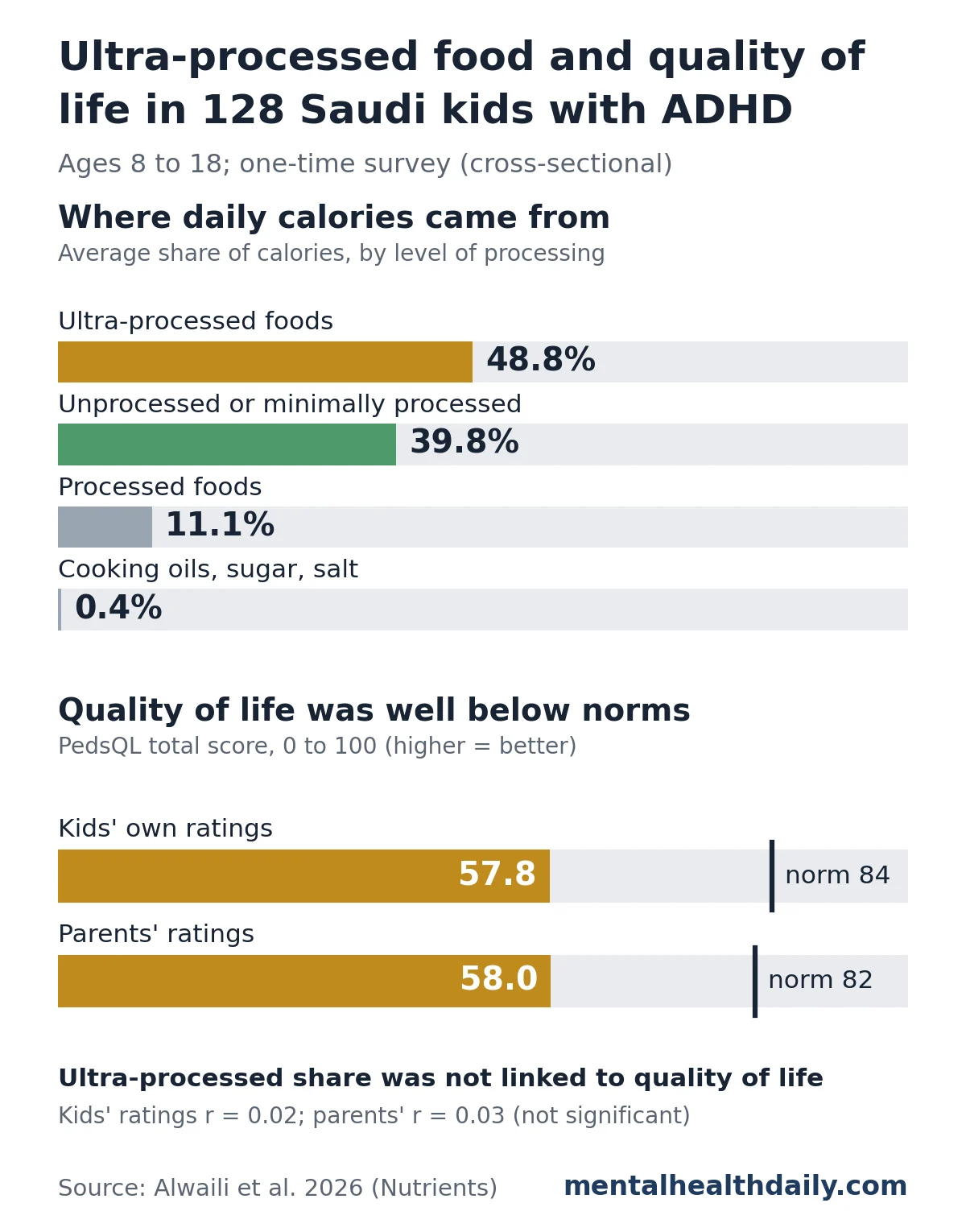
A landmark survey study conducted in Saudi Arabia in 2026 has brought to light significant dietary patterns and quality of life challenges among children and adolescents diagnosed with Attention-Deficit/Hyperactivity Disorder (ADHD). The research, which analyzed data from 128 Saudi children and teens, revealed that nearly half of their daily caloric intake, precisely 48.8%, came from ultra-processed foods (UPF). While this figure aligns with growing global concerns about UPF consumption, the study presented an intriguing, and perhaps counterintuitive, finding: despite alarmingly low quality of life scores among these young individuals, there was no direct statistical correlation between their level of ultra-processed food consumption and their reported quality of life. This absence of a direct link, however, does not diminish the broader implications for public health and the urgent need to address the multifaceted challenges faced by children with ADHD.
The study’s findings underscore a dual public health concern within the Saudi context: the pervasive presence of ultra-processed foods in the diets of vulnerable populations and the profound impact of ADHD on children’s daily functioning and well-being. While the high intake of UPF among children with ADHD is consistent with observations in other populations, the lack of a direct correlation with quality of life suggests that the relationship between diet and well-being in neurodevelopmental conditions is complex and multi-faceted, potentially influenced by numerous other confounding factors that warrant deeper investigation.
A Deep Dive into Dietary Habits: Nearly Half of Calories from Ultra-Processed Foods
The research, led by Lina Alwaili and Abeer Alzaben at Princess Nourah bint Abdulrahman University in Riyadh, meticulously examined the dietary habits of 128 children and teens aged 8 to 18 years old with a confirmed ADHD diagnosis. The data, collected through an online survey between January 2024 and December 2025, painted a clear picture: ultra-processed foods dominated the caloric landscape, contributing an average of 48.8% of daily calories. In contrast, unprocessed or minimally processed foods accounted for 39.8%, processed foods 11.1%, and added cooking ingredients a mere 0.4%. This dietary composition remained remarkably consistent across various demographic groups, showing no significant differences based on sex, region, household income, parents’ education, number of siblings, medication use, or time since diagnosis.
To categorize foods, the researchers employed the NOVA classification system, a globally recognized framework that groups foods based on the extent and purpose of industrial processing rather than their nutrient content. This system comprises four categories:
- NOVA Group 1: Unprocessed or minimally processed foods (e.g., fresh fruits, vegetables, meat, eggs, milk, grains, legumes). These are foods in their natural state or minimally altered without adding substances like sugar, salt, or fat.
- NOVA Group 2: Processed culinary ingredients (e.g., oils, butter, sugar, salt, vinegar). These are derived from Group 1 foods and are typically used in small amounts to prepare meals.
- NOVA Group 3: Processed foods (e.g., canned vegetables, cheeses, freshly baked bread). These are made by adding salt, sugar, oil, or other Group 2 ingredients to Group 1 foods.
- NOVA Group 4: Ultra-processed foods (UPF) (e.g., soft drinks, packaged snacks, instant noodles, breakfast cereals, fast food, frozen meals). These are industrial formulations made from multiple ingredients, often including food additives, flavors, colors, and emulsifiers, designed to be convenient, palatable, and highly profitable.
The prevalence of UPF in the diets of Saudi children with ADHD mirrors broader global trends. The rise of UPF consumption is a significant public health concern worldwide, driven by urbanization, changing lifestyles, aggressive marketing, and their affordability and convenience. These foods are often high in unhealthy fats, sugar, and sodium, and low in fiber and essential micronutrients, contributing to a range of chronic health issues including obesity, type 2 diabetes, cardiovascular disease, and even some mental health conditions. For children with ADHD, who may already face challenges with impulse control and executive functioning, the allure of highly palatable UPF can be particularly strong, potentially exacerbating existing dietary imbalances.
Previous research provides further context. A Spanish case-control study involving 120 children found that those newly diagnosed with ADHD consumed more sugar, candy, and soft drinks, ate fast food more frequently, and adhered less to a Mediterranean-style diet compared to children without ADHD. Similarly, an Israeli national survey of 1,135 children aged 6 to 11 reported that the 111 children with ADHD were more likely to consume above-median amounts of ultra-processed food, even after accounting for age, sex, socioeconomic status, and calorie intake. These studies, like the Saudi research, highlight a consistent pattern of higher UPF intake among children with ADHD, though the precise nature of the link—whether dietary choices influence ADHD, or ADHD-related challenges influence dietary choices, or both—remains an area of ongoing investigation.
The Quality of Life Landscape for Children with ADHD: A Critical Concern
Beyond dietary analysis, the Saudi study shed critical light on the quality of life experienced by these children. Quality of life was assessed using the Pediatric Quality of Life Inventory (PedsQL), a widely validated, 23-question survey designed to measure physical, emotional, social, and school functioning. Both the children themselves and their parents completed versions of the questionnaire, with a high degree of agreement between their responses (correlation above 0.80), underscoring the reliability of the collected data. Scores are converted to a 0-to-100 scale, with higher scores indicating a better quality of life.
The findings were stark: the total quality of life scores averaged 57.8 in the children’s self-ratings and 58.0 in their parents’ ratings. These figures stand in stark contrast to published healthy norms of 84 and 82, respectively, derived from a large US reference sample (p < 0.0001). This significant disparity underscores the profound challenges faced by children and teens with ADHD in Saudi Arabia, suggesting their daily lives are substantially impacted by their condition across multiple domains.
A granular look at the PedsQL sub-domains revealed that school functioning was the hardest hit area, scoring lowest in both children’s and parents’ ratings. This is particularly concerning given that ADHD often manifests significantly in academic settings, impacting concentration, organizational skills, and behavior, which can lead to academic underachievement, social difficulties, and diminished self-esteem. Physical functioning, while still below healthy norms, scored highest, suggesting that while the physical aspects of daily life may be less impaired, the cognitive, emotional, and social dimensions pose greater hurdles. The emotional and social domains also showed considerable deficits, highlighting the pervasive nature of ADHD’s impact beyond just academic performance.
Attention-deficit/hyperactivity disorder (ADHD) is a persistent neurodevelopmental condition characterized by ongoing patterns of inattention, hyperactivity, and impulsivity that interfere with functioning or development. It typically emerges in childhood and can profoundly affect school performance, friendships, and family dynamics. The consistently low quality of life scores in this study serve as a poignant reminder of the comprehensive support needed for these children and their families, extending far beyond clinical symptom management to encompass holistic well-being.
The Unanticipated Null Finding: Diet and Quality of Life
Perhaps the most unexpected and significant finding of the study was the absence of a significant correlation between the share of calories derived from ultra-processed foods and total quality of life. Whether rated by the children themselves (r = 0.016, p = 0.85) or their parents (r = 0.034, p = 0.71), the correlation values were extremely close to zero. This indicates that knowing how much ultra-processed food a child consumed provided virtually no predictive power regarding their overall quality of life score. Furthermore, none of the eight specific domain scores (physical, emotional, social, school) showed a significant link to UPF intake.
This null result is crucial. It does not imply that diet is irrelevant to the overall health or even the symptoms of ADHD. Rather, it suggests that within the context of this specific cross-sectional study, the proportion of ultra-processed food in the diet was not a direct or primary determinant of perceived quality of life as measured by the PedsQL. This finding challenges simplistic assumptions that a direct, linear relationship exists between UPF consumption and broad quality of life metrics in this population. It also highlights the complexity of assessing the impact of diet, especially in conditions like ADHD where myriad factors—genetic predisposition, severity of symptoms, co-occurring conditions, medication efficacy, therapeutic interventions, family support, school environment, and socioeconomic status—all interact to shape an individual’s well-being.
While this study found no direct link, other research, using different methodologies, has explored more granular connections. For instance, a study following 3,206 Chinese adolescents for a year found that specific items like instant noodles, sugary drinks, and fried foods were linked to lower quality of life, while fruit consumption correlated with higher quality of life. The distinction lies in the approach: the Chinese study looked at specific food items and longitudinal changes, whereas the Saudi study focused on the total share of calories from ultra-processed foods at a single point in time. These differences in methodology, population, and specific dietary exposures can lead to varied findings, emphasizing the need for nuanced interpretation and further research.
Beyond Diet: Other Factors Influencing Quality of Life
While diet did not emerge as a direct predictor of quality of life in this study, other socio-demographic factors did show some connections. Notably, parents’ education level was the only family factor significantly linked to a higher quality of life for the children. This correlation suggests that higher parental education might be associated with greater access to resources, better understanding of ADHD and its management, increased advocacy for their child’s needs, or a more supportive home environment, all of which could positively impact a child’s overall well-being.
Conversely, quality of life did not significantly differ by sex, household income, medication use, medication type, or time since diagnosis. These non-findings are also important, as they suggest that the core challenges to quality of life in ADHD might transcend some common demographic or clinical variables, pointing to the inherent difficulties of the condition itself.
The study also explored body weight, finding a weak link between a higher BMI-for-age score and lower school functioning (r = –0.24 in kids’ ratings) and lower parent-rated total quality of life (r = –0.22). Intriguingly, higher BMI scores also had a borderline link with a smaller ultra-processed share (r = –0.18, p = 0.049). However, these were noted as weak results among dozens of tests run without correction for multiple comparisons, and they relied on parent-reported heights and weights for a subset of the children. Such weak, uncorrected correlations require cautious interpretation and are less robust than the primary findings.
Methodology and Study Design: A Closer Look
The study employed a cross-sectional design, meaning all data was collected at a single point in time. While this design is excellent for describing prevalence and identifying associations, it inherently cannot establish causality or determine which factor came first. For instance, it can show that high UPF intake and low quality of life co-exist in this population, but it cannot demonstrate whether reducing UPF would improve quality of life, or if low quality of life influences dietary choices.
Recruitment for the study took place between January 2024 and December 2025, involving families through the Saudi ADHD Society (the Ishraq Association) and King Abdullah bin Abdulaziz University Hospital. This collaboration ensured access to a relevant population and leveraged established networks for ADHD support. Of 145 families who initially completed the online survey, 17 were excluded due to implausible answers, such as daily calorie totals below 500 or above 5,000, or impossible height and weight combinations. This rigorous data cleaning process is a testament to the researchers’ commitment to data quality, ultimately yielding a robust sample of 128 children for analysis. Diet information was gathered using a validated Saudi food frequency questionnaire, completed by parents and converted into daily caloric intake via specialized software.
The researchers themselves acknowledged several limitations of their study. The cross-sectional nature is a primary constraint, preventing causal inferences. The reliance on self-reported data (via parents and children) for diet, height, and weight also introduces potential for recall bias or inaccuracies. The specific population of Saudi children with ADHD, while valuable for understanding local contexts, means the findings may not be directly generalizable to other populations or children without ADHD. The relatively small sample size, while adequate for some analyses, limits the power to detect subtle correlations or conduct extensive subgroup analyses. Finally, the potential for unmeasured confounding factors, such as specific ADHD symptom severity, co-occurring mental health conditions, or ongoing therapeutic interventions, cannot be overlooked.
Expert Commentary and Broader Implications
The findings of this Saudi study carry significant implications for public health, nutrition science, and the care of children with ADHD.
From the perspective of the researchers, Lina Alwaili and Abeer Alzaben, the high prevalence of ultra-processed food consumption in this vulnerable group is a clear call to action, irrespective of the direct quality of life link. They would likely emphasize that while the study did not establish a causal link to quality of life, a diet high in UPF is unequivocally detrimental to overall health and development. "Our findings highlight that children with ADHD in Saudi Arabia consume a substantial amount of ultra-processed foods, consistent with observations globally," an inferred statement from the researchers might suggest. "While we did not find a direct correlation with quality of life in this cross-sectional study, the general health implications of such a diet are undeniable. Future longitudinal and interventional studies are crucial to understand the nuanced relationship between diet, ADHD symptoms, and well-being."
Public health officials and nutritionists in Saudi Arabia would likely view these findings with concern. The rapid dietary transition in the Kingdom, marked by an increase in convenience foods and a shift away from traditional diets, poses significant health challenges. An inferred response from the Saudi Ministry of Health or a leading nutritionist might state, "The high intake of ultra-processed foods among our children, particularly those with conditions like ADHD, is a serious public health issue. These findings underscore the urgent need for comprehensive national strategies that promote healthy eating habits, encourage consumption of minimally processed foods, and educate families on the long-term health risks associated with UPF. This is not just about ADHD, but about the general health and future of our youth."
The Saudi ADHD Society (Ishraq Association), a key partner in the study, would likely highlight the broader context of supporting children with ADHD. An inferred statement from an advocacy group might articulate, "The consistently low quality of life scores, especially in school, are deeply concerning. This study reinforces what many families of children with ADHD already experience: significant challenges that impact every aspect of daily life. While diet is one piece of the puzzle, our focus must remain on providing holistic support, including educational accommodations, psychological therapies, and family counseling, to ensure these children can thrive and achieve their full potential."
The study’s null finding regarding UPF and quality of life is not an invitation to disregard healthy eating. Instead, it prompts a more sophisticated understanding of the factors influencing quality of life in ADHD. It suggests that while diet is critical for physical health and potentially for modulating some ADHD symptoms, the broader experience of living with ADHD and its impact on well-being is mediated by a complex interplay of clinical, social, and environmental factors.
Looking Ahead: The Path for Future Research
This cross-sectional study lays important groundwork but also illuminates the vast landscape for future research. The most pressing need is for longitudinal studies and interventional trials that can establish causality. Such studies would involve tracking dietary changes over time and observing their effects on ADHD symptoms, cognitive function, and quality of life. For instance, a randomized controlled trial comparing a low-UPF diet intervention with a control diet could provide invaluable insights.
Future research could also delve deeper than broad UPF categories, investigating the impact of specific food additives, artificial colors, preservatives, or high sugar content, which have been implicated in behavioral issues in some children. Exploring the role of specific micronutrients, gut microbiome composition, and inflammatory markers in children with ADHD, in conjunction with dietary patterns, could uncover more nuanced connections. Furthermore, larger, more diverse samples, potentially across different regions and socioeconomic strata within Saudi Arabia, would enhance the generalizability of findings.
Practical Takeaways for Families and Healthcare Providers
For families of children with ADHD, this study offers several practical takeaways, even with its limitations:
- Prioritize General Healthy Eating: A diet built primarily on unprocessed or minimally processed foods remains a cornerstone of good health for all children, including those with ADHD. While this study didn’t link UPF to quality of life, the established risks of UPF for obesity, diabetes, and other chronic diseases are reason enough to minimize their consumption. Focus on whole grains, lean proteins, fruits, and vegetables.
- Address Quality of Life Holistically: The consistently low quality of life scores, particularly in school and emotional domains, are a critical concern. Parents should actively raise these issues with their child’s doctor, psychiatrist, psychologist, or care team. Interventions might include behavioral therapy, academic support strategies, social skills training, and family counseling.
- No Single "Magic Bullet": The absence of a direct link between UPF and quality of life in this study reinforces that managing ADHD and improving well-being is not about a single dietary change. It requires a comprehensive, multi-modal approach that addresses symptoms, supports academic and social development, and fosters emotional resilience.
- Seek Expert Guidance: Nutritional advice for children with ADHD should ideally come from qualified dietitians or healthcare providers who can tailor recommendations to individual needs and integrate them into a broader treatment plan.
- Parental Education Matters: The link between parental education and higher quality of life underscores the importance of empowering parents with knowledge, resources, and support networks to navigate the challenges of raising a child with ADHD.
In conclusion, the Saudi study provides a crucial snapshot of the dietary habits and quality of life challenges faced by children with ADHD in the region. It highlights a significant public health concern regarding ultra-processed food consumption and underscores the urgent need to improve the overall well-being of these children. While the lack of a direct correlation between UPF and quality of life invites further complex research, it does not diminish the fundamental importance of healthy eating for all children, nor does it lessen the imperative to address the profound struggles experienced by children with ADHD in their daily lives. The path forward requires continued research, robust public health initiatives, and comprehensive, individualized support systems for children with ADHD and their families.

