

A groundbreaking international study has revealed that among individuals prescribed ADHD medication across five distinct health systems, recorded instances of self-harm were most prevalent in the three months prior to their first prescription, rather than subsequent to it. This significant finding challenges long-held concerns regarding the safety profile of ADHD treatments and reorients the understanding of self-harm risk in this vulnerable population. The research indicates a marked decline in self-harm risk once treatment commences, though it noted that the risk remained marginally elevated above each individual’s unmedicated baseline over the longer term.
Unpacking the Connection: ADHD, Self-Harm, and Treatment Concerns
Attention-deficit/hyperactivity disorder (ADHD) is a prevalent neurodevelopmental condition characterized by persistent patterns of inattention, hyperactivity, and impulsivity. Affecting millions globally, ADHD can significantly impact daily functioning, academic performance, and social relationships. Beyond these primary symptoms, individuals with ADHD are recognized to face a higher intrinsic risk of suicidal ideation and behavior compared to the general population. This elevated baseline risk naturally places the safety of ADHD pharmacological treatments under intense scrutiny, particularly concerning potential links to self-harm.
The pharmacological management of ADHD primarily involves two main categories of medications: stimulants and non-stimulants. Stimulants, such as methylphenidate and amphetamines, are often considered first-line treatments due to their effectiveness in improving core ADHD symptoms by increasing the availability of certain neurotransmitters in the brain. Non-stimulants, including atomoxetine and guanfacine, offer alternative options, working through different mechanisms and sometimes preferred for individuals who do not respond well to stimulants or have specific contraindications.
Historically, the relationship between ADHD medication and self-harm has been a subject of considerable debate and conflicting evidence. Earlier studies yielded mixed results, with some suggesting an increase in self-harm shortly after treatment initiation, while others reported a reduction during the course of treatment. This ambiguity was further compounded by regulatory warnings; for instance, atomoxetine in the United States carries a Food and Drug Administration (FDA) boxed warning concerning an increased risk of suicidal thinking in children and adolescents. These warnings, while crucial for patient safety, have contributed to clinical apprehension and sometimes led to hesitation in prescribing needed medication.
The methodological challenges in studying rare outcomes like self-harm are substantial. Randomized controlled trials (RCTs), considered the gold standard for evaluating treatment efficacy, are often too small in sample size and too short in duration to adequately capture rare adverse events like self-harm with statistical power. Consequently, much of the research into this area has relied on observational studies utilizing large health record datasets, which can track real-world outcomes over longer periods in diverse populations.
A Novel Approach: The Self-Controlled Case Series Design
To address the complexities and limitations of previous research, Adrienne Chan and her colleagues employed a sophisticated epidemiological method known as a self-controlled case series (SCCS). This design offers a powerful way to investigate transient effects of exposures, such as medication initiation, on rare outcomes by comparing different time periods within the same individual. Unlike traditional cohort studies that compare outcomes between groups of people (e.g., those who took medication versus those who did not), the SCCS design focuses exclusively on individuals who experienced the outcome of interest (in this case, self-harm). It then analyzes the incidence of that outcome during various predefined periods relative to an unexposed baseline period within each person’s own life.
The primary advantage of the SCCS design lies in its inherent ability to control for all stable, time-invariant confounders. Factors such as genetic predispositions, overall severity of ADHD, baseline socioeconomic status, family history, and other fixed individual characteristics that do not change over time are automatically accounted for, as each person serves as their own control. This eliminates a significant source of bias that often plagues between-person comparative studies.
For this particular study, each participant’s follow-up time was systematically divided into four distinct periods:
- Unmedicated Baseline Period: A period when the individual was not on ADHD medication, serving as the reference for comparison.
- Pre-Treatment Period: The 90 days immediately preceding the first prescription of ADHD medication.
- Early Treatment Period: The first 90 days following the initiation of ADHD medication.
- Later Treatment Period: All subsequent time periods while the individual remained on ADHD medication.
The researchers then calculated an incidence rate ratio (IRR) for each of these periods, comparing the rate of self-harm in that period to the rate during the individual’s unmedicated baseline. An IRR of 1.0 signifies no difference in the rate of self-harm, an IRR greater than 1.0 indicates a higher rate, and an IRR less than 1.0 suggests a lower rate.
While powerful, the SCCS design is not without its limitations. It cannot account for factors that change around the time treatment begins and might independently influence the risk of self-harm. Such time-varying confounders could include an acute worsening of ADHD symptoms, the emergence of new mental health diagnoses like depression or anxiety, stressful life events (e.g., family crises, academic failure), or the active seeking of clinical help for escalating difficulties. These events often cluster just before a first prescription and could confound the observed association. The researchers did adjust for age, season, and the use of other psychiatric medications, but acknowledging these inherent limitations is crucial for a nuanced interpretation of the findings.
International Scope and Key Findings: A Consistent Pattern Emerges
The study leveraged data from robust health records across five diverse geographical regions and healthcare systems: Hong Kong, New Zealand, South Korea, Taiwan, and the United Kingdom. This multinational approach, utilizing a standardized analysis code run locally at each site before pooling the results, significantly enhances the generalizability and robustness of the findings, reducing the likelihood that country-specific coding practices or prescribing habits could unduly influence the outcomes.
The pooled analysis across all 6,847 individuals who experienced self-harm at some point revealed a consistent and striking pattern:
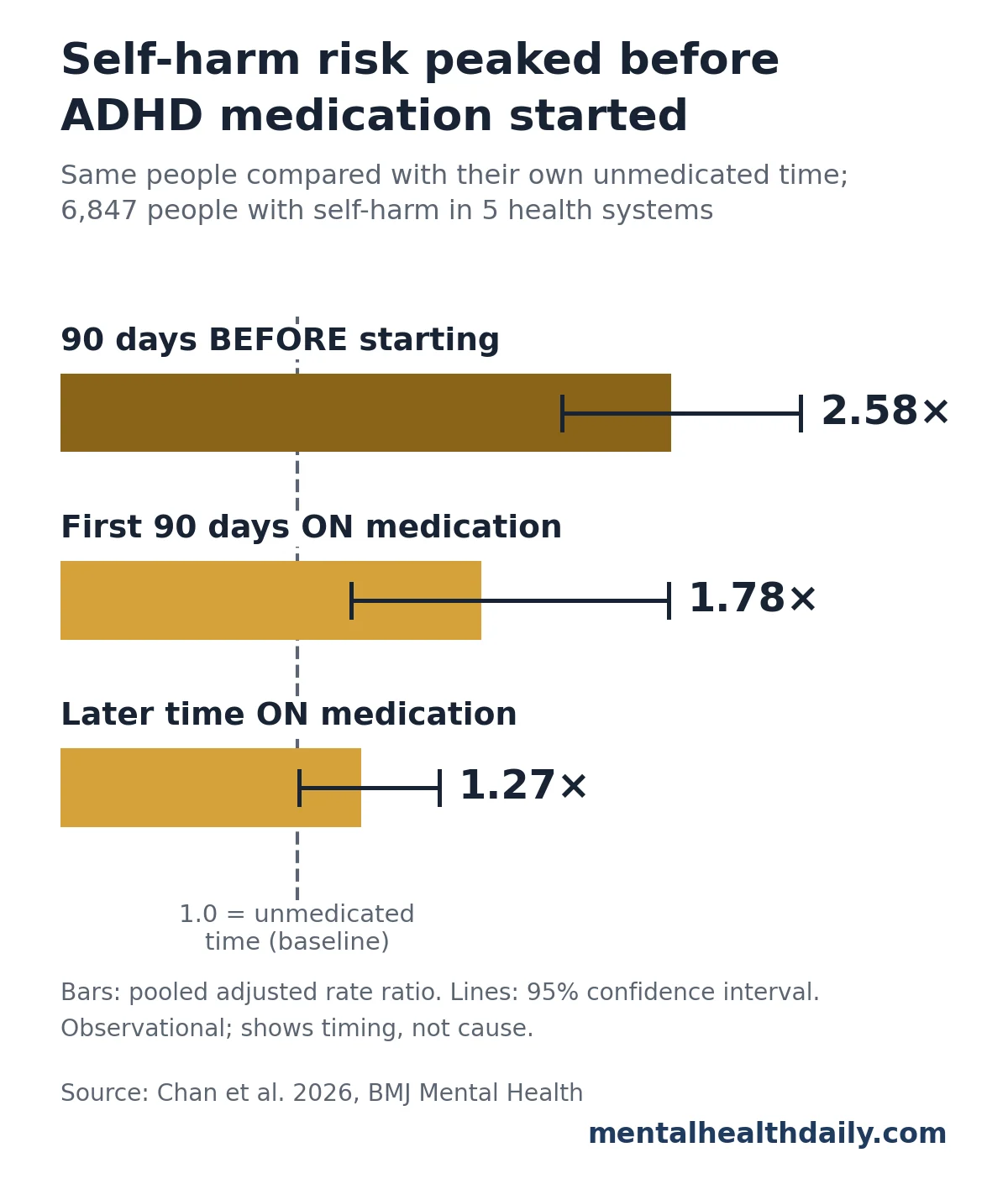
- Pre-Treatment Peak: The period spanning the 90 days before the initiation of ADHD medication exhibited the highest incidence of self-harm, with an Incidence Rate Ratio (IRR) of 2.58 (95% Confidence Interval [CI] 2.12 to 3.13) compared to the unmedicated baseline. This indicates that self-harm events occurred more than two and a half times as often in the immediate pre-treatment phase.
- Initial Treatment Drop: During the first 90 days on ADHD medication, the self-harm rate significantly decreased from its pre-treatment peak, yielding an IRR of 1.78 (95% CI 1.23 to 2.57). While a substantial reduction, this still represented a rate 78% higher than the unmedicated baseline.
- Later Treatment Stabilization: In the subsequent periods of ongoing ADHD medication use, the risk further attenuated, with an IRR of 1.27 (95% CI 1.01 to 1.60). This suggests that while the risk declined substantially from the pre-treatment peak, it remained approximately 27% higher than the individual’s unmedicated baseline.
Further contextualizing these rate ratios, the unadjusted rates within this specific cohort of individuals who experienced self-harm at some point revealed 11 to 29 recorded events per 100 person-years in the pre-treatment window across the various sites, compared to a baseline of 5 to 7 events per 100 person-years during unmedicated time.
Crucially, this pattern of a pre-treatment peak was remarkably consistent across all participating sites. Individual site-specific IRRs for the 90 days before treatment ranged from a low of 2.07 in the UK to a high of 4.10 in Hong Kong, underscoring the universality of the finding. A more granular follow-up analysis conducted in three of the sites, which allowed the data to generate a smooth curve rather than fixed 90-day blocks, reinforced this chronology, showing that the risk of self-harm began to climb at least 100 days prior to the first prescription and subsequently fell once treatment was initiated.
The consistency of these findings was also robust across different medication types. Analyses examining stimulant and non-stimulant medications separately yielded similar patterns, suggesting that the observed temporal relationship is not specific to a particular class of ADHD drug. Furthermore, sensitivity analyses, including those stratified by sex and one restricted solely to individuals with a formal ADHD diagnosis, consistently replicated the main findings, lending additional credibility to the study’s conclusions.
Interpreting the Timing: A Crisis Before Treatment
The temporal sequence of events observed in this study offers a compelling reinterpretation of the relationship between ADHD medication and self-harm. If ADHD medication itself were the primary driver of self-harm, one would logically expect to see an increase in self-harm rates after the first dose. Instead, the data unequivocally demonstrate that the peak risk occurred before any medication was taken. This critical finding leads the researchers to conclude that the results do not support the hypothesis of ADHD medication being the main causative factor for self-harm in this population.
A more plausible explanation, as posited by the study authors, is that the months preceding a first ADHD prescription often represent a period of escalating crisis for individuals with ADHD. This phase might be characterized by a significant worsening of core ADHD symptoms, the emergence or exacerbation of comorbid mental health conditions such as depression or anxiety, increasing academic or occupational stress, and mounting personal difficulties. It is precisely this period of heightened distress and functional impairment that often serves as the catalyst for individuals or their families to seek professional help, leading to a clinical assessment and, ultimately, a prescription for ADHD medication. The observed drop in self-harm risk after treatment initiation could therefore reflect a broader improvement in the individual’s overall clinical situation, rather than a direct anti-self-harm effect of the medication alone.
It is important to clarify that while the study suggests medication is not the primary driver of self-harm, it does not definitively prove that the medication itself directly lowers self-harm risk. The initiation of ADHD treatment typically involves a comprehensive clinical assessment, often accompanied by counseling, psychoeducation, closer clinical follow-up, and management of any co-occurring conditions. Any or all of these concurrent interventions could contribute to the observed reduction in self-harm risk. The study design, while excellent for controlling stable confounders, cannot fully disentangle the specific contribution of the medication from the broader package of care.
Persistent Elevated Risk and Clinical Implications
Despite the significant reduction from the pre-treatment peak, the study noted that the risk of self-harm did not fully return to the unmedicated baseline during later treatment, remaining about 27% higher. The lower bound of the confidence interval for this period sat just above 1.0, suggesting a sustained, albeit diminished, elevation. The researchers proposed several potential reasons for this. One possibility is that individuals on medication are seen by clinicians more frequently, leading to a higher likelihood of self-harm events being identified and formally recorded in health records, even if the actual incidence is lower. Additionally, it could reflect the persistent underlying vulnerability to self-harm inherent in the ADHD population, which medication may mitigate but not entirely eradicate. It is also worth noting that there was some variability across sites, with later-treatment rate ratios ranging from 0.87 in Taiwan (suggesting a return to baseline) to 2.22 in South Korea.
From a clinical perspective, the findings carry crucial implications. The researchers emphasize the critical need for close clinical follow-up and monitoring around the time of ADHD treatment initiation. Clinicians, patients, and families should be vigilant for changes in mood, behavior, and any emergence or worsening of self-harm thoughts during this vulnerable period. Crucially, the study provides strong evidence to counter the notion that ADHD medication itself directly increases self-harm risk, thereby supporting clinicians in making prescribing decisions without undue delay based on unsubstantiated safety fears. Effective management of ADHD, which can alleviate distress and improve functioning, may itself be protective against the broader constellation of risks, including self-harm, associated with untreated or inadequately treated ADHD.
Reinforcing Previous Evidence and Study Limitations
The current study builds upon and extends the findings of earlier "within-person" studies conducted in countries like Sweden and the US, which similarly found that self-harm events tended to cluster before, rather than immediately after, the start of ADHD medication. The strength of this new research lies in its unprecedented international scope, utilizing a shared analysis plan across five distinct health systems. This harmonized approach significantly reduces the chance that idiosyncratic coding practices, diagnostic criteria, or prescribing habits specific to any one country might explain the observed results, lending greater universality to the conclusions.
Despite its robust methodology, the study has several limitations that warrant consideration. As previously mentioned, the SCCS design cannot fully adjust for all time-varying confounders. The period leading up to a first ADHD prescription is often characterized by significant clinical and psychosocial flux, including worsening symptoms, new psychiatric diagnoses, or major life stressors. These factors, which are intrinsically linked to both the decision to start medication and the risk of self-harm, could not be completely isolated. The study also relied on recorded self-harm events, meaning that unrecorded or unreported instances would not be captured, potentially underestimating the true incidence. Furthermore, the findings are specific to individuals who were prescribed ADHD medication and experienced self-harm; they may not be generalizable to the broader ADHD population, including those who do not receive medication or who have never engaged in self-harm.
Ultimately, decisions regarding the initiation, continuation, or modification of ADHD medication must remain highly individualized. Such critical choices belong within the purview of a prescribing clinician who possesses a comprehensive understanding of the patient’s full medical and psychiatric history, current symptoms, and psychosocial context. The study’s findings, however, provide valuable evidence that can inform these discussions, reassuring both clinicians and patients that ADHD medication itself is unlikely to be the primary driver of self-harm, and that the period leading up to treatment is a critical window for heightened vigilance and support.
Support for Those Struggling
For individuals in the US who are struggling with thoughts of self-harm or experiencing a mental health crisis, immediate help is available by calling or texting 988 to reach the 988 Suicide & Crisis Lifeline, which operates 24/7. Outside the US, individuals should contact their local emergency services or a local crisis helpline for urgent assistance.

