

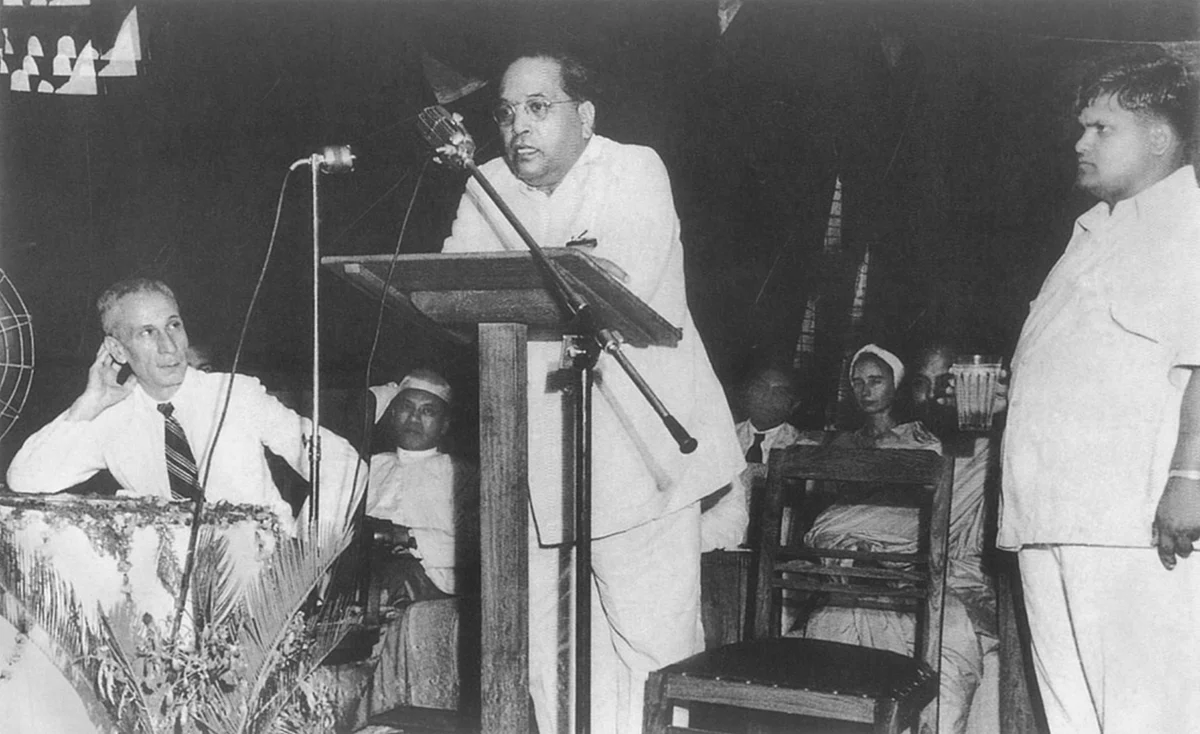
On October 14, 1956, a pivotal moment in Indian socio-religious history unfolded as Dr. B. R. Ambedkar, the towering Dalit leader and principal architect of India’s Constitution, led nearly half a million of his followers in a mass conversion to Buddhism. This monumental event ignited the genesis of Navayana, or "New Buddhism," a movement that unequivocally positioned Buddhism as a potent instrument of resistance against Hindu nationalism and the deeply entrenched caste system. Ambedkar’s profound interpretation of Buddhism saw it as uniquely suited to facilitate a radical reconstruction of Indian society, rooted in profound religious and social transformation. In the decades following his death, countless Dalits have emulated his example, embracing Buddhism as a powerful act of protest and a declaration of resistance against centuries of oppression.
To commemorate the seventieth anniversary of Ambedkar’s transformative conversion, Tricycle editor-in-chief James Shaheen engaged in a profound discussion with scholar William Edelglass, an expert whose extensive writings delve into Ambedkar’s life and enduring legacy. Their conversation, featured on a recent episode of Tricycle Talks, illuminated Ambedkar’s conviction that reform alone was insufficient to dismantle the deeply ingrained injustices of the caste system, arguing instead for its complete annihilation. The discussion also explored Ambedkar’s reinterpretation of the Buddha’s life story and his understanding of Buddhism as a path towards collective liberation from violence and pervasive social inequality.
The Roots of Resistance: Ambedkar’s Early Life and Caste Identity
The story of B. R. Ambedkar is inextricably linked to the harsh realities of the caste system that has historically defined Indian society. Born into the Mahar jati, Ambedkar was the fourteenth child of a family who, by virtue of their caste, occupied the lowest rung of the social hierarchy. While the four varnas (Brahmin, Kshatriya, Vaishya, and Shudra) provide a broad framework, it is the thousands of endogamous jatis that more accurately reflect the granular divisions of Indian society, dictating occupation, social standing, and economic opportunities. The Mahars, to which Ambedkar belonged, were considered "untouchables," a designation that carried with it profound social and physical segregation.
Ambedkar’s formative years were marked by the pervasive discrimination faced by his community. In school, he was relegated to the back, forced to sit on a burlap sack, and denied direct access to water, which had to be poured into his mouth by a cleaner to maintain the supposed ritual purity of the caste Hindus. This stark illustration of the caste system’s emphasis on purity and pollution underscored the systemic dehumanization faced by Dalits.
Despite these formidable obstacles, Ambedkar’s intellectual prowess and unwavering determination propelled him forward. He became the first person from his jati to attend college, enrolling at Elphinstone College in Bombay. His academic brilliance earned him a scholarship to Columbia University in New York, where he studied under luminaries like John Dewey, and later to the London School of Economics, where he pursued advanced degrees in economics. His legal education at Gray’s Inn culminated in his qualification as a barrister. Returning to India as a highly educated and accomplished individual, Ambedkar dedicated his life to advocating for the rights of Dalits, becoming a formidable scholar, professor, dean, politician, and activist.
The Inadequacy of Reform: Towards the Annihilation of Caste
Ambedkar’s early advocacy for Dalit rights was initially focused on achieving reforms within the existing caste system. For fifteen years, he tirelessly worked towards abolishing untouchability, spearheading initiatives such as the Mahad satyagraha in 1923. This movement sought to secure access to public water tanks, which were unjustly denied to Dalits, even though legal provisions mandated their accessibility. The denial of basic resources, even for those performing essential services for caste Hindus, exemplified the deep-seated discriminatory practices. The march to the Mahad water tank became a symbolic victory, commemorated as "Untouchable Independence Day." Ambedkar also championed the cause of Dalits gaining entry into temples, challenging religious exclusivity and discrimination.
However, these efforts gradually led Ambedkar to a profound realization: the caste system was not merely a set of discriminatory practices but was intrinsically woven into the fabric of Brahminical Hindu culture. He concluded that reform was an insufficient strategy; the system’s very foundation needed to be dismantled. This conviction culminated in his seminal work, The Annihilation of Caste, originally intended as a speech for Hindu reformers. The speech, deemed too radical by its intended audience, was subsequently published in 1936, articulating a powerful argument for the complete eradication of caste.
This philosophical shift coincided with a personal declaration that profoundly shaped his religious trajectory. In late 1935, Ambedkar famously stated, "I had the misfortune to be born a Hindu, but I will not die a Hindu." This declaration marked the beginning of his intensive search for a new religious tradition that could offer a viable alternative to the oppressive Hindu social order.
Religion as a Catalyst for Social Change: The Embrace of Buddhism
Ambedkar’s exploration of religious traditions was deeply informed by a comparative study of various faiths. He recognized the limitations of Eurocentric views that often privileged monotheistic traditions, asserting the value and depth of other religious systems. However, he also cautioned against a purely relativistic approach, emphasizing the need for a critical and evaluative perspective on religious doctrines and practices.
His critical assessment of Hinduism, particularly its Brahminical form, highlighted its inherent violence and the centrality of the caste system, which he characterized as a system of "graded inequality." This system, he argued, fostered contempt among those above and hatred among those below, not due to the inherent nature of individuals, but because the religion itself perpetuated these attitudes.
While acknowledging the potential for religion to be a source of social harm, Ambedkar also believed in the necessity of a "sacred morality" or "transcendent morality" to guide societal transformation. He contended that political structures, including the Indian Constitution, while granting legal equality and freedom, were insufficient to ensure these rights were realized in lived experience. The cultural milieu in which Dalits existed often denied them the very freedoms enshrined in law. Drawing parallels with Edmund Burke’s observations on societal crimes, Ambedkar asserted that when societal practices perpetuate injustice, political punishment is inadequate; a fundamental cultural shift is required.
In this context, Buddhism emerged as the most compelling alternative. Ambedkar envisioned Buddhism not merely as a religion but as a "way of life." He believed that by cultivating Buddhist precepts, the Eightfold Path, and the paramis (perfections), individuals could develop the capacity to engage with others across differences, fostering broader communities through maitri (benevolence) and karuna (compassion). For Ambedkar, Buddhism was fundamentally about morality, a morality that transcended mere political expediency or self-interest. It offered a foundation for the ideals of fraternity, liberty, and equality, which he saw as core tenets of the Buddha’s teachings.
The Twenty-Two Vows and the Birth of Navayana
Ambedkar’s quest for a new religious identity led him to consider various traditions, including Sikhism, Islam, and Christianity. However, Buddhism held a unique appeal due to its indigenous roots in India and its historical legacy of egalitarian reform movements.
On October 14, 1956, Ambedkar formally converted to Buddhism, an event followed by the conversion of an estimated 400,000 to 500,000 Dalits the following day. Tragically, Ambedkar passed away just six weeks later, on December 6, 1956. However, in the decade preceding his conversion, he had immersed himself in Buddhist studies, learning Pali, meticulously reading hundreds of books, and authoring The Buddha and His Dhamma. This comprehensive work laid the philosophical and historical groundwork for what would become known as Ambedkarite Buddhism, or Navayana.
Central to the Navayana movement are the twenty-two vows Ambedkar crafted for the conversion ceremony. These vows are specifically designed to facilitate a transition from Hinduism to Buddhism and serve as a powerful affirmation of self-dignity for individuals emerging from contexts of marginalization and subordination. Some vows focus on adherence to Buddhist principles like the precepts and the Eightfold Path, while others directly address the rejection of Hindu deities and practices, such as refraining from viewing the Buddha as an incarnation of Vishnu, a common Hindu appropriation of Buddhism.
The impact of these vows and the conversion movement has been profound. Today, Dalit Buddhists in India often exhibit higher rates of literacy, demonstrate improved economic standing, and possess a strong sense of self-worth, partly attributed to their embrace of a worldview that affirms their inherent dignity and rejects hierarchical subjugation. Mass conversions have continued intermittently, with millions more embracing Buddhism by the end of the decade, and the movement continues to inspire contemporary generations.
Critical Fabulation: Reimagining Buddhist History and Identity
Ambedkar’s The Buddha and His Dhamma represents a significant act of "critical fabulation," a concept borrowed from scholar Saidiya Hartman. Hartman uses this term to describe the process of creatively reconstructing the lives of marginalized individuals whose experiences are absent or poorly documented in historical archives, often due to systems like slavery and colonialism. By employing imagination and inference, critical fabulation seeks to honor these forgotten lives and make them present to contemporary audiences, thereby shaping our understanding of history and its impact on the present.
Ambedkar engaged in a similar project by reinterpreting Indian historiography, particularly concerning the origins of untouchability and the Dalit experience. Lacking definitive archival evidence for the historical origins of this oppressive system, he employed creative license to posit that Dalits were originally Buddhists who were subsequently defeated and ostracized by Brahminical forces and culture. This narrative offered a powerful counter-history, suggesting that Dalits were not inherently inferior but belonged to a once-noble and egalitarian culture that was worth preserving. By connecting contemporary Dalits to this imagined past of honor and dignity, Ambedkar sought to instill a sense of value and self-worth, enabling them to stand tall as Buddhists and participants in a long tradition of egalitarianism, in stark contrast to what he viewed as the hierarchical and violent Brahminical culture.
Antiviolence: Beyond the Dichotomy of Violence and Nonviolence
Ambedkar’s reimagining of Buddhist history is also linked to his concept of "antiviolence," a term that distinguishes itself from the more commonly understood "nonviolence." Scholar Aishwary Kumar brought attention to the aptness of French political thinker Étienne Balibar’s concept of antiviolence in understanding Ambedkar’s approach. Edelglass suggests that the dichotomy of violence and nonviolence can be overly simplistic.
Ambedkar’s own life provided a stark example of this complexity in his conflict with Mahatma Gandhi over separate electorates for Dalits. While Muslims were granted separate electorates by the British, Ambedkar advocated for the same for Dalits, arguing that their political representation would be subsumed and rendered powerless within the broader Hindu majority. Gandhi, fearing that this would further alienate Dalits from the Hindu fold, launched a fast-to-the-death, a nonviolent act that nevertheless exerted immense pressure on Ambedkar, forcing him to compromise on the negotiated electorates.
Ambedkar observed that actions presented as nonviolent could, in fact, perpetuate violent structures. He identified "structural violence" as the systemic marginalization and privilege embedded within societal frameworks. Nonviolence, he argued, could sometimes be employed to preserve these inherently violent structures. Ambedkar’s focus on antiviolence prioritized minimizing harm while confronting violence. In his writings, he suggested that while the Buddha was against violence, he recognized that violence might be permissible when necessary to uphold justice. Antiviolence, therefore, is an approach that acknowledges the limitations of nonviolence in preserving oppressive systems and posits that judicious use of force might be necessary to establish and maintain a more just and less violent societal structure.
The Enduring Legacy: Navayana and Social Activism
The movement inspired by Ambedkar’s vision continues to evolve, with significant contributions from activists who have carried forward his mission. Chandrika Ramteke, an activist leader in the Ambedkarite movement, exemplifies the spirit of Navayana, instrumental in spreading New Buddhism to rural villages. Despite facing personal adversity, including an abusive marriage, Ramteke emerged as a formidable activist. Her approach to antiviolence was pragmatic and courageous. She actively participated in elections, ensuring Dalits could exercise their right to vote, even resorting to disruptive tactics like using chili pepper to deter those obstructing voters or, in one instance, igniting an outhouse to create a diversion, thereby enabling Dalit voters to cast their ballots. Her bold act of lying down in front of Indira Gandhi’s car led to a crucial audience with the then-Prime Minister.
Beyond her direct activism, Ramteke, along with other Ambedkarite Buddhist women, played a pivotal role in educating local Dalit women in rural areas. They taught them to read The Buddha and His Dhamma, practice the five precepts, and follow the Eightfold Path and paramis. This sustained effort of collective learning and practice, reading a few pages of Ambedkar’s seminal work daily, represents a profound embodiment of individual practice integrated with social engagement. This approach, Edelglass notes, is not about choosing between individual cultivation and social action but recognizing their interconnectedness, as suffering is often rooted in systemic social structures.
Ambedkar’s vision of democracy was one that facilitated revolutionary change without bloodshed. He defined democracy as the ability to coexist and work with those with whom one disagrees, to win without total domination, and to maintain a sense of community and shared future. For Ambedkar, maitri, karuna, and prajna (wisdom) were democratic virtues, enabling individuals to engage with dissenters, even vehemently, while preserving a sense of belonging to a larger community.
The State of Ambedkarite Buddhism Today
Seventy years after Ambedkar’s historic conversion, Ambedkarite Buddhism continues to grow and develop, both within India and internationally. Despite the challenges of leadership fragmentation following Ambedkar’s passing, the movement has persevered. Its influence has extended beyond India, with Roma communities in Hungary and Indigenous populations in Taiwan and Japan drawing parallels between their experiences and the Dalit struggle, finding Ambedkar’s analysis and proposed solutions resonant. There is also ongoing dialogue between Ambedkarite Buddhism and Black Buddhism in the United States, exploring shared themes of liberation and social justice.
A significant aspiration within the movement is to transcend its current identity as primarily "Dalit Buddhism" and to move beyond the confines of the caste system it was born to dismantle. Initiatives like the development of an Ambedkarite Buddhist seminary, aimed at training teachers and chaplains, signal a commitment to strengthening and expanding the movement. While acknowledging the persistence of caste-based divisions, there is a hopeful outlook for a future where a more open and egalitarian approach gains wider acceptance, potentially as a counter-narrative to the rise of religious nationalism in India.
Ambedkarite Buddhism stands as a powerful testament to the profound intersection of individual spiritual practice and collective social action. It offers a compelling example of how deep personal cultivation can be intrinsically linked to addressing systemic injustices, demonstrating that these two dimensions of human experience are not mutually exclusive but mutually reinforcing. As Edelglass concludes, there is no single Buddhism; there are many, and Ambedkarite Buddhism, with its unique history and radical vision, provides a profound model for how a spiritual path can be a potent force for social transformation and the pursuit of justice.

