

A recent study conducted in Beijing has illuminated a critical link between in-hospital fatigue in older adults with rheumatoid arthritis (RA) and their subsequent well-being post-discharge. The research, involving 177 patients aged 55 and older, found that fatigue experienced during a hospital stay was the sole predictor among five tracked symptoms for worse sleep and increased difficulty with daily activities one month after patients returned home. This groundbreaking insight, utilizing a sophisticated cross-lagged symptom network analysis, underscores the profound and persistent impact of fatigue, advocating for its routine assessment and targeted management in clinical practice.
Understanding Rheumatoid Arthritis: A Chronic Challenge
Rheumatoid arthritis is a chronic autoimmune disease characterized by the immune system mistakenly attacking the lining of the joints, known as the synovium. This leads to inflammation, causing painful swelling, stiffness, and eventually, bone erosion and joint deformity. While RA primarily affects the joints, it is a systemic disease, meaning it can impact other organs and bodily systems. Beyond localized pain and swelling, many individuals with RA contend with a spectrum of debilitating symptoms, including persistent exhaustion, disrupted sleep patterns, mood disturbances such as anxiety and depression, and significant limitations in performing daily tasks. The global prevalence of RA is estimated to be around 0.5% to 1% of the adult population, with its onset typically occurring between the ages of 30 and 50, though it can affect individuals at any age. The disease imposes a substantial burden on quality of life, productivity, and healthcare systems worldwide.
The Unique Vulnerability of Older Adults with RA
Older adults diagnosed with rheumatoid arthritis often face a compounded set of challenges that distinguish their experience from younger patients. As individuals age, the presence of comorbidities—other chronic health conditions—becomes more common, leading to polypharmacy, which is the use of multiple medications. This can complicate RA management, increase the risk of adverse drug interactions, and potentially mask or exacerbate RA symptoms. Furthermore, older adults may experience a more aggressive form of RA, or their symptoms might be intertwined with age-related degenerative changes, making diagnosis and treatment more complex.
The impact of RA on an older person’s independence is particularly severe. Functional limitations, which include difficulties with mobility, self-care, and household chores, can rapidly erode an older adult’s ability to live autonomously, increasing their reliance on caregivers and potentially leading to social isolation. Fatigue, a pervasive symptom in RA, is especially detrimental in this demographic. In older patients, fatigue can manifest as extreme tiredness that is not relieved by rest, significantly impairing physical activity levels, cognitive function, and overall engagement in life. It can contribute to a vicious cycle where reduced activity leads to deconditioning, further exacerbating fatigue and functional decline. The post-discharge period following a hospital stay is a particularly vulnerable time for older adults with RA, as they navigate medication adjustments, initiate rehabilitation programs, and lose the structured routine and immediate support provided in a hospital setting. This transition period often exposes patients to a heightened risk of symptom flare-ups, complications, and readmission, underscoring the critical need for comprehensive transitional care planning.
The Beijing Study: Design and Methodology
The research, led by Yuan Ren et al., aimed to meticulously track the interplay of symptoms in older RA patients following their hospital discharge. The study meticulously enrolled patients aged 55 and older from the rheumatology department of Beijing Hospital between August 2025 and February 2026. Out of 195 individuals initially enrolled, 177 successfully completed both the in-hospital and one-month post-discharge assessments, providing a robust dataset for analysis.
The researchers strategically chose a one-month follow-up window to capture a crucial period of adjustment. This initial month at home is characterized by several significant changes: patients often undergo medication regimen alterations, begin outpatient rehabilitation, and lose the structured, predictable routine of a hospital environment. These transitions can profoundly influence how various symptoms interact with each other and impact a patient’s recovery trajectory.
At both time points—during the hospital stay and one month after discharge—patients were asked to self-rate five key symptoms. While the specific scales used were not detailed in the original report, these self-reported measures are standard in chronic illness research and typically involve validated questionnaires designed to assess symptom severity. The five symptoms tracked were:
- Fatigue: The subjective experience of overwhelming tiredness, lack of energy, and feeling of exhaustion.
- Pain: The physical sensation of discomfort, often measured by intensity.
- Sleep Disturbance: Problems with sleep quality, duration, or onset, often leading to non-restorative sleep.
- Anxiety-Depression: A combined measure reflecting emotional distress, including feelings of worry, sadness, hopelessness, or loss of interest.
- Functional Limitation: Difficulties in performing daily activities and tasks due to physical symptoms.
Unpacking the "Cross-Lagged Symptom Network"
To analyze the complex relationships between these symptoms over time, the researchers employed a sophisticated statistical technique known as a cross-lagged symptom network. This approach offers a significant advantage over traditional methods that might simply aggregate symptom scores or look for simple correlations.
A symptom network conceptually treats each individual symptom as a "node" or point within a larger system. The statistical connections or associations between these symptoms are then represented as "lines" or "edges" linking these nodes. Instead of collapsing all symptoms into a single, overarching "total score," this method visually and quantitatively reveals which symptoms tend to co-occur, which ones are more central to the overall symptom experience, and how they influence each other within a snapshot in time.
Building upon this, a cross-lagged panel network introduces the crucial element of time. For each symptom measured at the one-month post-discharge mark, this model asks a critical question: how well does each symptom measured during the hospital stay predict its later manifestation, even after accounting for all other symptoms, including the symptom’s own initial level? For instance, if a link is observed from in-hospital fatigue to later sleep disturbance, it signifies that higher levels of fatigue during hospitalization predicted worse sleep a month later, independent of how poor sleep already was during the hospital stay. This method allows researchers to infer potential temporal precedence and directional influences, providing stronger insights into the dynamic progression of symptoms. It’s akin to understanding a chain reaction or a domino effect, rather than just observing that dominos have fallen.
A key metric within this network analysis is expected influence. This measure quantifies the overall strength of a symptom’s connections within the network. "Outgoing expected influence" indicates how strongly a particular symptom predicts or influences other symptoms in the network. Conversely, "incoming expected influence" reveals how strongly a symptom is predicted or influenced by others. By examining these measures, researchers can identify "driver" symptoms that exert a broad impact and "receiver" symptoms that are largely consequences of other issues [1].
Key Findings: Fatigue as a Predictive Factor
The analysis revealed several compelling insights into the symptom dynamics among older RA patients. Fatigue emerged as the most prevalent symptom during the hospital stay, affecting a significant proportion of the patient cohort. One month after discharge, however, sleep disturbance became the most commonly reported symptom, highlighting a shift in the primary burden of illness as patients transitioned home [1].
Regarding symptom intensity, both pain and fatigue showed a slight easing on average after discharge. In contrast, sleep quality, as measured by the Pittsburgh Sleep Quality Index (PSQI), actually worsened slightly, with the average score increasing from 7.31 in the hospital to 7.84 a month later. A higher PSQI score indicates poorer sleep quality, suggesting that the home environment might pose greater challenges for restful sleep [1].
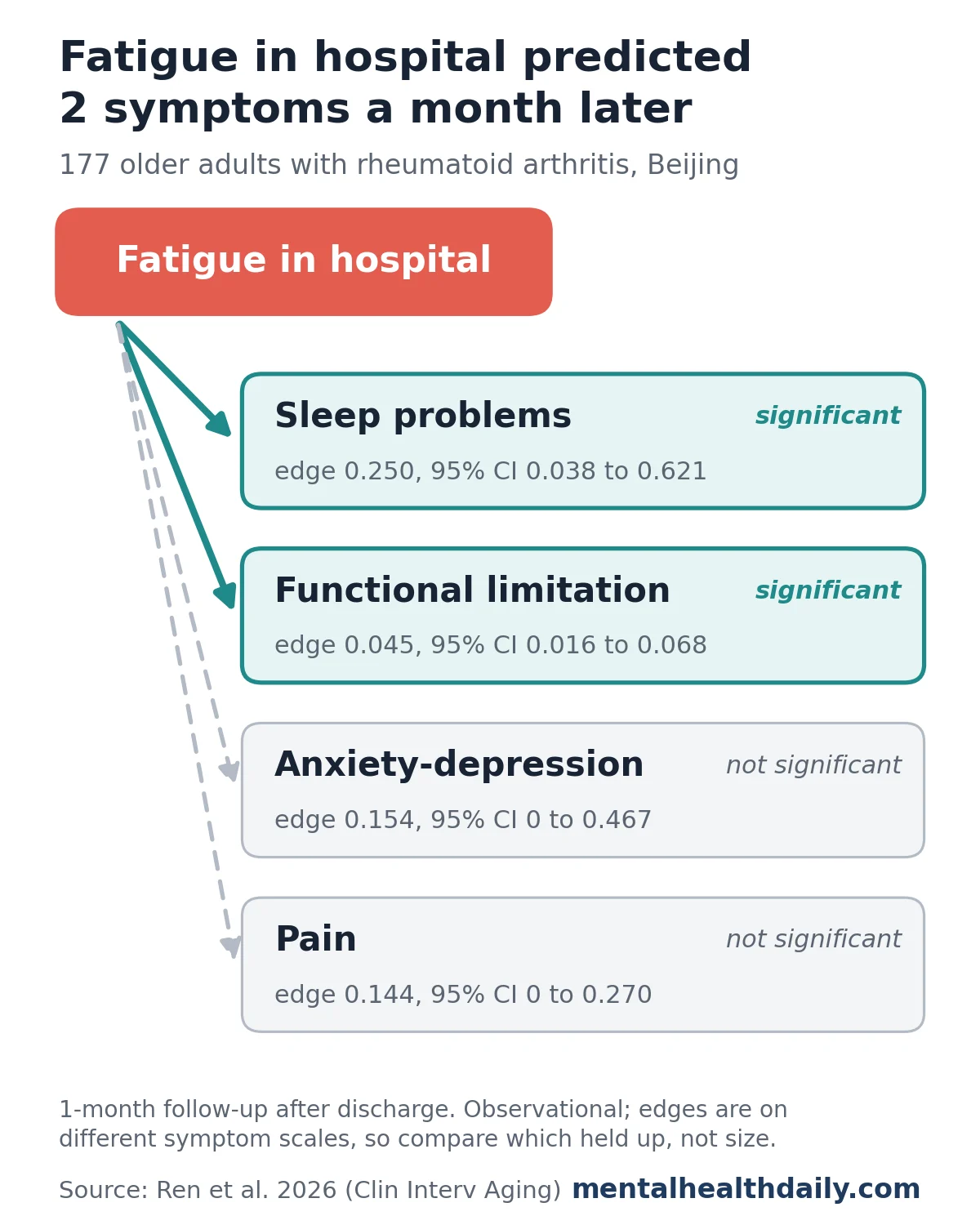
In the cross-lagged network analysis, a fundamental finding was that every symptom significantly predicted its own later level. This indicates a degree of stability and persistence in individual symptoms over time. The strongest self-predictive links were observed for sleep (0.477), functional limitation (0.463), and fatigue (0.462) [1]. However, when examining the relationships between different symptoms across time, a singular and striking pattern emerged: only in-hospital fatigue demonstrated statistically significant predictive power over other symptoms one month later. Specifically, fatigue experienced during the hospital stay significantly predicted:
- Worse sleep problems one month after discharge (edge coefficient 0.250, with a 95% confidence interval of 0.038 to 0.621).
- Greater functional limitation one month after discharge (edge coefficient 0.045, with a 95% confidence interval of 0.016 to 0.068) [1].
It is important to note that these two significant numbers are not directly comparable due to the different scoring ranges of the respective scales (sleep is typically scored from 0 to 21, while functional limitation often ranges from 0 to 3). Crucially, both these predictive links remained statistically significant even after rigorous statistical correction for testing multiple links simultaneously, reinforcing their robustness [1].
To further validate these findings, the researchers conducted an adjusted analysis, controlling for various potential confounding factors such as age, sex, marital status, disease duration, family history of RA, and baseline joint function. Even after accounting for these variables, in-hospital fatigue continued to significantly predict later sleep disturbance (0.209) and functional limitation (0.044). Furthermore, fatigue maintained the highest "outgoing expected influence," confirming its role as a key driver symptom within the network [1].
The Interplay of Symptoms Post-Discharge
Beyond the predictive analysis, the study also examined "snapshot" networks at each time point, revealing how symptom interconnections evolved. During the hospital stay, pain and fatigue exhibited the strongest and most tightly linked relationship. However, one month after discharge, the connections between fatigue and sleep, and between fatigue and daily function, became notably stronger. The researchers posited that the disruption of the hospital’s regulated routine, which often includes scheduled rest and activity, might allow tiredness and poor sleep to reinforce each other more intensely in the less structured home environment [1]. This suggests that the transition home removes protective factors present in the hospital, making patients more susceptible to the escalating effects of fatigue and sleep problems.
Anxiety and Depression: A Consequence, Not a Driver?
The study also shed light on the role of combined anxiety-depression within the symptom network. This symptom cluster demonstrated the highest "incoming expected influence" (0.819; 0.865 in the adjusted analysis), indicating that it was predominantly predicted by other symptoms rather than being a predictor itself. Interestingly, anxiety-depression showed no significant link to any later symptom. The largest single link into anxiety-depression came from functional limitation (0.634), followed by fatigue (0.154), although the researchers did not report these individual links as statistically significant [1].
The research team interpreted these findings to suggest that in older RA patients, emotional distress, such as anxiety and depression, tends to build upon and reflect underlying physical symptoms, rather than acting as a primary driver of those physical symptoms. This interpretation aligns with a common clinical understanding that chronic physical illness can significantly impact mental well-being. However, it is worth noting a slight discrepancy in the original report: while the discussion section suggested that fatigue predicted later anxiety-depression, the results section explicitly stated that this specific link was not statistically significant [1]. Additionally, the researchers acknowledged that a one-month follow-up period might be too short to observe significant changes or predictive patterns in mood, as psychological states often evolve more slowly than acute physical symptoms.
Broader Context: Previous Research on RA Fatigue
The findings from the Beijing study resonate with and build upon a growing body of research highlighting the pervasive and multifaceted nature of fatigue in rheumatoid arthritis.
Fatigue has many sources: A comprehensive systematic review published in 2019 underscored the complex etiology of RA fatigue. It found strong correlations (0.50 or higher) between fatigue in RA and various factors, including physical disability, poor mental well-being, pain intensity, sleep disturbance, depression, and anxiety. Most of these correlations remained significant even when analyzed together, prompting the authors of that review to propose a network model where these interconnected factors perpetuate a vicious cycle of fatigue [2]. This aligns with the Beijing study’s identification of fatigue as a central and influential symptom.
Pain may come first early on: Another study, a 12-month investigation involving 100 individuals with RA, found that while 83% reported fatigue at baseline, 60% continued to experience it a year later. In that cohort, baseline pain was identified as the only independent predictor of persistent fatigue [3]. This suggests a potential temporal sequence where pain might initially trigger or exacerbate fatigue, which then, once established, can become a self-sustaining problem that spreads its influence to other symptoms. The Beijing team’s hypothesis that pain may help initiate fatigue, while fatigue then propagates to other symptoms, provides a valuable framework for understanding this progression.
Fatigue often outlasts inflammation control: A significant challenge in RA management is the persistence of fatigue even when inflammation is well-controlled. A study involving 184 patients with established RA who were initiating biologic drugs, which are highly effective at reducing inflammation, found that only 18% experienced an improving fatigue pattern over a year. Critically, continued fatigue was predicted by patient-reported measures of symptom burden, not by objective markers of inflammatory disease activity or joint ultrasound findings [4]. This highlights a crucial disconnect: simply controlling inflammation might not be sufficient to alleviate fatigue, emphasizing the need for direct fatigue management strategies.
Clinical Implications and Recommendations
The robust findings of the Beijing study carry significant implications for the clinical care of older adults with rheumatoid arthritis, particularly during and after hospitalization.
Fatigue is worth raising: The study unequivocally positions fatigue as a critical symptom that warrants proactive attention. Given its prevalence during hospitalization and its predictive power over subsequent sleep and functional limitations, healthcare providers should integrate routine and systematic screening for fatigue into their assessment protocols for older RA patients during hospital stays. This could involve simple, validated fatigue scales that patients can complete quickly.
The weeks after discharge are a vulnerable stretch: The observation that sleep problems escalate and fatigue-sleep links strengthen after patients return home underscores the vulnerability of the post-discharge period. Discharge planning should therefore explicitly include discussions about potential sleep disturbances and strategies for managing fatigue. Providing patients with combined fatigue and sleep guidance, perhaps through educational materials or counseling, could empower them to better navigate this challenging transition. Non-pharmacological approaches such as energy conservation techniques (pacing activities, taking planned rests), graded activity programs (gradually increasing physical activity to build stamina without exacerbating fatigue), and sleep hygiene education are valuable components of such guidance [1].
Low mood may reflect physical strain: When an older person with RA reports feelings of anxiety or depression, the study suggests that clinicians should look beyond purely psychological interventions. While emotional support is undoubtedly crucial, the findings indicate that these mood disturbances may often be a consequence of uncontrolled physical symptoms. Therefore, alongside addressing emotional well-being, a thorough assessment and optimization of fatigue, pain, sleep quality, and functional capacity should be prioritized [1]. Improving these physical symptoms could indirectly, but significantly, alleviate psychological distress.
Can Treating Fatigue Improve Sleep in Rheumatoid Arthritis?
While this observational study cannot directly answer whether treating fatigue will improve sleep, it strongly identifies fatigue as a highly reasonable and promising target for future intervention trials. The existing landscape of fatigue treatments for RA offers some hope, albeit with modest effects. A Cochrane review encompassing 24 studies and 2,882 individuals with RA found that physical activity programs reduced fatigue by approximately 9 points on a 0 to 100 scale when compared to control groups. Similarly, psychosocial interventions led to an average reduction of about 6 points [5]. The critical question that remains is whether these benefits extend to improving sleep quality and daily function, a hypothesis that future clinical trials would need to rigorously test.
Addressing Limitations and Future Directions
Like all research, the Beijing study has certain limitations that warrant consideration. The reliance on self-reported symptoms, while common and valid in chronic illness research, introduces a subjective element. Furthermore, the study was conducted at a single center in Beijing, which may limit the generalizability of the findings to more diverse populations or healthcare systems with different cultural contexts and resource availability. The one-month follow-up period, while strategically chosen for the immediate post-discharge phase, is relatively short, especially for capturing the slower trajectory of mood changes. Finally, as an observational study, it can identify associations and predictive relationships but cannot establish direct cause-and-effect.
These limitations, however, also point towards crucial avenues for future research. Longer-term studies are needed to understand the sustained impact of fatigue and other symptoms. Multi-center studies across diverse geographical and cultural settings would enhance the generalizability of the findings. Most importantly, interventional trials are essential to test the efficacy of specific fatigue management strategies—both pharmacological and non-pharmacological—and to determine if these interventions can indeed lead to improvements in sleep, functional capacity, and overall quality of life for older adults with rheumatoid arthritis. Such trials could investigate integrated care models that combine fatigue and sleep management, physical therapy, and psychological support.
Conclusion: Empowering Patients and Practitioners
The Beijing study delivers a powerful message: fatigue is not merely an unavoidable side effect of rheumatoid arthritis, particularly in older adults following a hospital stay. It is a potent predictor of subsequent functional decline and sleep disturbances. This research provides a robust, evidence-based foundation for prioritizing fatigue assessment and management in clinical practice. By proactively screening for fatigue during hospitalization and implementing comprehensive discharge plans that address both fatigue and sleep, healthcare providers have an opportunity to significantly improve the recovery trajectory and long-term quality of life for older adults living with rheumatoid arthritis. Empowering patients to vocalize their fatigue concerns and providing them with actionable strategies for self-management are vital steps towards a more holistic and patient-centered approach to RA care. The study serves as a call to action for both clinicians and researchers to continue exploring effective interventions for this debilitating, yet often overlooked, symptom.

